
Learning to make knives WIP (Changed Title)

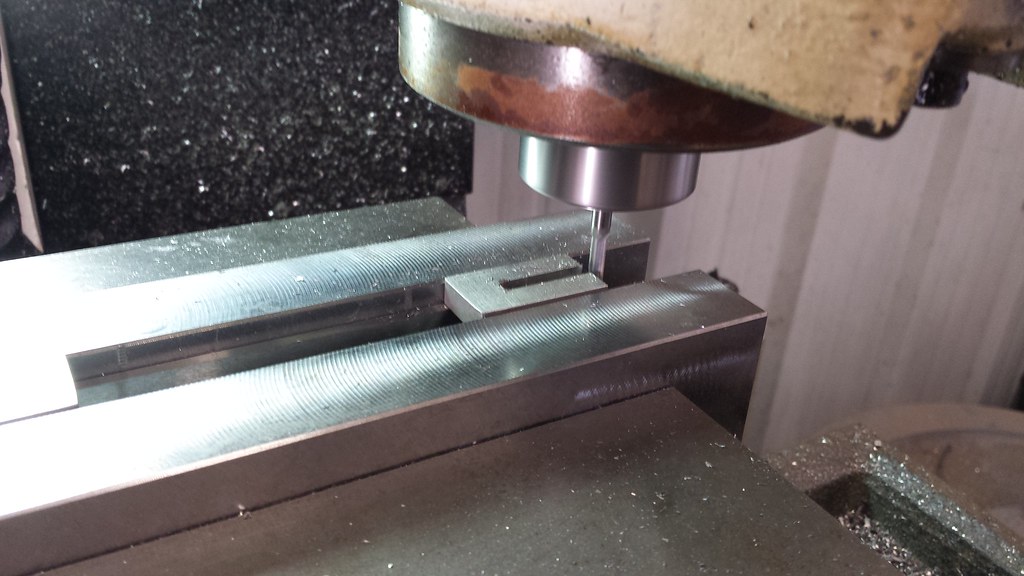
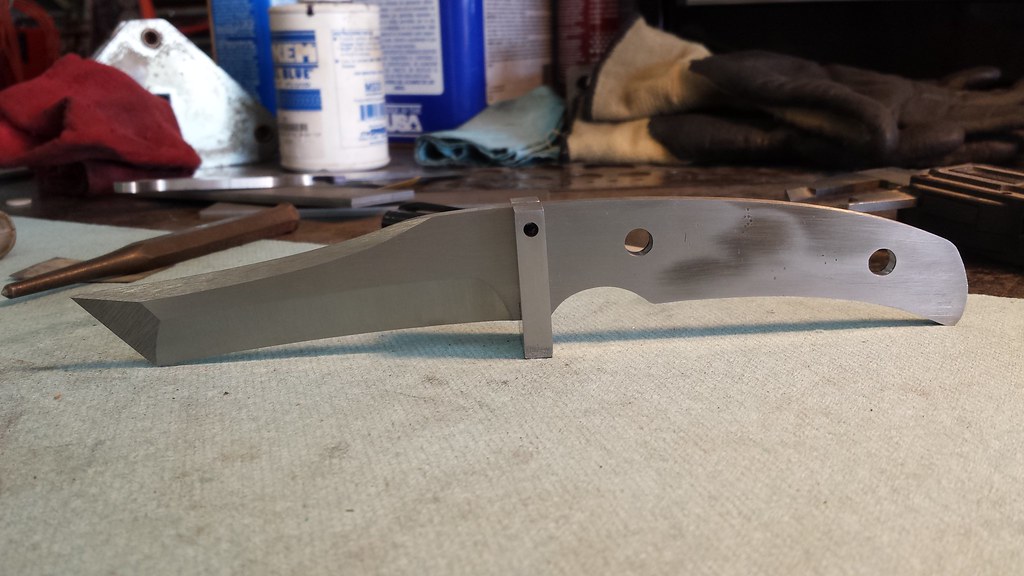
Another update. I posted a pic of this clip point, recurve tanto in the "What's going on in your shop?" thread. I made the guard for it from 304L. I've gotten fairly bold with the slotting process so it doesn't take me all day to mill a slot. I'm using a 5/32" 4-flute carbide endmill and slotting at .050" depth of cut per pass at about two inches per minute. I'm sure I could run it quite a bit faster but this is as fast as I feel I can comfortably stop the power feed at the end of the pass.

Untitled by Ranger_Bob, on Flickr

Guard in place on knife.

Untitled by Ranger_Bob, on Flickr

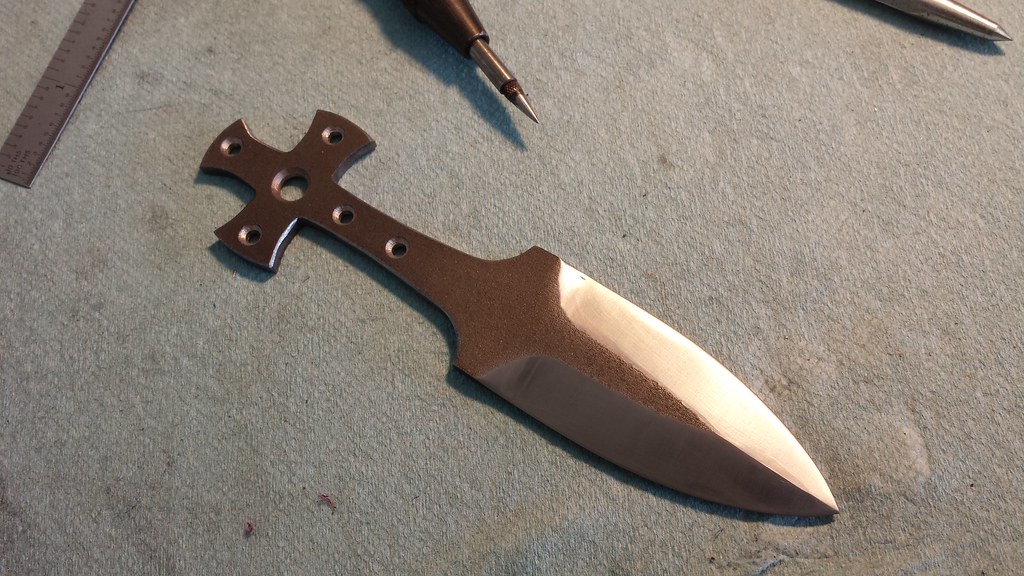
My wife and I were hanging out on the beach in Florida a few weeks ago with some friends. My buddy Jeff and I were talking about how I screwed up his knife and started over and his wife said she wanted a throwing knife. I decided to oblige her. I took my inspiration from Danny Trejo in Desperado. I know nothing about throwing knives but after a little googling, I made this. It is 5-3/4" long from 1/8" 440C. I used my reloading scale to help determine balance with some weights and then removed what I felt would be the equivalent amount by drilling the holes. The chamfer on the holes is how I fine tuned the balance. This is my first dagger grind. I did it all freehand on the flat platen. Far from perfect but good enough for this project.

Untitled by Ranger_Bob, on Flickr
 
I haven't posted to this thread in a while so, here's some updates. I will try not to cover too much that I've mentioned in other posts. First up is a group portrait of all the knives that I have been working on in this thread. This is after they came back from heat treating the first time. They had to go back to heat treating again and that is discussed in another thread. All of these blades were completed to this stage before I went to Johnny Stout's knifemaking class. Honestly, with what I learned in his class, I probably would have pitched them in the trash but Johnny said no. He said I needed to finish them.

Untitled by Ranger_Bob, on Flickr

Next in my learning to make knives progression is the blades I did in Johnny class. Lots of practice grinding on mild steel.

Flat grinds

Untitled by Ranger_Bob, on Flickr

Hollow grinds

Untitled by Ranger_Bob, on Flickr

...And my finished knife of 440C, nickel silver, and red linen micarta

Untitled by Ranger_Bob, on Flickr

When I came back from Johnny's class, I decided that I needed a few more things to keep me moving in the right direction. One of those items was a heat treating oven. I purchased a new Evenheat KO18. Yesterday I heat treated my first blade. It is 440C (from the same batch as the stuff that got sent back for re-treating), 5/32" thick, Blanchard ground. I set the Rampmaster control to heat to 1400° and hold for 20 minutes then continue to ramp to 1900° and soak for an additional 20 minutes. I plate quenched in a woodworkers vise with mounted plates which I learned on this forum. Here's the packet after quench.

Untitled by Ranger_Bob, on Flickr

Here's the blade pulled from the packet

Untitled by Ranger_Bob, on Flickr

I actually thought something had gone wrong when I saw how clean the blade came out. I tested it with my Ames tester and it was 61hrc...perfect! I then tempered for an hour at 375° and it only came down about half a point. I think it was because I cooled it too quickly using the plates. I did a second draw at 400° for an hour and let it cool in still air and I got 58hrc. I'm very happy with that.

I'm still working on getting a dewar so I can cryo the blades; I know it will make them a bit tougher so it's worth the expense to me. Today, I am hoping to surface grind the blade and put the bevels on. Maybe even get to gluing and pinning the handles/bolsters.

Bob
 
Great thread Bob, especially for a noob like me. After your comment about wanting to trash your previously made blades upon returning from Johnny Stout's class, does any single thing stick out in your mind as to what advanced your proficiency the most? Perhaps just all of the practice? Again, thanks for this thread and the detailed images.

gene
 
Great thread Bob, especially for a noob like me. After your comment about wanting to trash your previously made blades upon returning from Johnny Stout's class, does any single thing stick out in your mind as to what advanced your proficiency the most? Perhaps just all of the practice? Again, thanks for this thread and the detailed images.

gene

The main thing was the very detailed approach. On the first day Johnny showed me exactly how he grinds bevels. Every part of what he showed me was important. Much of it I didn't even catch until I'd make a mistake. Then he would show me why I made the mistake and it would be one of the things he already told me. I don't think all the practice would have meant much without his watchful eye. About throwing the other blades out; one of the things he said was, if you make a mistake and your thinking about throwing it away, don't because your skills will continue to improve and you can come back to it later with a different mindset and more skill and come up with something cool.

Bob
 
Ranger Bob, You mentioned that you did not like j flex belts because of the bump and wondered what to use after the 120 grit belt. I would like to suggest that you try some Norax belts from USA knifemakers. I clean up my 50 or 60 grit initial hollow grind with a ceramic 3 M 220 grit belt and then use X65, X45, X30, X16, and X5. You can satin finish or high polish from this point. I always run the edge of the belt 1/16 to 3/32 over the wheel for a nice deep plunge line. I also use Trizact "Gator" belts for clean cuts but refine my plunge with the Norax belts. You might try an X 65 and an x45 Norax for starts and see if works for you. I like your latest blade designs with the swedge. Nice looking and functional too.
 
So, I think when I finish this knife, I will stop posting to this thread. This knife feels like the one that says, I have a good idea how to make knives now. It's only number two and really will be the first one I've done unsupervised. Got a lot done today.

Surface ground with a 60 grit Blaze and a A45 Trizact

Untitled by Ranger_Bob, on Flickr

Measured blade thickness, divided by two and then added .010" to get my scribe lines for a .020" edge thickness

Untitled by Ranger_Bob, on Flickr

Painted the edge with Dykem, set the height gauge to .093" and scribed the lines

Untitled by Ranger_Bob, on Flickr

Ground a clean 45° bevel to the scribe line

Untitled by Ranger_Bob, on Flickr

Trying to split the line. Not perfect but good enough I believe.

Untitled by Ranger_Bob, on Flickr

Rough grind with a new 60grit Blaze belt

Untitled by Ranger_Bob, on Flickr

Color the bevels in with big sharpie and move on to a A160 Trizact belt to start cleaning up the grinds

Untitled by Ranger_Bob, on Flickr

The Sharpie shows where you need to keep working to get a smooth bevel. Repeat this step with an A65 and A45 Trizact belt as well

Untitled by Ranger_Bob, on Flickr

After the A45 belt, I go to a 400grit cork belt with emory. The cork belt really refines and starts putting some polish on the bevels. After the cork, I hit it with a blue Scotch-Brite belt for the final finish on the bevels.

Untitled by Ranger_Bob, on Flickr

And...I skipped a few steps. I needed to get everything glued up in time to go make dinner so I quit taking pics. Should be able to finish it tomorrow

Untitled by Ranger_Bob, on Flickr
 
Can you describe the steps you are taking to do the polished bolsters but with the satin blade? I want to do this, but having some difficulty figuring out the steps without scratching the bolsters.

I'm about to make my first (no bolsters yet), but have a goal knife in mind (satin blade, polished dovetail bolsters with some high quality wood scales) that I want to work towards that is similar to the finished blades you've posted.

These look great, by the way...
 
Thanks guys. Johnny definitely gave me a leg up in my knifemaking. I will be getting some better photos of this one posted this weekend.

Can you describe the steps you are taking to do the polished bolsters but with the satin blade? I want to do this, but having some difficulty figuring out the steps without scratching the bolsters.

I'm about to make my first (no bolsters yet), but have a goal knife in mind (satin blade, polished dovetail bolsters with some high quality wood scales) that I want to work towards that is similar to the finished blades you've posted.

These look great, by the way...

You just need to completely finish the blade (except sharpening!) before attaching anything to it. Shape and polish the front of the bolsters before attaching them to the knife.

Bob
 
Back
Top