
-
The BladeForums.com 2024 Traditional Knife is available! Price is $250 ea (shipped within CONUS).
Order here: https://www.bladeforums.com/help/2024-traditional/
You are using an out of date browser. It may not display this or other websites correctly.
You should upgrade or use an alternative browser.
You should upgrade or use an alternative browser.
Looking for a machete
- Thread starter machie147
- Start date
For reasons stated above, an Ontario would be last on my list. Tramontana or Imacasa 18" - 20" Latin style.
No offense but there's only one sane steel question regarding machetes: is it stainless? If the answer is yes walk away.
I will paste below several great machete articles by Sam Cade. After reading these you will scramble to the cheapest source of Imacasas and order a handful of machetes.
http://www.shootingreviews.com/machetes-and-you-a-short-introduction-for-the-novice-user/
http://www.shootingreviews.com/machtes-and-you-getting-a-grip-and-basic-techniques/
http://www.shootingreviews.com/mach...ge-care-and-feeding-for-your-new-best-friend/
http://www.shootingreviews.com/ontario-1-18-machete-the-old-soldier/
No offense but there's only one sane steel question regarding machetes: is it stainless? If the answer is yes walk away.
I will paste below several great machete articles by Sam Cade. After reading these you will scramble to the cheapest source of Imacasas and order a handful of machetes.
http://www.shootingreviews.com/machetes-and-you-a-short-introduction-for-the-novice-user/
http://www.shootingreviews.com/machtes-and-you-getting-a-grip-and-basic-techniques/
http://www.shootingreviews.com/mach...ge-care-and-feeding-for-your-new-best-friend/
http://www.shootingreviews.com/ontario-1-18-machete-the-old-soldier/
Last edited:
If it were me I'd try to find a Collins & Co. Legitimus. American made and good tools. Someone posted a thread on one here within the last couple of days...by that title.
The Tramontinas appear to me to be cheap--thin in the pants--and they require an inordinate amount of final blade work when you receive them. If I were buying another machete I would probably shop one of the knife makers like Cold Steel, Condor or Ontario. I hear a lot about the Gerber Gator too; but I can't imagine....youknow.
The reason people are asking what you will be doing with it is to determine what KIND of machete you should buy. Is this your first? How do you know you want a Latin? If it 's for looks and 'cool', that's fine, but if you're going to be doing something specific there may be better.
Are you going to use it in grassland, savannah, jungle or the Maine woods? Aggressive (wood collecting/building) or passive (hiking/trail clearing) use?
Are you wanting a machete for a purpose or just to have a big knife? Practically, a 21 is OK in a Latin but cumbersome in a bolo.
The Tramontinas appear to me to be cheap--thin in the pants--and they require an inordinate amount of final blade work when you receive them. If I were buying another machete I would probably shop one of the knife makers like Cold Steel, Condor or Ontario. I hear a lot about the Gerber Gator too; but I can't imagine....youknow.
The reason people are asking what you will be doing with it is to determine what KIND of machete you should buy. Is this your first? How do you know you want a Latin? If it 's for looks and 'cool', that's fine, but if you're going to be doing something specific there may be better.
Are you going to use it in grassland, savannah, jungle or the Maine woods? Aggressive (wood collecting/building) or passive (hiking/trail clearing) use?
Are you wanting a machete for a purpose or just to have a big knife? Practically, a 21 is OK in a Latin but cumbersome in a bolo.
The Tramontinas appear to me to be cheap--thin in the pants--and they require an inordinate amount of final blade work when you receive them.
If you're not set up to put an edge on a machete there's really no point in buying one. They need frequent sharpening (by design). It takes a couple minutes to put an edge on a dull-from-the-factory new machete. This way you get to tune it to your needs.
If you're not set up to put an edge on a machete there's really no point in buying one. They need frequent sharpening (by design). It takes a couple minutes to put an edge on a dull-from-the-factory new machete. This way you get to tune it to your needs.
Right. Which is why if you use one a lot, between the bastard file and the rasp they don't last long either.
Any machete is going to need after-purchase blade refinement. But both Ontario and Tramontina seem to require an inordinate amount of it, as I said.

- Joined
- Apr 3, 2001
- Messages
- 27,786
I've had a Tramontina for about 25 years. It has been through hell, and it's still in one piece.
It did not require an inordinate amount of time to sharpen it from the factory, nor does it ever after I use it. Takes about 10 minutes with a bench stone at most. I don't like it to have a razor edge though. I go for toothy on a machete. Seems to hack through vegetation better.
It did not require an inordinate amount of time to sharpen it from the factory, nor does it ever after I use it. Takes about 10 minutes with a bench stone at most. I don't like it to have a razor edge though. I go for toothy on a machete. Seems to hack through vegetation better.

- Joined
- Nov 20, 2005
- Messages
- 19,385
Ontario handles suck. It would be the last machete I'd buy and I own some.
- Joined
- Apr 3, 2001
- Messages
- 27,786
I met a guy from Jamaica on the beach once that was selling drinks served in green coconuts. He was chopping the tops off with a machete.
Being a knife guy, and being interested in people using knives daily in their profession, I talked to him for a while. He had been using the same machete for 20 years. I asked if I could look at it. He handed it to me and I looked it over. It was well used, for sure, but it was definitely sharp, and had definitely been sharpened A LOT. It was not a toothpick of a blade. Sure it had some metal missing, but it was still machete shaped. I asked him what he paid for it, and he said he traded a conch shell for it!
I asked him how he kept it sharp. He whipped out a hockey puck shaped stone that was pretty coarse and gave the blade a few swipes.
The brand? Tramontina. So much for machetes taking an inordinate amount of time to sharpen and not lasting a long time if you use them often.
Being a knife guy, and being interested in people using knives daily in their profession, I talked to him for a while. He had been using the same machete for 20 years. I asked if I could look at it. He handed it to me and I looked it over. It was well used, for sure, but it was definitely sharp, and had definitely been sharpened A LOT. It was not a toothpick of a blade. Sure it had some metal missing, but it was still machete shaped. I asked him what he paid for it, and he said he traded a conch shell for it!
I asked him how he kept it sharp. He whipped out a hockey puck shaped stone that was pretty coarse and gave the blade a few swipes.
The brand? Tramontina. So much for machetes taking an inordinate amount of time to sharpen and not lasting a long time if you use them often.
Last edited:
- Joined
- Dec 31, 2012
- Messages
- 68
i have a cold steel latin machete but if i had to chose today i will pick a tramontina according to all the somments and reviews ( low budget !  )
)
)
not2sharp
Platinum Member
- Joined
- Jun 29, 1999
- Messages
- 20,763
When it comes to machetes simple works best. I would go with a Tramontina or Imacasa. For $50 you should be able to get a variety of examples. I would start with a relatively short (no more than 18") length, and work up slowly as you gain experience and technique. Longer machete can be particularly dangerous, since the springy blade can bounce and hit your legs. I find that 14 to 18" models do just about anything I care to do.
A word to the wise: machetes are most often aimed at targets that are low towards the ground and which bar visibility; you swing at brush. So expect frequent contact with stones and other hard obstructions.
n2s
A word to the wise: machetes are most often aimed at targets that are low towards the ground and which bar visibility; you swing at brush. So expect frequent contact with stones and other hard obstructions.
n2s
Last edited:

- Joined
- Mar 8, 2008
- Messages
- 26,274
Any machete is going to need after-purchase blade refinement. But both Ontario and Tramontina seem to require an inordinate amount of it, as I said.
Not to toot my own horn, but I offer grinding services on all of the machetes I sell, so even models that come with virtually no edge on them will arrive with a polished thin edge on them, ready for work.
I met a guy from Jamaica on the beach once that was selling drinks served in green coconuts. He was chopping the tops off with a machete.
Being a knife guy, and being interested in people using knives daily in their profession, I talked to him for a while. He had been using the same machete for 20 years. I asked if I could look at it. He handed it to me and I looked it over. It was well used, for sure, but it was definitely sharp, and had definitely been sharpened A LOT. It was not a toothpick of a blade. Sure it had some metal missing, but it was still machete shaped. I asked him what he paid for it, and he said he traded a conch shell for it!
I asked him how he kept it sharp. He whipped out a hockey puck shaped stone that was pretty coarse and gave the blade a few swipes.
The brand? Tramontina. So much for machetes taking an inordinate amount of time to sharpen and not lasting a long time if you use them often.
Yeah I hear machetes can last 100 years in captivity making umbrella drinks. A lot different in the real world.
Not to toot my own horn, but I offer grinding services on all of the machetes I sell, so even models that come with virtually no edge on them will arrive with a polished thin edge on them, ready for work.
Having bought an Imacasa from FortyTwoBlades, I can second this. I use it on a daily basis for brush control along fencelines on my little hobby farm, and it came with a great edge on it. Faster and quieter than a weedeater for my uses.
Ontario handles suck. It would be the last machete I'd buy and I own some.
I was going to post that earlier but didn't. I've seen the Ontarios in batches and all the handles were misfit...would have caused hot spots within five minutes of use. Unfortunately it's similar for the Tramontinas--unfinished wood handles, no F&F, splinters still in the tang gap (In fairness, I think rough handles are typical of all the Central American machete imports). Even Opinel puts a finish on their handles. The good side of that is you can shape the wood into anything if you're willing to put the time in. You could end up with a comfortable custom handle after a while. The Ontario, though, seems hopeless--not a lot you can do with misfit composite. Except...
leather wrap or paracord them first thing. Which I often do even with good handles.
- Joined
- Mar 8, 2008
- Messages
- 26,274
If you have a belt sander with fine belts you can sand down the polymer. It's just a pain in the butt.
If you have a belt sander with fine belts you can sand down the polymer. It's just a pain in the butt.
Exactly.
I just noticed...it looks as though you'd know more than I do about this.
Do you notice that the Tramontinas come unfinished? And are ALL the Ontario handles bad fits? Do you find the blades of the Ontarios and Central American brands to arrive even rougher than some other brands, requiring a bit more work?
It's good that you offer finishing on the blades for your customers. I know a few dealers do that.
I've always felt the Latin machete profile excels at lower work and grassy vegetation...not what you would encounter so much in the wild, which would be higher work and harder, more woody fare.
I'm more a bolo guy--keeps it basic--so to me some of the machetes just seem too thin for what I require. Especially with a whippy 21"er.
not2sharp
Platinum Member
- Joined
- Jun 29, 1999
- Messages
- 20,763
....I'm more a bolo guy--keeps it basic--so to me some of the machetes just seem too thin for what I require. Especially with a whippy 21"er.
The 14" Tramontina bolo is very good. Yes, they come a little rough, but about 20 minutes with a bastard file and sandpaper will get them just the way you want them. The basic idea is for the final user to put the final edge on, which doesn't matter since they will be re-sharpening frequently.
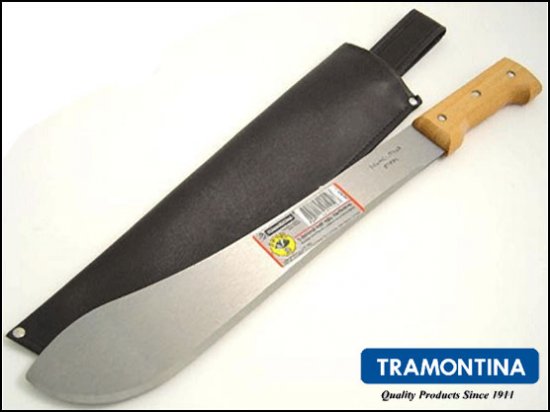
n2s
Last edited:
- Joined
- Mar 8, 2008
- Messages
- 26,274
Exactly.
I just noticed...it looks as though you'd know more than I do about this.
Do you notice that the Tramontinas come unfinished? And are ALL the Ontario handles bad fits? Do you find the blades of the Ontarios and Central American brands to arrive even rougher than some other brands, requiring a bit more work?
It's good that you offer finishing on the blades for your customers. I know a few dealers do that.
I've always felt the Latin machete profile excels at lower work and grassy vegetation...not what you would encounter so much in the wild, which would be higher work and harder, more woody fare.
I'm more a bolo guy--keeps it basic--so to me some of the machetes just seem too thin for what I require. Especially with a whippy 21"er.
Tramontinas come with the wood slightly proud of the tang, the blade beveled but not sharpened, and the tip rounded and completely unground. ALL of the Ontario handles (other than the injection molded D-guard models obviously) have a rather sloppy fit to them, although historically this was not the case. The edges on Ontario machetes require a lot of work, if anything more than Tramontinas do.
Blades over 20" in length really tend to require distal taper to keep them from becoming floppy or dead in the hand.
Latin machetes come in all sorts of thicknesses, tapers, and specific profiles, so a broad statement about target suitability isn't easily done. A very thin and light model like an Imacasa "pata de cuche" model would be best for grasses, lush vegetation, vascular weeds, and brambles, and is capable of handling green woody targets about as thick as your thumb without going outside its comfort zone. This work may be done at either high OR low levels and both types of cutting are often encountered "in the wild". It all depends on where you're actually venturing. Bolos are better for woodier growth due to their end weighted design, but then you have all kinds of other patterns like pangas, tapangas, colimas, guarizamas, sables, rozadors...each broadly/generally geared towards a different prioritized mix of targets that they handle good/better/best and some targets you probably just want to avoid entirely. The Latin pattern is, in general, a "jack of all trades, master of none" pattern that can handle the widest mix of targets "pretty ok" but is easily outpaced in any target class/mix by more fine-tuned patterns that are designed for that subset of targets.
- Joined
- Apr 3, 2001
- Messages
- 27,786
Yeah I hear machetes can last 100 years in captivity making umbrella drinks. A lot different in the real world.
Captivity? That's not "real world usage"? FFS, the guy chops coconuts with it all day long every day! What do you do with yours? I bet you blaze a 40 foot swath through the Amazonian jungle daily huh? Is that your real world?
There's just no convincing some people.