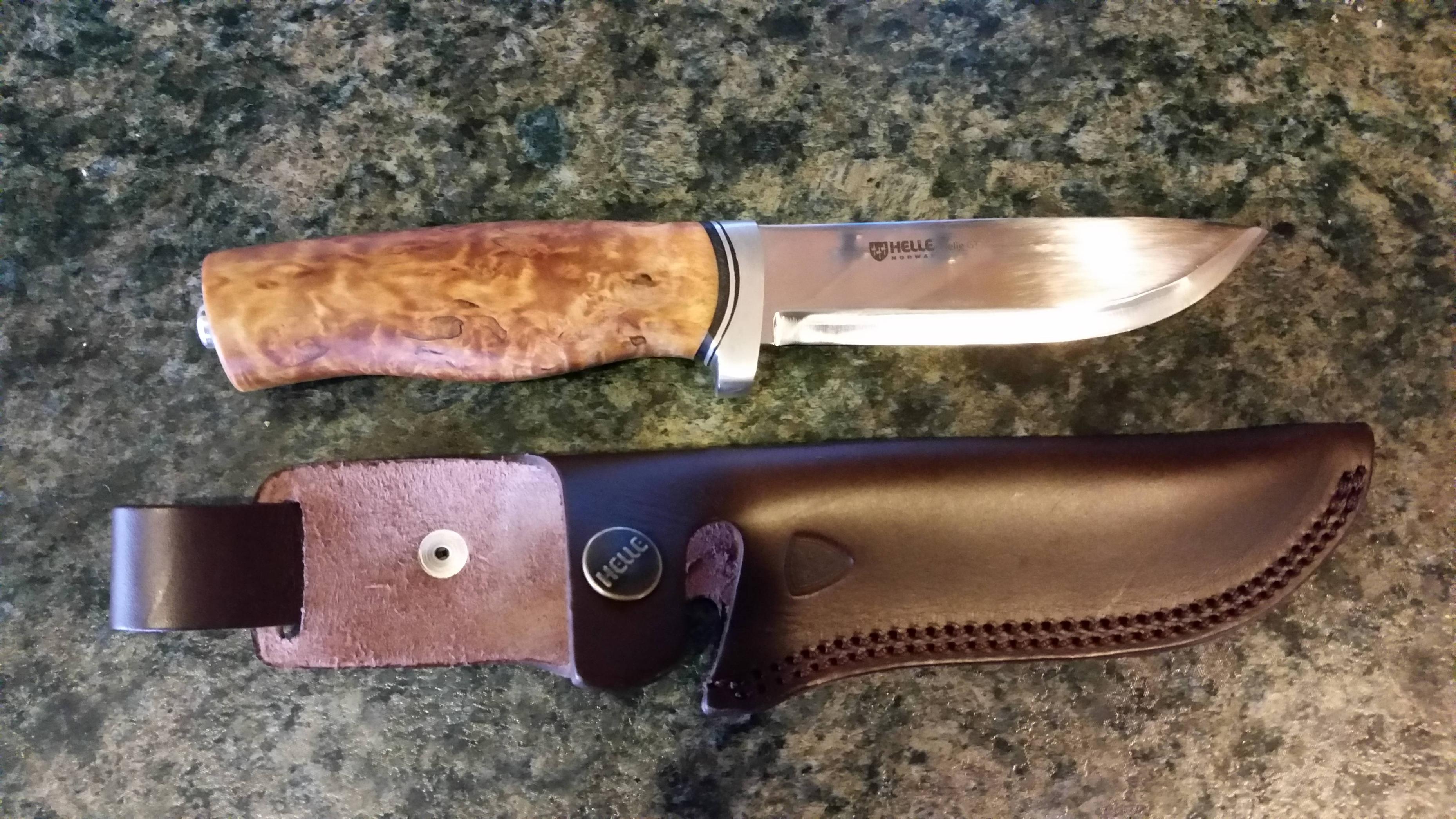
Yeah, fallkniven are awesome. I should have mentioned it in the original post, I meant to but forgot, but I already have a fallkniven f1, so the plan is to use both the f1 and whichever one of the bigger ones I end up with as a two knife system. The big one for the jobs that require a big knife and will put a lot of wear on it, and the little one for the delicate work that requires precision and a very sharp blade that hasnt been worn out making a shelter or cutting firewood. I'm also reluctant to try batoning with the f1 as the steel is a laminate and I hear that's not exactly a good combo.
Why not a sami knife? Well the sami knife is basically the reason why I thought of the RTAK2, because the RTAK2 seems to me to be pretty much just a high tech sami knife. Compared with the RTAK2, the sami knife just seems like an inferior version. Softer steel that dulls rather quickly, no protective coating, a grip that's much more prone to slipping, no lanyard options, and a leather sheath that has a reputation for being cut by the knife, will degrade from the elements and will stay wet longer. So technically the RTAK2 seems better, concept wise I cant tell much difference except the RTAK2 is an inch longer than sami knives usually are. If RTAK2 was made up here, I think they'd probably be marketing it as precisely a high tech sami knife.
And strictly speaking the land of the sami knife starts a bit north of here, but it's not that far, especially where I hunt is pretty close.
Complicate that chopping with extreme cold and that laminated blade may not be the best thing.
Yeah, strictly speaking the "Sami knife" or leuku originated in Finland. The design was refined many years ago with the reindeer herders living in brutal conditions. I consider Scandinavia to be leuku country, which is why I made the comment. Since you were so kind to point out my technical error, let me point out a major one of yours:
I laughed hard at your calling an RTAK a "high-tech Sami knife." An RTAK is not at all a "sami knife" design.
An RTAK is basically a big kitchen knife, dissimilar to a leuku in so many ways, not to mention balance, blade and handle profile, and long-use handle comfort. Frankly, an RTAK would be confined to my kitchen and probably never make it out of the house.
This "softer" steel you talk about means easier sharpening in wilderness conditions when a rock may be your only means. Also, it is usually a "tougher" steel. The steel of a good leuku is not a concern---if anything it is tougher for the jobs at hand. Your protective coating does nothing for cutting action, in fact can impede it. It's basically to keep a cheaper knife from rusting. If you feel more secure with a painted blade, fine. It's unecessary with a little care.
You won't find many painted leukus. Not sure how that paint would do after a week of hard work in 40-below.
As for tip and spine strength in the respective designs, it's not even a contest.
You must not be familiar with the advantages of birch, maple, larch etc. for handle material, but in a harsh environment they are among the best. There are REASONS they are preferred for a harsh environment knife. And they are certainly
not prone to slipping--leuku handle design is biased toward comfort after long periods of work. And a lanyard is a pretty easy thing to add if you want one--drill a hole or wrap the handle allowing a lanyard or fob.
You also aren't familiar with the advantages of leather over Boltaron, Kydex, and the other dex's. Especially at 30-40 below zero. Leather is simple to treat for waterproofing. Any idea what happens to kydex and the synthetics at extremely low temperatures, especially if you sit on, fall on, or bend them?
I can break your kydex...you can't break my leather. You POLISH knives with leather; you SCRATCH knives with the dex's. So many advantages to leather in real-life wilderness situations that it would require another thread. If a knife is shredding your sheath you have other problems.
A good leuku will be a far superior chopper to the RTAK too. And much handier at limbing due to its design.
"An inch longer than leukus usually are..." ??? What does that mean? Leukus are available in as many sizes as any other knife. Scandinavians would never be so unwise as to market an RTAK as a "high-tech Sami knife."
An RTAK is by no means a leuku. Nor should it even be placed in the same category of knife.

 .
.