Looking for a survival/general wilderness knife for use primarily in Norway

I'd go with the new Fallkniven A1 PRO SERIES. The laminated cobalt steel is awesome. I have the volcano and love it. Holds a wicked edge for a good long time and is easy to sharpen back up and then strops to laser status. I love it.

Does the cobalt steel sharpen more easily than the laminate vg10? Also is it tougher?
 
I am a little bit confused why the knife designed for the Norwegian military cannot be used. Ragweed Forge in the USA lists Stromeng leuku knives with 8 or 9 inch blades as being designed for the Norwegian military. Are these not available to civilians in Norway? :confused:
 
You have lots of good recommendations here. But, they will be biased mostly towards knives that are a good value in the USA. For instance, I will pick a backer bk16 at under $70 all day long compared to some of the more expensive (for here) knives from closer to you. But, if the prices were reversed (as I suspect they might be for you), I might pick the opposite.

A basic mora knife might be a good first option for you. They are cheap, light, surprisingly tough and many people like them. (Plus probably cheap in your area as well). Then, you have time to look for a higher end knife.
 
I'm not sure where people are having problems with laminated blades from fallkniven, helle morseth or others. The idea behind the lamination process is to have a knife that WILL be tougher than the homogenous blade of the harder core steel. Anyone who has seen the destruction videos from ole NOSS back in the day can see for themselves that the fallkniven took a severe amount of abuse (and yes... id did delaminate) but it held out far longer than most knives did to this type of foolishness. I myself have carried an F1 for the past 8-9 years as one of my main EDC blades and i can attest to it being more than adequate for toughness. just my 2c.
 
I'm not sure where people are having problems with laminated blades from fallkniven, helle morseth or others. The idea behind the lamination process is to have a knife that WILL be tougher than the homogenous blade of the harder core steel. Anyone who has seen the destruction videos from ole NOSS back in the day can see for themselves that the fallkniven took a severe amount of abuse (and yes... id did delaminate) but it held out far longer than most knives did to this type of foolishness. I myself have carried an F1 for the past 8-9 years as one of my main EDC blades and i can attest to it being more than adequate for toughness. just my 2c.

My only hesitation with a laminated blade would be extreme hard use in extreme cold.

The bonding of two disimilar steels with differing expansion/contraction rates, in theory, may be more likely to delaminate in such conditions.

Are the chances of it happening high? Probably not, with modern manufacturing processes. However, it would remain a concern to me. I've owned a few such blades and really liked them....but I never put them to the above test.
 
i'm assuming some of our metallurgist friends must have an opinion on this... anyone care to chime in? I would love to know, as i do use laminated blades a fair bit, i do live in canada and i am in the military so i do see a bit of the weather and i would love to know if my tools are less likely to remain whole.
 
Laminated blades from Fällkniven, are measured to be 20% stronger than the monosteel blades!
The tests are made at the Technological Institution of the University in Luleå.
They are scientifically repeatable and are published on the Fällkniven homepage.
Facts, not fiction.


Regards
Mikael
 
Last edited:
My only hesitation with a laminated blade would be extreme hard use in extreme cold.

The bonding of two disimilar steels with differing expansion/contraction rates, in theory, may be more likely to delaminate in such conditions.

Are the chances of it happening high? Probably not, with modern manufacturing processes. However, it would remain a concern to me. I've owned a few such blades and really liked them....but I never put them to the above test.

Your concerned about delamination at low temperature?

Based on what?

Sources?

Stainless doesn't suffer the same embrittling that carbon steel does at sub zero temperatures.

http://www.bssa.org.uk/faq.php?id=26


"Can I use stainless steel at low temperatures?

Austenitic stainless steels are extensively used for service down to as low as liquid helium temperature (-269 deg C). This is largely due to the lack of a clearly defined transition from ductile to brittle fracture in impact toughness testing.

Toughness is measured by impacting a small sample with a swinging hammer. The distance which the hammer swings after impact is a measure of the toughness. The shorter the distance, the tougher the steel as the energy of the hammer is absorbed by the sample. Toughness is measured in Joules (J). Minimum values of toughness are specified for different applications. A value of 40 J is regarded as reasonable for most service conditions.

Steels with ferritic or martensitic structures show a sudden change from ductile (safe) to brittle (unsafe) fracture over a small temperature difference. Even the best of these steels show this behaviour at temperatures higher than -100 deg C and in many cases only just below zero."
 
Your concerned about delamination at low temperature?

Based on what?

Sources?

Stainless doesn't suffer the same embrittling that carbon steel does at sub zero temperatures.

http://www.bssa.org.uk/faq.php?id=26


"Can I use stainless steel at low temperatures?

Austenitic stainless steels are extensively used for service down to as low as liquid helium temperature (-269 deg C). This is largely due to the lack of a clearly defined transition from ductile to brittle fracture in impact toughness testing.

Toughness is measured by impacting a small sample with a swinging hammer. The distance which the hammer swings after impact is a measure of the toughness. The shorter the distance, the tougher the steel as the energy of the hammer is absorbed by the sample. Toughness is measured in Joules (J). Minimum values of toughness are specified for different applications. A value of 40 J is regarded as reasonable for most service conditions.

Steels with ferritic or martensitic structures show a sudden change from ductile (safe) to brittle (unsafe) fracture over a small temperature difference. Even the best of these steels show this behaviour at temperatures higher than -100 deg C and in many cases only just below zero."

Yeah, sources and incidents I've read about. I see nothing in what you posted that considers a laminated blade comprised of two differing steels. So how does this apply to what I wrote?
 
Yeah, sources and incidents I've read about. I see nothing in what you posted that considers a laminated blade comprised of two differing steels. So how does this apply to what I wrote?
Lets discuss this in more detail

You are concerned about using a Fallkniven abusivly in arctic weather?

The source provides that the 420j2 cladding does not become brittle in sub zero temperatures sinces its an Austenitic stainless.

Here's another about why Laminated blades have more strength and ductility.

http://www.sciencedirect.com/science/article/pii/S2090123212000082

This is a journal from a Material science engineer
Mohammad H. Serror

He uses computer modeling to show the analytical strength of laminated steel compared to homgonus steel.

Here he explained the how a laminated steel sheet fails compared to homogeneous steel sheet.

"Therefore, the deformation instability is different between a freestanding metal sheet and multilayered sheet laminate because the former exhibits only single-neck mode; meanwhile, the later exhibits also multiple-neck mode. However, the most critical mode that is leading the final rupture in both of the sheets is the single-neck mode."
Eventually they both fail the same. But at the start the laminated steel seems to disperse the stress better.

Here is his summary

"It is found that the DLS sheet metal retards the deformation instability of the BHS sheet metal to an extent that depends on the abovementioned three controlling parameters. Hence, enhanced strength–ductility combination can be achieved by laminated structure compared with the freestanding one. Such combination is essential for metal forming applications"


If the above material is too thick and boring heres a caveman explanation by Noss
https://youtu.be/gIL_UM1BWt4
[video=youtube;gIL_UM1BWt4So]http://www.youtube.com/watch?v=gIL_UM1BWt4So[/video]

In the following video, Noss was able to baton a piece of sheet metal after cracking the outer laminate without the blade failing and snapping in two.

So, with the 420j2 outer not having any brittleness due to sub zero temperatures and a laminated construction to increase the strenght which prevents critical faililure of the blade.

The Fallkniven A1 is the ultimate arctic survival knife.

It just would be super dull from all the abuse like any sharp knife becomes from mistreatment.
 
Last edited:
I typically don't try and wade into these types of thread. Because they often seem to end in train wrecks. But here goes.

OP,
I read your post and the following posts. My suggestion is take a Wilderness First Aid, or Wilderness First Responder course if you haven't done so already. Then perhaps a Wilderness Leadership course. These will pay you dividends over your lifetime.

Knives are very subjective. You can see it here. Everyone has their favorites. Everyone has reasons not to like the ones they don't like. It's just the way it is. I too have been up and down the knife spectrum. It's a slippery slope.

Like it or not. The knife you own, the F-1 is a seriously capable woods tool. I agree the handle can be a bit small for larger hands. But that rubber coating can be a blessing in cold weather.

As I type this, I debate where I want to go and where I don't. Because I don't want to contribute to that trainwreck I mentioned earlier.

After reading your post and using it as a guide. Trying to picture in my minds eye. You and your dad on some remote boreal island. Stranded, with one hurt in bad weather. Frankly, I just don't see the bigger knife as your most important component.

Shelter building, wood processing, extreme cold. To me, this just screams axe!
Secondly a small folding saw will process a lot of would and build shelters quite efficiently.

And lastly of course the proper skills. This is really the first and most important. But it just isn't as cool as a big honkin' knife.

In reality any of the knives mentiond will suit you fine. The molecular make up of steel does cause it to become more brittle across the board in extreme cold conditions. But getting into which ones, and why they become more brittle could fill a book. Steel, alloy, heat treat, blade design all have a role.

Many woodsman who roam the cold hinterlands, recommend warming your knife inside your clothing before beating the snot out of it in extreme weather. Most of those also recommend you carry and axe.

Pick a knife. Maybe your F-1, maybe a different one. Go out into the woods and use it. Go out some Saturday afertnoon and build youself a shelter. Prefferably in weather like the stuff you plan on encountering. See how it goes. Waiting until someone is hurt to practice this stuff is a recipe for disaster.

Use your knife for a week or two. Use it for everything you use a knife for. No exceptions. It well tell you a lot about your choice.


As for my recomendations. I would add somthing like this to what you already have.


Here is a brief review I did on my Fallkniven S-1 over in the Outdoors Setion.
http://www.bladeforums.com/forums/showthread.php/1294005-The-6S-Survival-System?highlight=Fallkniven

As you will see, I don't take myself, or my reviews too seriously. But I do take not dying rather seriously. At 56 years of age, I have been not dying for quite a while now.


Here is a look at my KA-BAR in action. The KA-BAR, while not mentioned here. IT is a very interesting knife. In reality, it has been helping people not die in some very interesting places. For well over half a century.
http://www.bladeforums.com/forums/showthread.php/1300572-Dog-s-Head-Utility-The-First-Thirty-Days


I don't have any cool reviews of my saws. I should get on that. But they are like a fork at dinner time. It is always there. You can snag one pretty cheap. Can't afford a Silky, grab an Opinel 12 or 18.


As the Templar Knight said to Indy as he reached for that cup.
"Choose Wisely"
 
Last edited:
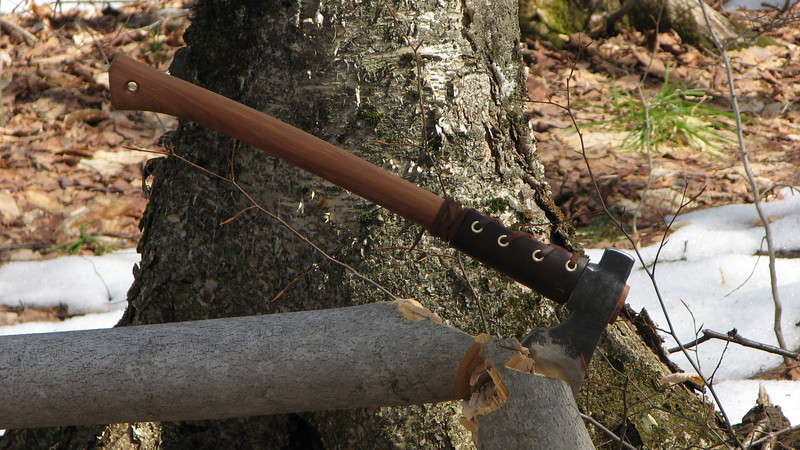
Cold weather often equals cold hands or hands where your dexterity has been reduced. Carry a small axe or worthy hatchet as they require less dexterity to use and you don't have to worry about breaking it due to the cold. I know you want a new knife, so get a larger Falkniven and be happy.
 
Lets discuss this in more detail

You are concerned about using a Fallkniven abusivly in arctic weather?

The source provides that the 420j2 cladding does not become brittle in sub zero temperatures sinces its an Austenitic stainless.

Here's another about why Laminated blades have more strength and ductility.

http://www.sciencedirect.com/science/article/pii/S2090123212000082

This is a journal from a Material science engineer
Mohammad H. Serror

He uses computer modeling to show the analytical strength of laminated steel compared to homgonus steel.

Here he explained the how a laminated steel sheet fails compared to homogeneous steel sheet.

"Therefore, the deformation instability is different between a freestanding metal sheet and multilayered sheet laminate because the former exhibits only single-neck mode; meanwhile, the later exhibits also multiple-neck mode. However, the most critical mode that is leading the final rupture in both of the sheets is the single-neck mode."
Eventually they both fail the same. But at the start the laminated steel seems to disperse the stress better.

Here is his summary

"It is found that the DLS sheet metal retards the deformation instability of the BHS sheet metal to an extent that depends on the abovementioned three controlling parameters. Hence, enhanced strength–ductility combination can be achieved by laminated structure compared with the freestanding one. Such combination is essential for metal forming applications"


If the above material is too thick and boring heres a caveman explanation by Noss
https://youtu.be/gIL_UM1BWt4
[video=youtube;gIL_UM1BWt4So]http://www.youtube.com/watch?v=gIL_UM1BWt4So[/video]

In the following video, Noss was able to baton a piece of sheet metal after cracking the outer laminate without the blade failing and snapping in two.

So, with the 420j2 outer not having any brittleness due to sub zero temperatures and a laminated construction to increase the strenght which prevents critical faililure of the blade.

The Fallkniven A1 is the ultimate arctic survival knife.

It just would be super dull from all the abuse like any sharp knife becomes from mistreatment.

I own several laminated and san mai blades. I like them all.

Good luck with that A1. It's a good knife. it's a good feeling, isn't it...to know you have the best knife on the planet for the arctic, period? Thanks for enlightening me to that fact.
 
I use Scandinavian knives here in the USA. They are by far the best woods knives that I have used for my purposes. If you want to process some wood, I recommend an axe, saw, and maybe a large Lukko or some other chopping knife.
 
Back
Top
