Machining WIP

Nathan the Machinist

KnifeMaker / Machinist / Evil Genius
Moderator
Knifemaker / Craftsman / Service Provider
Joined
Feb 13, 2007
Messages
18,933
Mr Barron asked me to post photo's of the build process of some curved platens I'm milling.

I figure this might be of some interest to anyone curious how things get machined. That, and its my turn to watch the kids tonight, so I'm just sitting here...

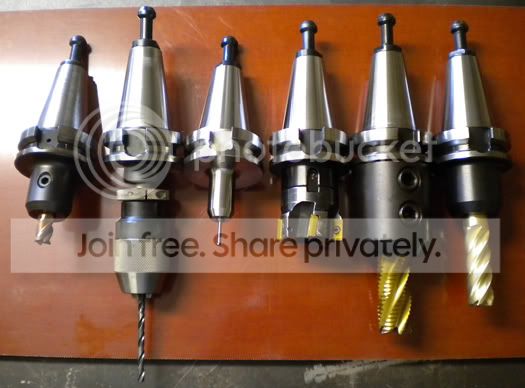
The first thing I do is figure out, in my mind, how I want to go about it and select the cutters I'm going to use so I can write my programs. This is the spread I'll be using:
1.jpg


That's a 1/2" endmill, a .200 drill, a .182" thread mill, a 2" 5flt face mill, a 1" 5flt rougher and a 3/4" 5flt finisher.

I stick them in the carousel, touch them off and zero out a vice. I saw off a blank and stick it in the vice.
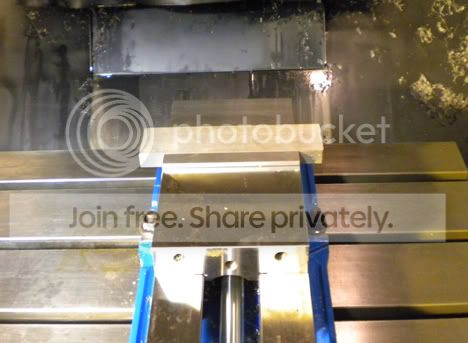
2.jpg


And then mill it.

3.jpg

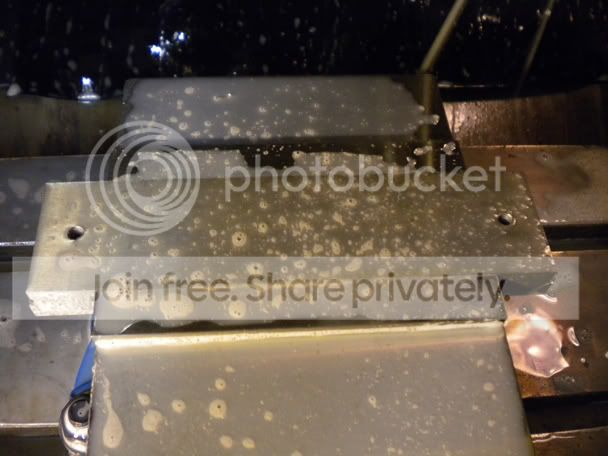
I drilled the holes, applied a chamfer, milled the 1/4-20 threads and squared up the ends. It is wet from the coolant, which is a water oil emulsion.

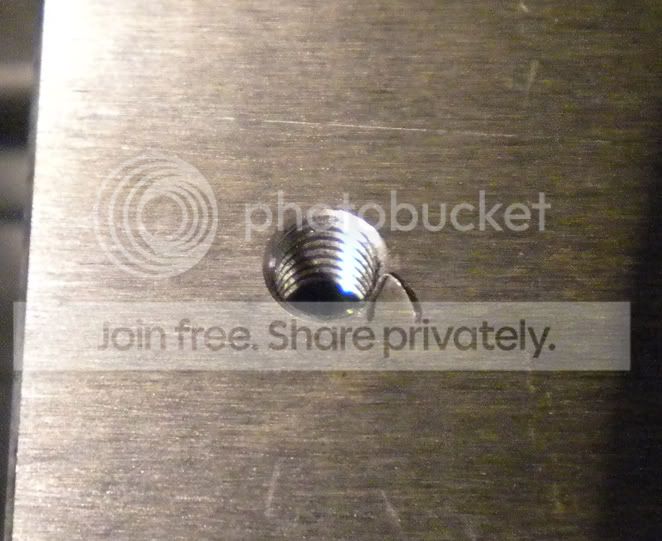
This is what a milled thread looks like:
4.jpg


Shiny huh? I don't remember why I started milling my threads, but I just about don't even use taps any more.

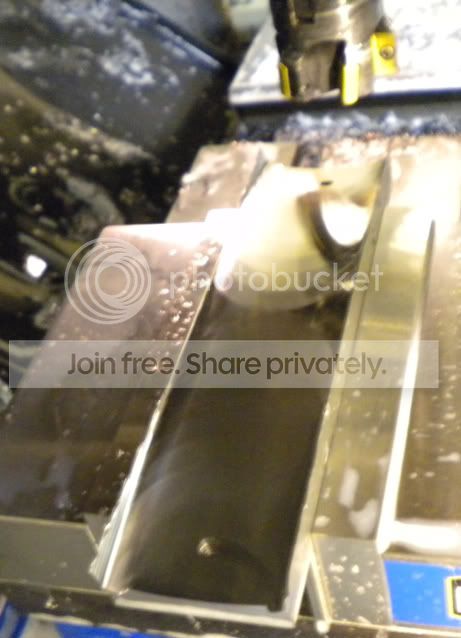
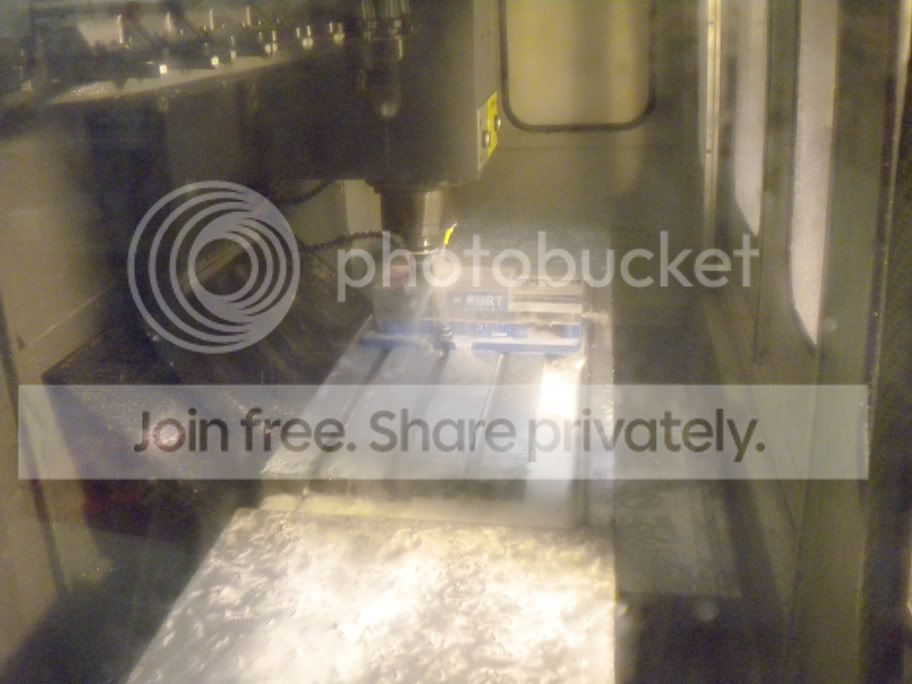
The next step is to cut the radius. Most rational folks would turn it on the side and cut it. But I'm going to rough it out from the top first with a little 2" inserted face mill to save on cutters.

This is what the inside of an old mill looks like while making that cut.
5.jpg


And a picture of a rough milled part

6.jpg


So, I've got a bunch of these to run before I setup and do the re-rough and finish cut from the side - so I'll have to finish this later.

Thanks
Nathan
 
Nathan,
Thanks for showing this. I love seeing things I may never be able to do. Love it, Jess
 
Very cool, Nice finish too. That's the rough can't wait to see the finish pass. I have never had a machine that would mill threads. It looks really nice, no ragged edges. If I had a machine that would do it I would also mill threads. One big plus is NO BROKEN TAPS. Even in tough material.

Thanks for the updates.
 
Hi Nathan,

It's been years since I've been in a machine shop, and all my work was on manual tools (no CNC), so I'm having a hard time coming to grips with milling threads. Maybe it was the beer I had last night watching the Siants play. Could you give me a brief description of the process. Thanks
 
part of me still insists a good cnc designer/operator is at least part magician. I can, however, see how you'd machine threads after seeing that bit, without seeing it I probably would have taken quite a while to figure it out. I'm guessing you would use different size tips for different threading, to keep it to a single run, or do you do that in multiple passes and it is just limited by how deep the cuts can be with a given head?
 
Awesome.... I see you are still a bit ahead of me with your machining skillz. LMAO... AWESOME. Thanks for sharing Nathan!!! :thumbup: :)
 
Page,

I'm making both 36 and 48. This one was a 36.

Y'all,

Thread milling involves a little lollipop cutter that has a 60 deg v profile that you run out in a cork screw path (a helix). This is a single profile, so you have to do as many revolutions as you have turns of your thread. That one thread mill can do 1/4" threads to 1/2" threads, and about 28 TPI to prolly 13 TPI. It can chamfer its own thread and it can cut a full form all the way to the bottom of a square hole. In production you frequently use a full form cutter that does the deal in one rotation. They cut internal threads or external threads. The thing I like about them the best is in these plastic manifolds I make. Nice clean threads, no stringy swarf up inside a part where you can't see it. Most folks would tap a 1/4" hole in A2, but you know me.
nutter.gif


Nick, you got some crazy skillz. The longer you stay out of the machine trade, the longer folks like me will look like we know what we're doing...
 
That whole milling threads thing is way COOL! It makes ya wanna go out and buy a CNC mill. HA HA.

Will the cutter make the threads in one pass or does it take multiple passes?
 
Hi Nathan,

Thanks for the explaination. I kinda had something like you explained in mind, but wanted to hear how it was done. I would really like to see it in operation. I've done a few small hole internal threads into a square bottom manually on a lathe. Scary stuff for me! Can't wait to see the rest of the run.
 
I'm curious about the thread cutting too Nathan. I only made it through the manual machining at school... I'd often hang my head over in the CNC guys' area... but not enough to learn anything beyond, "WOW!!!" ;) :D

BTW- Thanks for the kind words, your check is in the mail ;)
 
Nathan,

I've never personally done any thread milling but it definitely looks like a superior way to do it vs. taps. I can definitely see the benefit in stringy materials like you mentioned. From the first time I tried, I have loved manually turning threads on a lathe so I could see myself enjoying this process much more than tapping even on a CNC. Using taps/dies just makes me feel uneasy, because I don't have a lot of control over the final size.

What CAM package are you using?
 
Very cool! I'm definately interested in aquiring one of the radius plattens (hell, or maybe both sizes someday) myself, though I know I had not expressed intrest in the other thread that you had going.

I've always thought machining stuff was wicked cool. Right now I need to just learn how to use the metal lathe that I just picked up before i worry about learning any other tools =) The only CNC i've ever used was one where I was able to just insert a cad design and it spit the part out, so there was no 'learning' on my part hehe.
 
Its funny, the thread milling is the cool bit. I wouldn't have thought that, but I guess it is pretty cool.

Mike,

It can do it in one pass, but that old cutter maybe isn't as sharp as it once was, so I take a spring pass too. You can get a great finish if you bump it up in Z, then again down in Z so it is only cutting on one side. Neat trick for a hand load mold core where you don't want a lot of drag unscrewing it.

Mark,
I hear you. I hate chasing threads on a lathe in a blind bore. I've been known to draw a line on the ways with a sharpy just to know where I'm at *giggle*...

I swear, if it weren't for CNC, about the only thing I'd be good for in a shop would involve a broom. I'd don't know, depending in your tool, perhaps you can try turning your tool upside down or turning it around and cutting on the back side so you can run the lathe in reverse and run it out of the bore.
 
Last edited:
Nathan, That looks like a Mori mill except for the tool changer. Is it a Mori? Thread mills are the way to go. We use them mostly for oddball metric stuff, but I'm trying to convince the shop owner to use them for everything. Cool WIP :thumbup::thumbup:
 
Back
Top