"Made in Sheffield" 1830-1930, A golden age ?

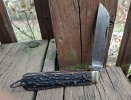
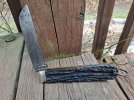
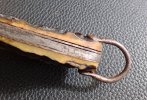
This is an unusual knife, it's 6 1/8" closed, weighs 10.6 ounces. The main blade is approximately 3/8" shorter than it was originally. I think the stove pipe kick on the secondary blade is pretty cool. Flush and square, snaps to match its size! For size reference the Lambsfoot is 3 1/2" closed.

View attachment 3102163View attachment 3102164View attachment 3102165View attachment 3102166View attachment 3102167View attachment 3102168
Wow, incredible Rob! :cool: Looks OLD :thumbsup: What do you know about it?
 
What a stunner Rob matey! 😍
Thanks, Duncan 👍
Wow, incredible Rob! :cool: Looks OLD :thumbsup: What do you know about it?
Thanks, Jack, I don't know much about it, my brief internet search didn't turn up anything. I bought it directly from a collector who lives approximately an hours drive from Sheffield, so I assume it was made in that area. With the only markings being "Earle" I can't be 100% sure it's a Sheffield made knife, but based on the integral bolsters, F&S joint, and the tiny stove pipe kick it sure leads me to believe it is a Sheffield piece, and an early one at that. I assume it would have been carried in some type of holster or tool belt. The secondary blade looks like a small pruner, but the monster sheepsfoot has me scratching my head. I would have liked to have seen the buck that the stag came from :cool:
 
Thanks, Jack, I don't know much about it, my brief internet search didn't turn up anything. I bought it directly from a collector who lives approximately an hours drive from Sheffield, so I assume it was made in that area. With the only markings being "Earle" I can't be 100% sure it's a Sheffield made knife, but based on the integral bolsters, F&S joint, and the tiny stove pipe kick it sure leads me to believe it is a Sheffield piece, and an early one at that. I assume it would have been carried in some type of holster or tool belt. The secondary blade looks like a small pruner, but the monster sheepsfoot has me scratching my head. I would have liked to have seen the buck that the stag came from :cool:
I agree with your theories Rob :) I'm having a really busy week, but I'll try and find out something. A lot of the early Sheffield cutlers used a simple registered name/word like that :thumbsup:
 
Here is one that rode in the same box with the big sheepsfoot. Buck & Hickman, London. It has S.T.C. stamped on the backspring. I assume it is a contract knife. Buck & Hickman opened in 1830, it was the first major tools distributor in the UK. It is still operating today as part of the Rubix group. This one is 4 1/2" closed.
20260210_163520.jpg20260210_163538.jpg20260210_173435.jpg
 
This is an unusual knife, it's 6 1/8" closed, weighs 10.6 ounces. The main blade is approximately 3/8" shorter than it was originally. I think the stove pipe kick on the secondary blade is pretty cool. Flush and square, snaps to match its size! For size reference the Lambsfoot is 3 1/2" closed.

View attachment 3102163View attachment 3102164View attachment 3102165View attachment 3102166View attachment 3102167View attachment 3102168
Rob, I always have loved Sheffields Stovepipe Kicks - especially when the blades get very small and there is this dainty wee Stovepipe there.

I was looking through Tweedale's for some sub-brand of a major Cutlery firm that used "Earle", I did find on the net in the UK Earle Bros. who were Ship Builders and Engineers around the pre & mid 1800's???? But the name or Title of Earle was used a lot wasn't it.

I have to say it again just how magnificent those two editions are my friend.
 
This is an unusual knife, it's 6 1/8" closed, weighs 10.6 ounces. The main blade is approximately 3/8" shorter than it was originally. I think the stove pipe kick on the secondary blade is pretty cool. Flush and square, snaps to match its size! For size reference the Lambsfoot is 3 1/2" closed.

View attachment 3102163View attachment 3102164View attachment 3102165View attachment 3102166View attachment 3102167View attachment 3102168

Here is one that rode in the same box with the big sheepsfoot. Buck & Hickman, London. It has S.T.C. stamped on the backspring. I assume it is a contract knife. Buck & Hickman opened in 1830, it was the first major tools distributor in the UK. It is still operating today as part of the Rubix group. This one is 4 1/2" closed.
View attachment 3103177View attachment 3103178View attachment 3103181

Both of those are fabulous, and the stag is to die for!
 
Thank you, Duncan. I appreciate your interest in the knife, and sharing your findings. I've aquired a dozen or more sheffield knives in the past 6 or so months, mostly Lambsfoot and a few sheepsfoot, nothing spectacular, just good solid users for the most part, I need get busy and take a few pictures to post. Thanks for the compliments 👍
Rob, I always have loved Sheffields Stovepipe Kicks - especially when the blades get very small and there is this dainty wee Stovepipe there.

I was looking through Tweedale's for some sub-brand of a major Cutlery firm that used "Earle", I did find on the net in the UK Earle Bros. who were Ship Builders and Engineers around the pre & mid 1800's???? But the name or Title of Earle was used a lot wasn't it.

I have to say it again just how magnificent those two editions are my friend.
 
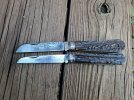
This pair of Johnson Western Works have been posted in the Stag Saturday thread, they may not fit the "golden age" timeline, hopefully no feathers get ruffled by sharing them here. Both are 4" closed.
View attachment 3104720
I'd say they were before 1930, the thick, gnarly blackened Stag gives a quality hint (unless some skilled hafter has put some old slabs on but don't think so!) pins, the bolsters, are the knives steel lined or brass ? I suspect the former.

Your previous 'monster' knife is something bizarre...almost like an archeological find :D Why so outlandishly massive and heavy? It demanded a mass of Stag too. You might think it was a piece of cutler's whimsy, making a huge knife for an exhibition or presentation but it has most clearly been used rather than laying idle for decades. Duncan Campbellclanman Campbellclanman is correct that Earle were shipbuilders in Victorian times based in Hull, they were a leading builder in the 1870s the time steam and iron began to take over but were sold in the 1890s after the Earle brothers both died , the new owners kept the name. Due to its massive size yet fancy bolster work this must have been a costly knife at the time and maybe had this maritime connexion, Hull been not so far from Sheffield either, so a knife made for the shipwrights? Possibly, or for one of the engineers actually involved with shipbuilding who wanted a showpiece knife that got used ?

Interesting to speculate but impossible to say so far. However, we in this century often wrongly regard the Victorians as a prissy set of dullards with a prudish queen. Unfortunately, it is true that for many, life was appallingly brutal and exploited in the factories, mills, mines & sweatshops and in the allegedly green and pleasant fields of England's farms. Yet, the Victorians were also a very modern outward looking people, besotted by engineering feats and other wealth making endeavours. The Great Exhibition of 1851 was a national triumph of prowess & skills, embodied by The Crystal Palace, Brunel's bridges and massive steamships like The Great Eastern, huge railway building with lavish hotels in the London stations, developing the Underground train system were embodiments of national vitality . So it could be that Earle refers to a company who wanted a lavish knife commissioned to swell their reputation or to gift to a leading figure . It might have been used in connexion with a very specific trade/skill in construction that has vanished, hence our puzzling over its dimensions. Or not ? Or it might be the name of a shop who sold knives? It might have been made in Germany or America and arrived in England over time but it has that English look to my eye.

Whatever, it is a very interesting, extraordinary piece and worthy of contemplation :cool::thumbsup:
 
Back
Top