MagnaMax questions

Joined
Nov 29, 2015
Messages
88
I know this is a new steel so there's not a lot of info out there on it yet, but I'm curious and this is the internet so what the heck ;)

First, how does it do with a polished edge? My only other experience with a highly wear resistant steel was with M390 (~61 hrc), and it seemed to last a lot longer with a "toothy" edge. I can see where this would be fine for a pocket knife or a generic application, but I've found that a toothy edge annoys the crap out of me. Don't get me wrong, they bite into the skin of a tomato great, and it does a great job on stuff like nylon webbing, but (to me) a polished edge feels SO much better when slicing through something. I have a couple of magnacut blades that I used last year that held a polished edge very well IMHO. Curious whether the MagnaMax shares that trait with its older brother, or if it wants a tooth edge.

Second question is toughness. I realize its not going to be super tough. As I mentioned, I have a couple of magnacut blades that I use for processing game. They're pretty thin (.090"-.100") and I like them a lot. They handle incidental bone contact just fine, but I'm also not trying to chop through bone with them and I'm butchering on a butcher block style table top. Curious if the Magnamax would hold up to that kind of use just as well. In the past I used a couple of 01 blades and never had a problem with them chipping, but the M390 blade I used liked to develop micro chips any chance it got. I would swear that I once put a small chip in it by laying it down near a staple.... Anyway, I'm a little overly sensitive to having that kind of experience again.
 
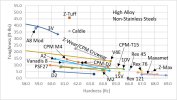
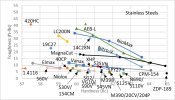
It's much tougher than M390,
Is it? Provided it's stainless 10v/k390.
1000002159.jpg
1000002160.jpg


Also how does 10v appear to have nearly the same toughness at such a wide range of hardness? That's kinda crazy no wonder Spyderco treats the k390/10v so high.
 
Is it? Provided it's stainless 10v/k390.
View attachment 3219493
View attachment 3219494


Also how does 10v appear to have nearly the same toughness at such a wide range of hardness? That's kinda crazy no wonder Spyderco treats the k390/10v so high.
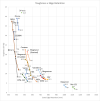
It's really closer to Vanadis 8 than 10V, and those charts are so squashed that it's hard to see the differences. Use this (M390 at 62 HRC is right below S60V):

1000015481.png
 
Last edited:
I typically sharpen at some pretty shallow angles (13-15 dps). I'm thinking that I might need to stay with the tougher Magnacut for my boning/fillet knives. MagnaMax would make a pretty sweet skinner though. I still haven't read anything about how well it does with a polished edge vs a coarser finish.
 
Wouldn't its performance with a polished edge be similar to other steels with the same level of carbides?
 
These charts are getting confusing.

The toughness of 10V at 65.5 Rc is shown as about 7 ft-lbs on Dagoth Blur's chart, which I think is Larrin's.

On Synov's chart, it is shown as about 3.8 ft-lbs.

That's a big difference.
 
These charts are getting confusing.

The toughness of 10V at 65.5 Rc is shown as about 7 ft-lbs on Dagoth Blur's chart, which I think is Larrin's.

On Synov's chart, it is shown as about 3.8 ft-lbs.

That's a big difference.

I agree. I prefer to use Larrin's as none of the others (to my knowledge) have been properly vetted, nor based upon results obtained directly by the individuals posting them. (Which is not to say they may not be accurate...)

Larrin Larrin , perhaps you can add some context here to help avoid any unnecessary confusion. Thank you in advance.
 
Wouldn't its performance with a polished edge be similar to other steels with the same level of carbides?
That's kind of my question. I don't really understand why some steels don't do well with a polished edge. I assumed it had something to do with a lack of toughness and the arrangement of the carbides. Mr Thomas points out how small the carbides are in magnamax. Wasn't sure how that impacted its performance with a polished edge. I've been happy with the way Magnacut has performed in this regard, and it seems to have a similar grain structure but again I'm not sure if that's a good correlation to make on my part.
 
That's kind of my question. I don't really understand why some steels don't do well with a polished edge. I assumed it had something to do with a lack of toughness and the arrangement of the carbides. Mr Thomas points out how small the carbides are in magnamax. Wasn't sure how that impacted its performance with a polished edge. I've been happy with the way Magnacut has performed in this regard, and it seems to have a similar grain structure but again I'm not sure if that's a good correlation to make on my part.
They might "push cut" well based upon the geometry, but not "slice" as well due to carbide content / size. That's when you read about some highly finished edges "skating" instead of cutting into the material.
 
That's kind of my question. I don't really understand why some steels don't do well with a polished edge. I assumed it had something to do with a lack of toughness and the arrangement of the carbides. Mr Thomas points out how small the carbides are in magnamax. Wasn't sure how that impacted its performance with a polished edge. I've been happy with the way Magnacut has performed in this regard, and it seems to have a similar grain structure but again I'm not sure if that's a good correlation to make on my part.
Besides the amount, size and type of carbides it also matters how you get your polished edge. Something like MagnaMax needs diamonds or CBN, especially as you go higher in grit. Toughness itself should have very little effect on how well an edge polishes. It is the microstructure of high wear stainless steels that causes both low toughness and difficulty in polishing. Because MagnaMax achieves high wear resistance from harder carbides that are smaller and in lower amount, as compared to other stainless steels with high wear resistance, it should be better at grinding and polishing. You still need appropriate abrasives and skill to get there of course.
 
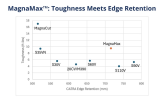
While awaiting input from Larrin, the chart posted by nsm nsm in another thread may be useful:


From Larrin's numbers, I believe MagnaCut shown here is at about 60.5 Rc, below what most people prefer (but what I do prefer).

MagnaMax, on this chart, is about 62.5 Rc. At that hardness, Vanadis 8 will be a bit tougher (10 vs 9 ft-lbs) and K390 will be about the same (9 ft-lbs).
 
I agree. I prefer to use Larrin's as none of the others (to my knowledge) have been properly vetted, nor based upon results obtained directly by the individuals posting them. (Which is not to say they may not be accurate...)

Larrin Larrin , perhaps you can add some context here to help avoid any unnecessary confusion. Thank you in advance.
I can’t vouch for the accuracy of anyone else’s charts, even when they are using my data. Mistakes are possible, of course, even by me when trying to plot data. So I don’t know why the 10V datapoint is too low for toughness.
 
These charts are getting confusing.

The toughness of 10V at 65.5 Rc is shown as about 7 ft-lbs on Dagoth Blur's chart, which I think is Larrin's.

On Synov's chart, it is shown as about 3.8 ft-lbs.

That's a big difference.
It looks like a 10V number and a 15V number got mixed up when I was making that chart. Posting the corrected version now.
 
Besides the amount, size and type of carbides it also matters how you get your polished edge. Something like MagnaMax needs diamonds or CBN, especially as you go higher in grit. Toughness itself should have very little effect on how well an edge polishes. It is the microstructure of high wear stainless steels that causes both low toughness and difficulty in polishing. Because MagnaMax achieves high wear resistance from harder carbides that are smaller and in lower amount, as compared to other stainless steels with high wear resistance, it should be better at grinding and polishing. You still need appropriate abrasives and skill to get there of course.
Historically, I was using mostly ceramics and stropping with whatever I could find, but that was with the older high carbon and stainless steels. Since I started dealing with higher vanadium steels, I switched over to using a combination of diamond and ceramic. I do most of the work with admittedly inexpensive diamond plates up to 3000, then do a little work with a fine ceramic (mainly to minimize the stropping), then strop with a diamond emulsion loaded on a nanocloth strop.
 
Last edited:
Back
Top