MagnaMax questions

You might be able to determine how it will perform with a polished edge by comparing micrographs of MagnaMax with micrographs of steels you are familiar with. See the Knife Steel Nerds site I linked to above. Dr. Thomas has many micrographs on the site. I'm speculating, but it might be worth the effort.
 
The polished edge will require bonded diamond/cBN stones and stropping compound for best results.

M390 has less than 2% vanadium carbide so it doesn't fight back as hard as steels with vanadium/niobium carbides at higher volume.

If you never had any problems with the toughness M390 than it should be a non issue.

The toughness of MagnaMax is in the CPM S35VN/ CPM 154 range.

The whole premise of MagnaMax is not just a new stainless, but something that Bridges the gap between previous iterations of PM stainless and PM tool steels offering the highest corrosion resistance and toughness relative to the carbide volume.

Compared to MagnaCut you are doubling the carbide volume which is to improve the cutting edge retention at the consequence of some toughness loss but there is still plenty of toughness and you can adjust the edge angle to your preferences and uses to improve durability at the cost of cutting ability.

TL;DR

Screenshot_20260630-132151.png

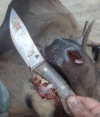
Cuts good, no need to resharpen in the field, plenty of toughness. Keeps the bite at the edge, no orange rust spots even when stored dirty with animal product.
 
The polished edge will require bonded diamond/cBN stones and stropping compound for best results.

M390 has less than 2% vanadium carbide so it doesn't fight back as hard as steels with vanadium/niobium carbides at higher volume.

If you never had any problems with the toughness M390 than it should be a non issue.
That's just it, I hated the M390. I bought it as an EDC. It seemed like it was just looking for the edge to chip. I bought it before finding all the information at Knifesteel Nerds. If I had gone there first, I would have realized that its about the worst steel I could use for most of my purposes. I used a couple of 01 blades for several years. They were tough enough, but I was never happy with the edge retention. That's what started me looking for some better tools.

I run very shallow angles for almost everything, and I can't think of an application where I'd be willing to go up to a 20 dps angle to increase the knifes toughness at the cost of how efficiently it cuts. I do run my hunting knife at 20dps, but that's because I'll occasionally use a hammer to tap it through the pelvic bone on a whitetail. 20 years ago, that was our normal process but these days we normally used a small hand saw of some kind. Sometimes it gets forgotten at the house though so we make do with what we have... Regardless, that's about the only knife I use like that. Still seems like I'm better off sticking with something like Magnacut across the board since I like to have a thin edge. Obviously there are other good steels in that category as well, but at this point it's not sounding like I'd be happy with the way Magnamax cuts.

 
It’s really hard to tell how a new to you steel will perform until you actually try it for yourself on the materials you cut and the other variables involved. I’ve also had one knife in 20cv that did very well and then another knife in 20cv that did terrible. I don’t know if it was the heat treatment or what that made the difference but one micro chipped a lot and the other didn’t chip at all and kept a good sharp edge for a long time. I’ve never been a fan of polished edges as they take a lot of time and effort to get them nice and then keep them nice and shiny. Im in to much dirt, sand and harsh environments to keep anything shiny polished. I prefer a micro toothy edge for most of my needs anyway and gives me a good aggressive bite when I need it.
 
That's just it, I hated the M390. I bought it as an EDC. It seemed like it was just looking for the edge to chip. I bought it before finding all the information at Knifesteel Nerds. If I had gone there first, I would have realized that its about the worst steel I could use for most of my purposes. I used a couple of 01 blades for several years. They were tough enough, but I was never happy with the edge retention. That's what started me looking for some better tools.

I run very shallow angles for almost everything, and I can't think of an application where I'd be willing to go up to a 20 dps angle to increase the knifes toughness at the cost of how efficiently it cuts. I do run my hunting knife at 20dps, but that's because I'll occasionally use a hammer to tap it through the pelvic bone on a whitetail. 20 years ago, that was our normal process but these days we normally used a small hand saw of some kind. Sometimes it gets forgotten at the house though so we make do with what we have... Regardless, that's about the only knife I use like that. Still seems like I'm better off sticking with something like Magnacut across the board since I like to have a thin edge. Obviously there are other good steels in that category as well, but at this point it's not sounding like I'd be happy with the way Magnamax cuts.

MagnaMax is plenty capable of holding a thin edge, guess you'll just have to see for yourself. 🤙

Screenshot_20260630-145343.png
 
It’s really hard to tell how a new to you steel will perform until you actually try it for yourself on the materials you cut and the other variables involved. I’ve also had one knife in 20cv that did very well and then another knife in 20cv that did terrible. I don’t know if it was the heat treatment or what that made the difference but one micro chipped a lot and the other didn’t chip at all and kept a good sharp edge for a long time. I’ve never been a fan of polished edges as they take a lot of time and effort to get them nice and then keep them nice and shiny. Im in to much dirt, sand and harsh environments to keep anything shiny polished. I prefer a micro toothy edge for most of my needs anyway and gives me a good aggressive bite when I need it.
Full transparency, on the knives that I process with, I don't always maintain a polished edge. Depends on the knife. If stropping will bring it back pretty quickly, then that's what I'll do. Otherwise, it gets touched up with a relatively high grit and put back to work. A few days after all the work is done (sometimes I just wait until the end of the season), I'll bring everything back to a polished edge and put it away until the next time. On the opposite end of the spectrum, my crappy kitchen knives get several strokes across the sharpening steel from the butcher block every time I pull one off the magnet. Dad is still using a 4" Buck 100 that he got in the 70's. He has a relatively smooth sharpening steel that he calls a beef steel, and that's about the only thing he's ever used on it. It maintains a wicked sharp edge on that old 420c steel. My good kitchen knives, and my EDC fixed blade are about the only things I regularly maintain a polished edge on. My good kitchen knives don't get abused and rarely need touched up. My EDC wears a polished edge mainly for fun and appearance sake.

Once its more readily available, maybe I'll get a piece of Magnamax and make a good slicer out of it. I can use it in the kitchen, and to chunk up meat for the grinder, and maybe slice backstraps into jerky to see how it holds up ;)
 
Are you doing freehand or are you using a system?
Both. If I'm trying out a new knife or a new steel, I use a fixed angle system so I'm comparing apples to apples, especially with a new blade since I normally want to reprofile the blade to get the angles I want. Otherwise, I'm more prone to free hand. I'm new enough to the higher vanadium stuff, that I'm still doing them with a fixed system. Not sure I'm going to like doing those free hand, but they generally hold an edge long enough that I don't mind taking the time to set up the fixed system occasionally.
 
F fields_mj Everyone's edge angle should be different depending on how you use your knives and what knife you are using. Generally speaking keep lowering the edge angle every time you sharpen, and when you start getting unacceptable levels of edge damage back off on that angle very slightly.

Since geometry cuts above anything else, finding the lowest edge angle you can successfully use without damage will yield more results than anything else. You can also use a very teeny tiny micro bevel to help with this.
 
F fields_mj Everyone's edge angle should be different depending on how you use your knives and what knife you are using. Generally speaking keep lowering the edge angle every time you sharpen, and when you start getting unacceptable levels of edge damage back off on that angle very slightly.

Since geometry cuts above anything else, finding the lowest edge angle you can successfully use without damage will yield more results than anything else. You can also use a very teeny tiny micro bevel to help with this.
Now he's going to want a precise measurement for very teeny tiny ☺️
 
F fields_mj Everyone's edge angle should be different depending on how you use your knives and what knife you are using. Generally speaking keep lowering the edge angle every time you sharpen, and when you start getting unacceptable levels of edge damage back off on that angle very slightly.

Since geometry cuts above anything else, finding the lowest edge angle you can successfully use without damage will yield more results than anything else. You can also use a very teeny tiny micro bevel to help with this.
I used to use a micro bevel when I sharpened my knives but I got away from doing it. They have their place, I just don't use them at the moment.

That's my general strategy. Its hard to find anything that goes much below 15 deg, and almost as hard to find knives that can be sharpened at those angles without removing a significant amount of stock. That's basically what has me going down this rabbit hole. I have knives that I like the shape/profile of, but not the steel, scales/handle, heat treat, thickness, and/or sharpening angles. I've replaced the scales on the last 3 knives I've bought (factory) which takes me about 10-12 hrs to do. If I need to start up the belt grinder to reprofile angles, I might as well just buy the steel and a couple of jigs and make my own. I've made a few knives, and realize that I'm over simplifying it, but my point is that if I have the tools and know what I want, this seems like a better way to go. At least then if I'm not happy, it really is my own fault.... ;)
 
If you have the tools and skills, you can get the knife and steel you want and just do a blade regrind. That's a little simpler than making your own knife.
 
That's my general strategy. Its hard to find anything that goes much below 15 deg, and almost as hard to find knives that can be sharpened at those angles without removing a significant amount of stock.
Just get a rough diamond plate and you can thin out most knives pretty quickly. If it's a larger fixed blade it can take a little bit longer but isn't too bad in my opinion.

You then have the perfect opportunity to convex the edge if you choose.

Most factory knives are not going to be as thin as you want simply because the company has to grind everything based off the lowest common denominator...aka the end user.
 
That's true so long a I just want the bevels to be 10 degrees or less and sharpened at 14-15 degrees. If the blade is .150 thick I want it down under .100, that's a different story. If it doesn't have the HT I really want, or (worse yet) it has a crappy HT because its a relatively inexpensive mass produced blade, I'm hosed from the beginning. Just depends on what I'm going for vs what I can buy off the shelf. :)
 
Back
Top