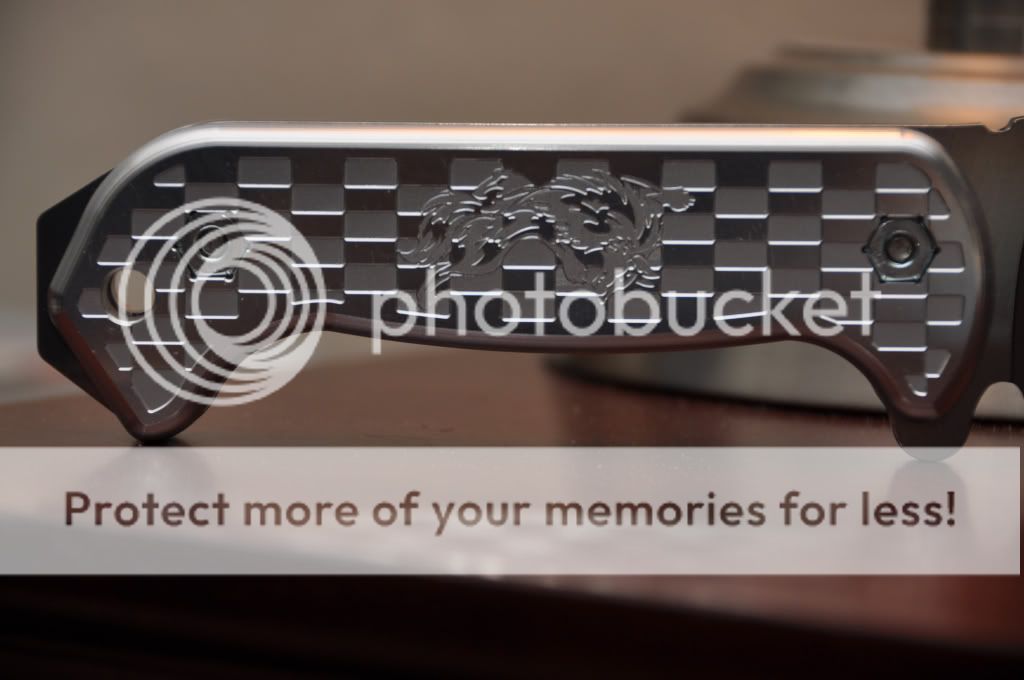
Making hex head holes in knife handles

Huh, interesting - I would have bet money that you'd just wind up with either a horrible mess or just a burn mark. Now try it with G10/G11. :D

Yeah, me too. I wouldn't have thought that a hot bolt would do much in micarta, because phenolic is a thermoset polymer, not a thermoplastic, and is not supposed to melt. It has cross linked molecular bonds that will char, but not become molten when heated. However, the proof is in the pudding and pictures don't lie, but I'm very surprised that worked.

For what it is worth, I create those features on a CNC mill.
 
Never challenge an idiot (me)...looking for a scrap piece of G10.:D

Go for it. I'm interested in seeing what will happen -- I would expect the glass fibers to give you a problem. But I didn't expect the phenolic in micarta to deform like that either.
 
Go for it. I'm interested in seeing what will happen -- I would expect the glass fibers to give you a problem. But I didn't expect the phenolic in micarta to deform like that either.

It didn't work. It just sizzled on it until the heat left the nut.....ehh....I had to give it a shot though.
 
It really did seat nicely and cleaned up very well. Sure beats spending $$
for a CNC capable mill!!
:thumbup:

For what it is worth, I create those features on a CNC mill.

Nathan, you create entire knives on a CNC mill! :)


Thanks for trying the G10, Wolfjohn. Saves me the trouble. Maybe that Orange G10 destined for a rigging knife will get pins & epoxy...

-Daizee
 
very cool indeed, I would just drill the ID and file the hex.. although this is limited to micarta it is very cool.... I would think you'd discolor the micarta for sure, wonder how this would do on denim/carta :D also for other materials the best way to achieve the hex is with a jig and dremel... you can find prefabbed jigs for most nuts at your friendly neighborhood hardware store.. (locations may very).. super quick and clean...

but as a matter of preference I don't care for the hexagon look, unless of course its on a Becker :D
 
Last edited:
very cool indeed, I would just drill the ID and file the hex.. although this is limited to micarta it is very cool.... I would think you'd discolor the micarta for sure, wonder how this would do on denim/carta :D also for other materials the best way to achieve the hex is with a jig and dremel... you can find prefabbed jigs for most nuts at your friendly neighborhood hardware store.. (locations may very).. super quick and clean...

but as a matter of preference I don't care for the look, unless of course its on a Becker :D

Absolutely. I personally wouldn't like that look on anything beyond a camp/field chopper type knife, machete or a Mad Max paring knife....ok, I made that last one up.:rolleyes:
 
Outside of fixed blades, many folders use a hex head pivot and if you want to make your own custom scales you need to know how to do this.


-Xander
 
I'm curious about these template things. Indeed, I had been thinking I'd use a router with template bits to rough-shape handle scales in the near future.

However currently I don't use a dremel at all while making knives, so it's an entire extra tool system to chuck into the process.
Picked up a long-shank 10-32 today for $0.38. There's always a plumbing torch handy.

-Daizee
 
I've used the hot bolt/nut method before, in woods, composites, and plastics. It works fairly well, actually.
 
Last edited:
Here are some broach tool that you can use:
dm-13.jpg


Far right is the broach for broaching the Hex shape
Broach_types_and_examples.jpg


This is the reference of the hole size you need to drill out first, then using the broach tool to plunge in. That's it. But I too, using CNC mill for those feature.
la-13.gif


Specific tool for this job:
HexBroachTool.jpg
 
Last edited:
Here are some broach tool that you can use:

But a broach will create a through hole.
the point is to create a blind hole that will hold the nut from spinning so it will tighten the nut on the screw and hold down the scale.
 
But a broach will create a through hole.
the point is to create a blind hole that will hold the nut from spinning so it will tighten the nut on the screw and hold down the scale.

If the depth is controlled, then you can create a blind hole.;). I've been making scales for BK7 before:D

This is the broach tool to use in this case:
HexBroachTool.jpg
 
Last edited:
Hi Sh@rp, that looks like a simpler tool than the through-broaches (for lack of official vocabulary).
What do you chuck it into?

-Daizee
 
Cool thread and techniques. I've made removable scales for a couple Beckers before, but I just deepened the slots in regular Corby bolts and put them in normal round stepped holes. Saved the original scales/bolts/nuts and sent 'em back to the client.
 
Hi Sh@rp, that looks like a simpler tool than the through-broaches (for lack of official vocabulary).
What do you chuck it into?

-Daizee
Those work best if mounted in an end mill holder or any collet holder will do R8 if you have a manual mill, 5C for lathe engine. I mounted them on a lathe turret when I was making Allen crews 20 years ago. Now I just use CNC mill to mill the hex out of it heh heh...

Some thing like this
DSC_1251.jpg
 
Back
Top