
-
The BladeForums.com 2024 Traditional Knife is available! Price is $250 ea (shipped within CONUS).
Order here: https://www.bladeforums.com/help/2024-traditional/
You are using an out of date browser. It may not display this or other websites correctly.
You should upgrade or use an alternative browser.
You should upgrade or use an alternative browser.
Mills, square or round column....Update, machine on the way!!
- Thread starter jonnymac44
- Start date


- Joined
- Apr 10, 2002
- Messages
- 138
It looks like you may have the same machine as a buddy, can you give me all the info on your power feed unit?
It is an "Align" ?
Count, yes that's the one.

Bill DeShivs
Knifemaker / Craftsman / Service Provider
- Joined
- Jun 6, 2000
- Messages
- 12,967
ROUND allows ROTATION. A bad thing in a mill.

- Joined
- Sep 27, 2007
- Messages
- 7,680
ROUND allows ROTATION. A bad thing in a mill.
Yep, I just have to face that fact and pony up some cash, Bill!

BMK
BANNED
- Joined
- Jan 30, 2011
- Messages
- 831
I understand your reasoning but reject your conclusion.


ROUND allows ROTATION. A bad thing in a mill.
- Joined
- Jul 13, 2009
- Messages
- 21,855
Count, yes that's the one.
Could you look up the model numbers sometime?
They have several & we haven't found the right mounting yet.
- Joined
- Jul 13, 2009
- Messages
- 21,855
I understand your reasoning but reject your conclusion.
Then you're misinformed on this application.
BMK
BANNED
- Joined
- Jan 30, 2011
- Messages
- 831
Then you're misinformed on this application.
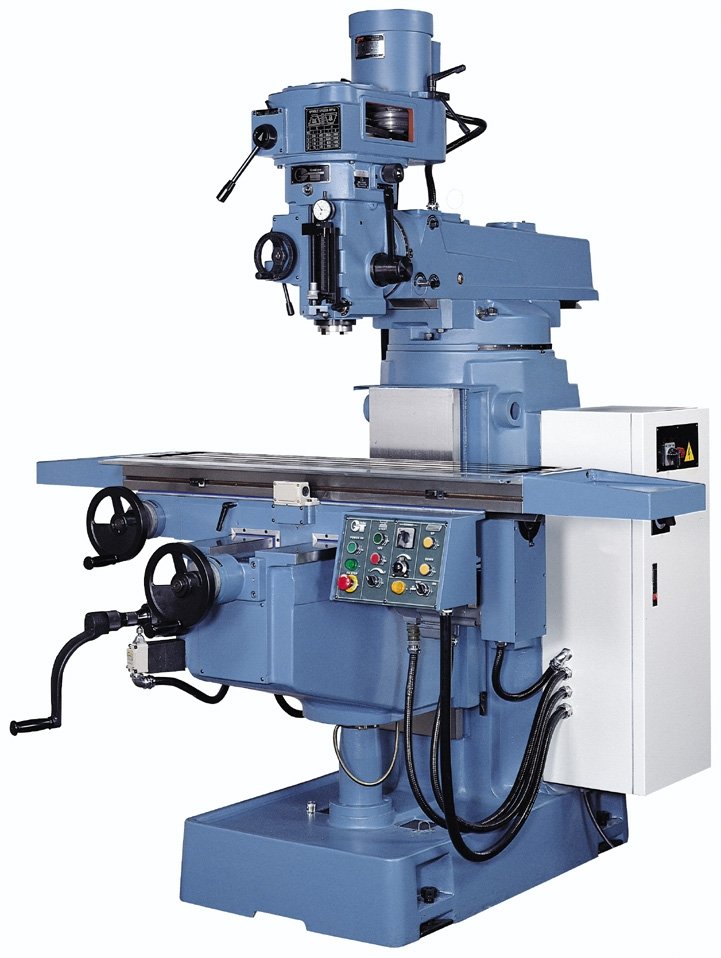
Good point. The round "parts" are indexed and designed to rotate.


- Joined
- Sep 27, 2007
- Messages
- 7,680
I understand your reasoning but reject your conclusion.
I'd appreciate it if this thread, which has been full of good discussion, didn't derail into a pissing match.
EDIT: Especially since those aren't even the same type of round column mills being discussed here. Let's stay on topic here. You want to start that debate, this isn't the place. You're free to start your own thread.
BMK
BANNED
- Joined
- Jan 30, 2011
- Messages
- 831
I thought round vs square was germane to "Mills, smaller square column or beefier round column?" I stand corrected - thank you.
I'd appreciate it if this thread, which has been full of good discussion, didn't derail into a pissing match.
EDIT: Especially since those aren't even the same type of round column mills being discussed here. Let's stay on topic here. You want to start that debate, this isn't the place. You're free to start your own thread.
- Joined
- Sep 27, 2007
- Messages
- 7,680
For the most part the only debate in this thread is due to the fact that most round column mills will lose their center when they swivel if you have to loosen the head to raise or lower it, where a square column mill can be raised and lowered and not lose it's alignment with the workpiece. That's been the only discussion here on round vs. square so far as I can tell.
Now, I could be wrong also, but looking at the round column mills you posted, the head doesn't raise or lower, but the table does, so the debate that's been going here does not apply to the mills you posted. That's why I don't think it belongs in this discussion, especially when it's done in a "look how much smarter I am than you" kind of way
Now, I could be wrong also, but looking at the round column mills you posted, the head doesn't raise or lower, but the table does, so the debate that's been going here does not apply to the mills you posted. That's why I don't think it belongs in this discussion, especially when it's done in a "look how much smarter I am than you" kind of way
- Joined
- Jul 13, 2009
- Messages
- 21,855
Just so we're all on the same page
In order to account for the different length of tools and work piece sizes mills can be adjusted.
Mills can be adjusted
On the round column mills, like this one:
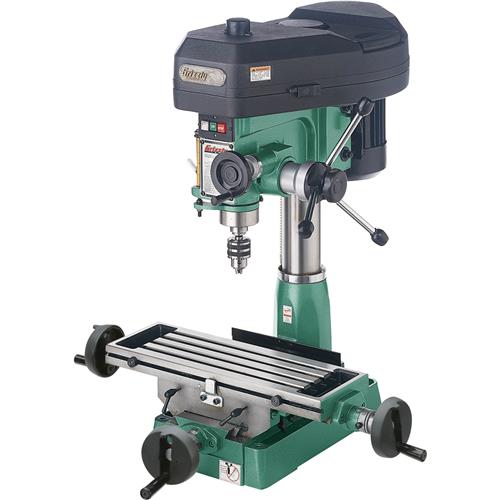
Those 2 black screws just in front of the motor are the only thing keeping the entire head in the same position.
It's a clamping force, not too rigid if you consider the vibration in cutting.
In knifemaking operations you will want to perform different operations on the same center
ie a short center drill, longer drill, then longer reamer all on the same center position.
Once you move that head, the center point is lost.
You can reduce that effect if you cut down the longer tools to stub shanks- make short reamers etc.
In the past several years, the mini mills have started to use square columns so that is less of an issue.
but you see, an overall smaller size of machine.
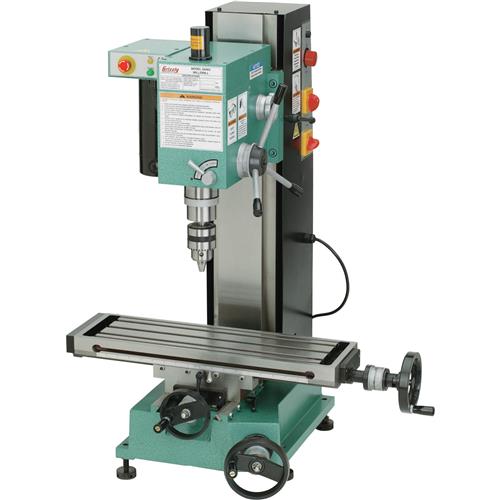
This is what I call a Knee mill - the knee (below the head).
The table moves up and down on dovetails with a cranked adjustment.
No moving the head.
This idea is used all the way up to the biggies that Monkey posted above.

In order to account for the different length of tools and work piece sizes mills can be adjusted.
Mills can be adjusted
On the round column mills, like this one:
Those 2 black screws just in front of the motor are the only thing keeping the entire head in the same position.
It's a clamping force, not too rigid if you consider the vibration in cutting.
In knifemaking operations you will want to perform different operations on the same center
ie a short center drill, longer drill, then longer reamer all on the same center position.
Once you move that head, the center point is lost.
You can reduce that effect if you cut down the longer tools to stub shanks- make short reamers etc.
In the past several years, the mini mills have started to use square columns so that is less of an issue.
but you see, an overall smaller size of machine.
This is what I call a Knee mill - the knee (below the head).
The table moves up and down on dovetails with a cranked adjustment.
No moving the head.
This idea is used all the way up to the biggies that Monkey posted above.
Bill DeShivs
Knifemaker / Craftsman / Service Provider
- Joined
- Jun 6, 2000
- Messages
- 12,967
Here's my cheapie.

- Joined
- Sep 27, 2007
- Messages
- 7,680
Here's my cheapie.
Yeah, but I bet you've made some cool parts with it!:thumbup:
- Joined
- Dec 31, 2003
- Messages
- 335
RJSmith, is that knee mill 3 phase or 1 phase? I saw one similar but saw that it was belt drive and thought it wouldn't be able to do as much work as one that was a gear drive. How is it working for you, and what price range do they run in?

- Joined
- Aug 21, 2006
- Messages
- 533
my 2 cents:
Buy the biggest badest mill you can afford and make room for it. honestly you will find so many things to do with it after you get it that you will want a bigger one. get something with a knee!!! I just went through this and picked up a very nice 1985 bridgeport with cnc controls for $4000.
I wish I would have bought something bigger but for knife making I would never go smaller. i can face a piece of 2" cpm154 from .220 to .150 in 15 min or so with a 2" carbide insert face mill. if you are gonna keep doing folder work you will want to be able to do that sort of thing every now and then. Pluss I have made countless jigs for the mill out of alum, and being able to take .060-.070 passes with a 2" facemill is sweet!
2-3 cents
Buy the biggest badest mill you can afford and make room for it. honestly you will find so many things to do with it after you get it that you will want a bigger one. get something with a knee!!! I just went through this and picked up a very nice 1985 bridgeport with cnc controls for $4000.
I wish I would have bought something bigger
but for knife making I would never go smaller. i can face a piece of 2" cpm154 from .220 to .150 in 15 min or so with a 2" carbide insert face mill. if you are gonna keep doing folder work you will want to be able to do that sort of thing every now and then. Pluss I have made countless jigs for the mill out of alum, and being able to take .060-.070 passes with a 2" facemill is sweet!2-3 cents

Erin Burke
KnifeMaker...ish
- Joined
- May 19, 2003
- Messages
- 1,330
In the past several years, the mini mills have started to use square columns so that is less of an issue.
but you see, an overall smaller size of machine.
Hey... it's my machine (minus the DRO's). I wasn't going to chime-in on this thread, because my experience is limited to ONLY this machine. I bought it (and the 3-axis DRO package) at the end of May last year. I was looking for a machine that would do the following:
- Be able to machine guards, folder parts/pivots, and small parts.
- Have repeatable accuracy. This is why I invested in the DROs.
- Fit into my tiny basement shop. At 353lbs, it was tricky to get this sucker down the stairs by myself - not to mention lifting it to the bench - but it was doable.
This machine DEFINITELY has its limitations though. It does NOT have the mass or power to drive any reasonably large end mills cleanly. Facing or large surfacing processes are painful. Half-inch is about as big as I like to go with an end mill in steel.
The minute I build a real shop - or move to a place where I have a real shop - I will upgrade to a larger knee mill... and this one will become a dedicated drill or tapping machine.
This is a photo of my machine just after I wired the DROs (but before I trained all the cables).

Erin

- Joined
- Oct 2, 2006
- Messages
- 3,238
http://cdn0.grizzly.com/pics/jpeg500/g/g1005z.jpg
This is the model I have, even with the head clamping bolts tightened so the head does not swivel, the column/head/quill (especially the column and the quill) flex so much that I will get 1/16 inch deflection in the direction the cutter is pulling on a 1/4 inch plunge cut with a 1/4 inch end mill on mild steel, makes precision work challenging at best
-Page
This is the model I have, even with the head clamping bolts tightened so the head does not swivel, the column/head/quill (especially the column and the quill) flex so much that I will get 1/16 inch deflection in the direction the cutter is pulling on a 1/4 inch plunge cut with a 1/4 inch end mill on mild steel, makes precision work challenging at best
-Page
- Joined
- Sep 27, 2007
- Messages
- 7,680
http://cdn0.grizzly.com/pics/jpeg500/g/g1005z.jpg
This is the model I have, even with the head clamping bolts tightened so the head does not swivel, the column/head/quill (especially the column and the quill) flex so much that I will get 1/16 inch deflection in the direction the cutter is pulling on a 1/4 inch plunge cut with a 1/4 inch end mill on mild steel, makes precision work challenging at best
-Page
Thanks Page,
Don't worry, I'm convinced that the round column machine would be regretted at some point. Time to save up a bit and go big

- Joined
- Apr 10, 2002
- Messages
- 138
Could you look up the model numbers sometime?
They have several & we haven't found the right mounting yet.
Count, i took a close look at the power feed and could not find the model number on it anywhere. However, i did receive a separate owners manual for the power feed included with the mill. The manual is from Align and it lists three models on the front cover, AL-300S, AL-400S, and AL-500S respectively. If your friends mill had previously had a power feed on it there should be no problem doing a replacement, but if the mill came from the factory without the power feed he might have to do some modifications. I have heard of people with the Grizzly version of this mill trying to retrofit a power feed and they had to cut the leadscrew i believe. At any rate, he may want to go over to yahoo.com and look for the 6x26 Mill group. There is a whole knowledge base over there and lots of help if needed. http://finance.groups.yahoo.com/group/6x26millingmachines/
Last edited: