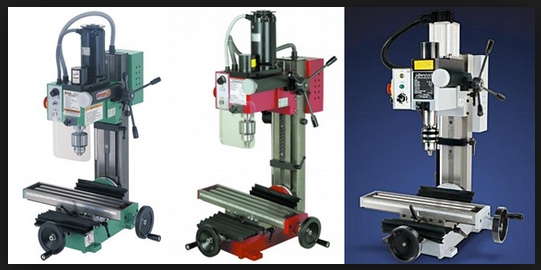
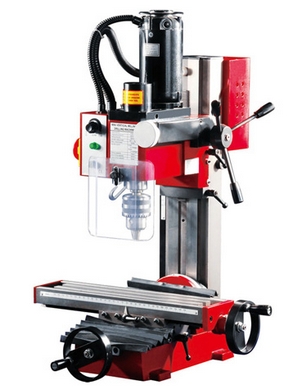
I am a former professional machinist, with experience from the mini machines up to larger industry CNC units.
Without being excessively negative, the smaller machines can be limited, but you can still make a decent part or two when needed, and they can be really handy in that way.
They are a solution for me at the moment, because I am not in a situation where I can drop a Bridgeport in my current shop space. If I could, that's what I would have purchased.
I have the g0463 mill and g4000 lathe. I think they are the minimum I personally would be happy with, but they get the job done for my limited use and have traveled with me from rental to rental as my fiance and I prepare to purchase a home.
Additionally, the g0463 uses R8 tooling which can be shared with a Bridgeport, which I consider a pretty huge thing.
Incidentally, knifemaking is one thing these small machines work exceptionally well for (compared to trying to use them for more traditional machining tasks).
A downside is that I feel these are kind of terrible machines to start on. They are tricky to get good results sometimes, and that is with my almost two decades of accumulated tricks and hints, and experience with machine maintenance and tuneup. A lot of successful machining is a careful (and sometimes loose) dance across fine lines.
Either way, if you are ready to accept their limitations, and be willing to go easy on them and learn their quirks, they can be incredibly useful and profitable machines for those that are unable to go with a larger machine.
I can move my mill and lathe with a cheap engine hoist, whereas many folks would have to spend $$$ to have their Bridgeport moved, or call in an expensive favor from a friend. Once I have a more permanent shop, that won't be a problem.
I use my mini machines for:
-Cutting guard and spacer slots
-Milling frame handle pockets
-Squaring/Flattening material
-Milling fullers
-Drilling tang sockets (starting them off with an end mill gives you a good start for the drill, and drilling with rigid tooling keeps the sockets lined up)
-Drilling/boring pin and lanyard tube holes
-Starting the tang taper on thicker stock full tangs
-Making tooling for my 2x72, and I even used the machines to build the grinder itself.
It performs all of these tasks quite admirably.
Edit: Here's a shot of the upgraded flat platen attachment I built using exclusively my mini machines. It's a hack-together from random scrap, but it runs super clean and is built to last. I can switch from hollow to flat grinding very easily, just rotate the support plate and change the tool rest position. Not perfectly engineered, but the machining came out solid enough for me to have a good working tool, which is fine by me.