mokume

Joined
Feb 17, 2007
Messages
3,375
I was wondering if I could take a stack of quarters and wrap them in ss foil place them in my oven and when they are hot enough give it a solid tap with a hammer. What temp should I shoot for. Would this work to give me a layered piece for a small guard. Could I further form it and how? I have some pure silver stamped as coins the size of old silver dollars would these and some copper be a better way to start. Thanks all
 
Cupronickel melts around 2140 F and according to here you should work it between 1700-1900 F although I'd probably go higher when you're actually trying to fuse them.
 
I'm not an expert, but I stayed at a holiday inn once and I saw a quarter mokume demo about 3 months ago. We used iron wire to hold them together and it was a bit of a pain.

I would probably try to make a jig to hold them. A flat mild steel base with two threaded rods running out and a flat mild steel plate at the top. Finger tighten it down on the stack and then tap the top plate when you pull them out. Just how I'd try it. They'll move about in the foil and it might be hard to get a good fuse.

Also, you want to quench the mokume in water/brine to soften it occasionally while you're working it. The copper will work harden and crack if you don't. You'll get plenty of pattern out of the quarters for your guard.
 
Only if you want to do time. It is now a federal offense to melt down american currency. Buy thin sheets of copper and nickel silver and fuse them. its cheaper and your sucess rate willbe much higher.
Thanks,
Del
 
http://www.coinflation.com/is_it_illegal_to_melt_coins.html


Where does it say that you can melt coins? Well, that's part of the problem. It doesn't say anywhere that the U.S. government is ok with this. But, go to the U.S. Mint web site and search for "illegal". You'll get this result:

1. Is it illegal to damage or deface coins?

Section 331 of Title 18 of the United States code provides criminal penalties for anyone who fraudulently alters, defaces, mutilates impairs, diminishes, falsifies, scales, or lightens any of the coins coined at the Mints of the United States. This statute means that you may be violating the law if you change the appearance of the coin and fraudulently represent it to be other than the altered coin that it is. As a matter of policy, the Mint does not promote coloring, plating or altering U.S. coinage: however, there are no sanctions against such activity absent fraudulent intent.


The keyword is fraudulent. When you take a 25 cent piece and try to pass it off as a Sacajawea Dollar, that's fraud. When you take a Buffalo Nickel, and scratch out one of its legs and try to sell it as a rare collectible, that's also fraud. But when you melt a pre-1982 cent, and sell it for its copper value, that's genuine and legal (visit coinflation.com to see today's coin values and likely candidates for melting).

Also, silver refiners have been melting coins for decades. Precedent is on your side.

I did a search and though google thinks it is illegal, most sources fall back to the fraudulent wording. There is nothing fraudulent about making makome out of them. Interestingly, it does appear that the wording is not so loose on bills as they are a note of debt.

I would think the US Treasury would have better things to do than take me in over it. But, anymore I would not be surprized by anything. In light of my search I will still do it.

 
well it won't be long before quarters make the list. I will do a bunch tonight and then in the future I won't have to worry as I did them all before the law was changed.

OK, I get some sheets of copper like used to make impressions. What metal should I use for good contrast and where would be a decent source.

Thanks for all the help
 
Copper, brass, and nickle silver sheet is readily available, and are what a lot of commercial Mokume is made from in the US. Pure nnickle sheet is a little harder to find, but will also do, and will givie a non-tarnishing silver color to the mix.
 
I'm a silversmith, and I've made Mokume Gaine pieces before from scratch.
-It ain't easy!
I used sterling and copper. First thing is that the whole process needs to be done as cleanly as possible because any CuO2 in between the layers of the final ingot will allow it to peel miserably while forging later. I suggest using air-propane, as oxy-fuel allows for too much oxidation no matter how perfect you get the mixture, which loads the flux too quickly and renders it useless.
I alternated heavy Gage sterling sheet & copper. Pieces must be dead flat and clean of any grease, oxidation or firescale for best results. (Newly bought sheet needs light scrub with 3M dishpad to remove factory anti-ox coating.)
The "sandwich" needs to be clamped with as small a steel clamp as possible because silver (pretty closely followed by Cu) is the most pain-in-the-ass heat conductor. The whole piece needs to be raised to temperature, and that includes the clamp, and any other heat-sink attached. (IE, no cast iron skillet as a base.)
The "sandwich" needs to be very liberally fluxed, and a second application near the end of the heating cycle helps. (No flux in between the sheets!)
As the layers heat, they expand quite a bit more than the steel clamp does, so immense pressure builds (-on a micro scale; not dangerously so...). As the silver and copper reach their eutectic temperatures (relatively close to one another, and I believe about 1150*, IIRC), the sheets actually braze together, sharing a microns thick alloy between them that bonds them together.
A "properly done" mokume ingot is as strong as the softer parent material. But because the materials have different work-hardening thresholds, the ingot can begin to show signs of surface peeling if hammered out to sheet again. In silversmithing, hammering it out to sheet is typical, and obviously is both a great test for how well one can create mokume, as well as testament to how durable it is when worked correctly (annealed more frequently in between hammer cycles than usual silver sheet, etc.) Rolling must be done cautiously and patiently, with annealing in between small increment. The ductility of silver is astounding, as is that of copper. But counterintuitively, sterling loses a great deal of ductility by comparison to pure Ag despite being alloyed with it's close cousin, copper.

If oxides are allowed to form within the ingot, whether by unfluxed heating, or contamination, a thinned piece will develop bubbles in the layers during annealing. I have yet to make a "perfect" mokume ingot. I've made about 10.

If you intend to use coins, be aware that they need to have the faces sanded dead flat to about 600 for best results.
Coin silver is 80% silver, 20% copper, so the yeild material will be much softer that sterling-copper mokume. It may actually be easier to make and work, but not having used it, I'm speculating.
I purchase my material at Hoover and Strong.
 
No, unfortunatly not any of the Mokume. I've been working on my website off & on, and have disappointed myself by realizing how small my portfolio is. I've only begun taking photos of my stuff recently.
The Mokume I've done have all been for bezel-fit boxes. I haven't gotten a clean enough ingot to successfully make a vessel. The one baby cup I tried ended up as a round bezel-fit box.
When my site is up and running, I'll be posting photos of my knife attempts. ;)
 
SterlingHammer,

Your mokume procedures seem to be flawed,you may want to take a look at James Binnion's website for better information than you have given here.

mokume1.jpg


mokumebrac.jpg
 
I have made a few quarter mokume pieces and they have turned out great. To hold them together I drilled out an 1/8" hole in each one and then peened them with copper, brass or nickel silver rod. The stack is then held by clamped tongs.

The first few I screwed up because the heat was not high enough. The trick seems to be in getting the stack hot enough that some actual melting starts on the outside. It should splat out some molten droplets on the first hammer blow. I never did like the pattern enough to ever use much of it. There is too much copper for a good contrast.
 
SterlingHammer,

Your mokume procedures seem to be flawed,you may want to take a look at James Binnion's website for better information than you have given here.
Jame Binnion is a thirty year expert on mokume gane. I make no such claim by any means. I also have none of the equipment he has.
 
I do copper/nickel silver mokume and I just use my gas forge, my anvil and a hammer. some may consider my gas forge fancy, but I don't. You can do good copper/NS mokume in the forge, and without alot of fancy equipment.

Thanks,
Del
 
I make mokume' gane for jewelery purposes and for knives. The jewelery mokume is various combinations of gold, silver, platinum, copper, and nickel.
The knife mokume is usually brass, nickel, and copper. I have a mokume press made from two 3.5X3.5" plates of 3/4" steel. They bolt together on the corners with 1/2" bolts. I stack the 2X2" sheets of 16 to 20 gauge metal up (surgically clean and pickled) and bolt as tight as I can. I seal the assembly in a foil HT bag with some powdered charcoal. I put it in the HT oven for up to 8 hours at a temperature about 50 degrees BELOW the eutectic point of the metals. The metal will come under high pressure and fuse during the process.When cooled down to about 1000F I take it out and GENTLY give it a light forging, increasing the force as it cools and firms up. DO NOT pound away at it. When at black heat, dunk in a bucket of water. The block should be sawn/ground to make all sides smooth. This will prevent cracks from forming when drawing out the billet, and will show any bad joints. You CAN save a bad billet, but it can be complex and frustrating. Once the billet is cleaned up, you forge it out to the size/thickness you want. Anneal ocasionaly by heating it to red and quenching in water. Work it with gentle force and work it cold. If you must work it hot,do not hot forge mokume any hotter than dull red. Pickling after quenching helps keep it clean from oxides. The billet can be folded, twisted, and drilled as would a damascus billet. I like to bring it to about 1/2" thick and then reduce it with a ball peen hammer. This produces a nice water pattern.
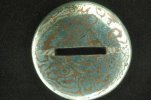
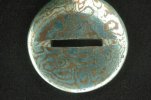
Here is a photo of a tsuba made in fine silver and copper.
BTW, Midgett's book opn "Mokume Gane" is excellent.
Stacy
 

Attachments

  • IMGP0977.JPG
    IMGP0977.JPG
    52.9 KB · Views: 40
  • IMGP0978.JPG
    IMGP0978.JPG
    54.4 KB · Views: 37
Thanks for all the great information on this stuff guys. I am going to make a press and try some quarters first. I have a bit of copper and brass sheet. I guess I should find some nickel silver for the other contrast. This is really interesting. Would my electric kiln work well enough. I have heard copper and stuff will "sour" a forge or damascus so don't want to use mine. I guess I could whip out another smaller forge.
 
I have heard copper and stuff will "sour" a forge or damascus so don't want to use mine. I guess I could whip out another smaller forge.

This is crap. I make both mokume and damascus in the same forge with no ill effects.
Stacy,
Thats funny, I just was forging some copper/NS at about 1800f, with the mixes you describe its the silver you don't want to work hot, its red short. The copper/NS stuff works great hot, the progress even hand hammering is quick.
Del
 
Back
Top