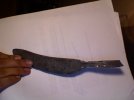
Moral destroyed by small tang...

Joined
Sep 8, 2006
Messages
1,188
Again i tried to forge the small tang with no fuller or skill... all i got out of my work was this silly looking tang on my knife and a burn under my eye where the hot blade jumped out of my tongs .... im gonna need to make a fuller, this anvil corner stuff isnt working out very well with my skill level. i read wayne goddards book and forged the general shape of the blade then went to the tang, and was supposed to finish forging the blade up after the tang, but i just shut it down for tonight... any tricks or things i should know? i would greatly appreceate it. what i did was just hold where i want it to dip over the edge and hamer over it then try to draw it out. i did this on both sides... thanks... sorry for the rant,.....
 

Attachments

  • Photo 58.jpg
    Photo 58.jpg
    22.7 KB · Views: 276
I went through a spring fuller and a guillotine fuller, whihc I broke, before I finally got my press set up. I would suggest cheating. either grind or file a couple of round indents on the top and bottom of the bar where they tang starts and forge back from there. Ofrgina tang by hand may be the most time consuming part of forging a knife. It is a real PITA. Now that i have my press, I want to get my Little Giant delivered so I can draw out the tang faster after i set the transition with the press.:D If you look at Kevin Cashen's forging instruction page, you will see that he tells you another way to cheat. Cut the tang end of the bar off at an angle and you only have to forge down about 60% as much steel. This really helps on bigger knives. Just make sure you leave the pointed part long enough for the tang you need. I used to do both of these things. When I cut the bar at an angle, I would flatten the pointed end on the grinder to a little bigger than the finished size. Kevin also has a good tip on smacking the ricasso down after you draw out the first part of the bevel. Not only does that set the ricasso, it also makes it esy to knock the intial bend out of the spine. You really have to do that with the blade still attached to the bar. I am forging from short roundbars now and even with the press.. it is not as easy to knock that curve back down without that nice 30 inch "handle"
 
Last edited:
yeah, im gonna have to do that, ive got to locate something o make a fuller out of, im proly gona try your cheating methods next time. thanks
 
I was going to recommend Kevin Cashen's Forging Tutorial, however, Joe beat me to it (but I included the link). I have been using Kevin's method since he showed it to me a couple of years ago. I think it works well.
 
Yes, Kevin spells it out very well !

Just a couple things that work for me, maybe they will help?

Getting the roundest hammer you can, re-crown one or make a cross-pien. Don't be afraid of trying things, as kids in my grandpa's blacksmith shop, my cousin liked a plain-ol claw hammer, he could move some steel with it!

Work the steel with a little more heat, come past critical a little more. Slag is not your friend, but hotter helps.

Welding or forging some sort of lip onto a pair of tongs will help keeping blades from doing stupid-steel tricks.

Driving your force right down the sweet-spot or middle of the anvil will concentrate a little more force. Grind a radius into your anvil if you think you found a good spot, you will use it again.

Think it out, take your time, see it yield before you swing.

I been pounding on iron for a long time, and had/have a lot of struggle getting the tangs-shoulder to yield. On the reverse , making a 12" horse shoe branch out to fit a 13" hoofed horse, what beautiful shoulders start to form sometime. (there is no need for shoulders on a horseshoe)

I know just what your dealing with, but it sure is nice when a tang is 'right', when fitting a guard, thats the real time consumer for me.

And have fun!
 
Last edited:
is the problem my hammer? ive been using a blacksmith hammer from home depot. should i be using a round hammer?
 
idea for a fuller is a wood cutting wedge. Grind it to the roundness you want and find a way to get it to stay flat. The idea that I have to still try out is a wood box for the bottom to fit into to be able to put up and down as needed.
Hope this helps
Eric Knight
P.S. I to am struggling with forging tangs.
 
is the problem my hammer? ive been using a blacksmith hammer from home depot. should i be using a round hammer?

Just guessing, hard to tell in the picture....

Looks like a couple things might have went wrong,,,, wonder how/why i can recognize them?

It looks like it's been worked cold, not enough stock, and what was there was stretched too far(?)

Uneven heats, some hot, some cold (looking at the texture(?)

Just from the hip.... try making a mild steel blade?

Just my $0.02 cents worth, it's so rewarding to me that it's worth trying anything!

No-one can have to many hammers anyways!
 
i worked it when it was orange and got frustrated and cut it off the bar at that lenght. i guess theres no saving that one. by mild steel do you mean the cheap stock they have at homedepot?
 
Looking at the photo I would suggest a couple of things:

It looks like it was worked too cold and the wrong hammer face was used.
Work your steel hot. carbon steel will move under the hammer better if it is in the plastic stage between 1700 and 2000F. Quit hammering when the color loses the red glow (black heat). Work it evenly, a few blows on one side..a few on the other. Get/make a drawing hammer to draw out the tang (and any stock that needs to be thinned/stretched). You make one by taking a blacksmiths hammer (HF cheapie will do fine) and grind the vertical peen to a 3/8 round radius at the edge. You strike the hot steel straight down with this and it pushes the steel away in both directions. A few firm blows on each side, a few flattening blows with the regular face (with the tang laid flat on the anvil) to straighten it back up a bit....re-heat...repeat. It will draw out the steel fairly quickly. Once it is drawn out, then you can clean up the shape nicely with the regular face.

I must admit that I often cut the basic tang shape into the bar after forging the blade.The band saw makes this job about 60 seconds long. Then I can just grind in the final shape...or forge it to final shape if it needs tapers and curves.

Another thing that the photo shows is that you didn't curve the blade downward before you started forging the bevels. After forging the basic profile of the blade, put the hot blade on the bick (horn part of the anvil) and curve it down like a banana. Then forge in the bevels. The blade will lift and straighten as you forge. You may even need to curve it down again when partly forged if the tip rises too far. Again, done at full forging heat, the steel will curve like play-doh. Done too cold and it will bend into strange shapes.

A set of box jaw U-tongs (my favorite) will help a lot,too. See Tom Clark'sTom Tongs and tools at:
http://ozarkschool.com/
I forge 90% of my blades with U-box tongs. I would suggest a pair of 1/4" X1" box jaw -U tongs and a pair of 1/4" X 1.5" box jaw -U tongs.
Stacy

 
Last edited:
As mentioned above, don't be afraid to modify a hammer or two! I have a 3lb cross pien that I flattened the cross to about 3/8" [or a little more] and radiused. Then put a good radius on the flat face.

Lots of good 'cheater' tips above,too. Keep it hot, and PRACTICE,PRACTICE,PRACTICE!!!
 
ive been leaving it in the forge until it reaches a dull orange and then forging it, is this too cold? and thanks for the help everyone
 
ive been leaving it in the forge until it reaches a dull orange and then forging it, is this too cold? and thanks for the help everyone

Just my idea, as it works for me, maybe it will help.....

Orange is a color, hang a magnet somewhere near the forge, a magnet mounted on a spring (like a door-stopper 'twangger' ) is handy.

Keep checking the steel , your looking for a point were it starts to loose magnetism, dead to a magnet, and a slightly hotter/brighter color then non-magnetic. (more of a feel then view)

Once you know were critical is (non-magnetic) you can get a feel for your best working temp by color, but only after you have a better idea off the magnet and how the steel works.

The other Kevin is fantastic at explaining what is happening in steel as we work it. I just know there is a point that steel just seems to want to fight us, and a point that it starts to move for us. Sometimes all it takes is a few heat cycles and the steel works better for us at any given temp,,,,,,, it may have something to do with the inner grain structure spearoidizing of steel or some hocas-poacs like that?

All I know is that you can bring it on by cycling the steel from critical, and turn the forge down or park the steel in a less-hot part of the forge till it losses a little color a couple times. Or just letting it soak for a few at just sub-critical gives us a better plastic to bang on.


Cycling this way in my forge a couple times can sure save a day that I think I am 'done' and makes my arm think it has a little more zip!
 
Another point about trying to judge temperature of steel based on color, is that the lighting has a large impact on our perception of color. On a bright sunny day, the steel can look like dull orange to almost black and still be quite hot, (1700 degrees F.), but on an overcast day, that same 1700 degree F. steel can look bright orange. In doors vs. outdoors has a large impact on our perception of color too.

I do what Crow Valley suggests and use my magnet to understand what color on that particular day is non-magnetic and then forge based on that information. I work with 52100, 5160, 1080, 1080, W2 and 1084/15N20 damascus. I understand these steels based on the non-magnetic temperatures.

Don't trust color, until you've confirmed what that particular color means on that particular day. If you forge outdoors on a partly cloudy/partly sunny day, the meaning of the color can change depending on whether the sun is behind a cloud or not. I forge under an awning out of the sun. This doesn't eliminate the changes in the look of the steel from cloudy or sunny conditions, but does tend to make it not as drastic of a change. This is why I go to my magnet often. I don't like to guess on the steel temperature any more than I have to. I tend to forge at the lower end of the temperature ranges, but still hot enough that I'm not hitting the steel cold.
 
Ive been looking online, and have had problems finding steel in the 1/4 x 1 and 1.5 inch sizes am i just looking in the wrong place? where is a good place to get forging steel that the tongs you suggested will fit?
 
Ive been looking online, and have had problems finding steel in the 1/4 x 1 and 1.5 inch sizes am i just looking in the wrong place? where is a good place to get forging steel that the tongs you suggested will fit?
1075/80 from Admiral Steel is decent stuff to start out with. Another option is to go to your local steel warehouse and buy a 22 foot bar of 1 1/2 5160 and have thme cut it into managable lengths.
 
No, but you can forge the end of a 3/8 bar down to 1/4" and then hold it in a 1/4" U-box tong.
Aldo Bruno has plenty of 1/4" 1084 on the "For sale" forum. Admiral steel and Crucible Steel are good suppliers.
Stacy
Stacy
 
cool, can you use the 1/4 inch tongs for 3/8 stock?

Yes.......

If you heat the tongs and re profile them to 3/8th stock.


Sorry if that sounds snide, you were going to find this one out your self.

Tongs feel and work the best when they fit, and the handles are 'just so' , with 1/4" on 3/8th" stock, the handles are too far apart to use with any comfort.

Just another three things for another $0.02 cents worth...

Check if there are any Farrier supply stores near you, bring in stock, blanks and give there tongs a grab. There are economy brands that can be easily altered to suit your needs. Also check junktiques dealer in your hood.

Again, you can't have too much 'stuff' , something that you might think you will never use, sometimes gets altered and one of your best 'go-to' tools.

For me it's fun to let the local kids play with fire and iron. Some of them really like plain-ol vice grips to grab small items. I will sometime use them for real odd-stock, dip a leather gloved-hand in water if they feel a little too short, but can get you by.
 
Back
Top