
-
The BladeForums.com 2024 Traditional Knife is available! Price is $250 ea (shipped within CONUS).
Order here: https://www.bladeforums.com/help/2024-traditional/
You are using an out of date browser. It may not display this or other websites correctly.
You should upgrade or use an alternative browser.
You should upgrade or use an alternative browser.
My first Bowie/present for a friend WIP (fingers corssed)
- Thread starter Fletch Helical
- Start date


- Joined
- Sep 29, 2009
- Messages
- 1,614
Thanks Willie, it means a lot to get input from other makers.
So I drew out the sheath today, I'm still on the hunt for my Chuck Burrows custom knife sheath video. Should turn up eventually. I consider leather working my weakest part of the game (not that I really consider anything necessarily strong either ). But I've made exactly one sheath and I like to push for glory as I'm going for on this one.... So I scrapped the idea of making a triangle because I didn't like the way it looked so I modified it a bit to keep with the theme I want to do. Then I decided to "jazz" it up a little bit. I'm open to thoughts or suggestions. The dark areas are where the stingray inlay will be and the diamond at the top will be the star, I'm figuring it's easier to just find a picture of a star online and print it out then shrink it to size unless I find a star template somewhere. Free handing them never works out for me.
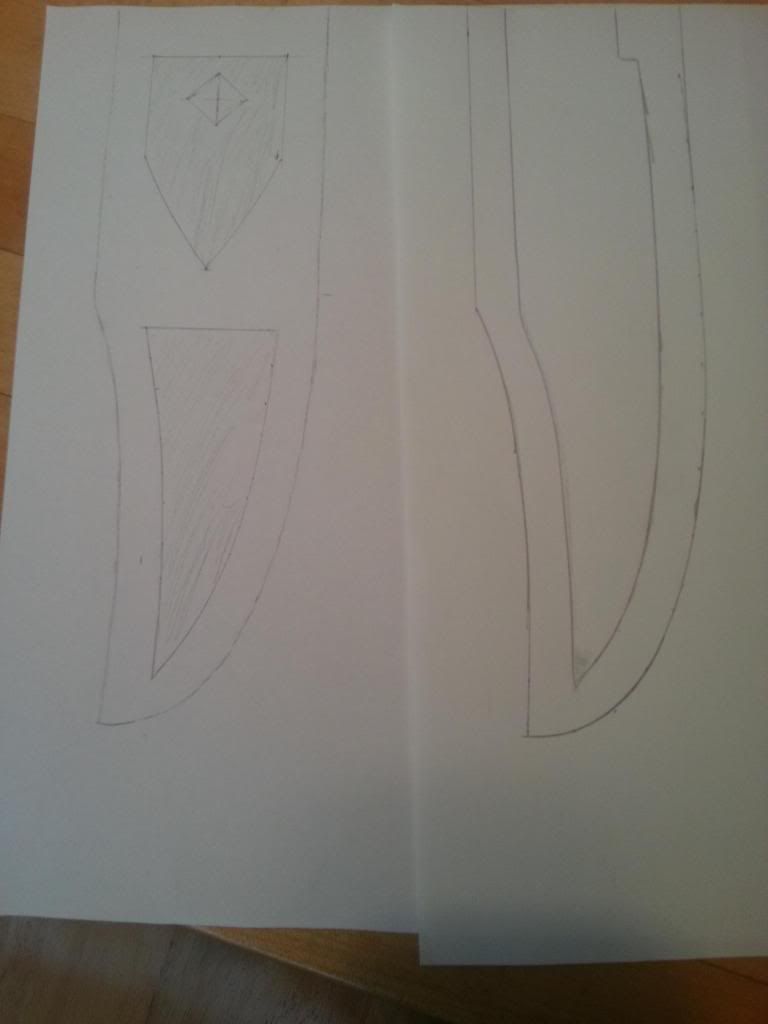
When I ordered a lot of things for the first sheath I made I bought a basket weave stamp, part of me is considering basket weaving the face of this but that might be a bit TOO ambitious. I'm debating adding a strap and/or snap to go over the guard. It's not going to be carried I already asked and there's no need to put a belt loop on it. It'll just be for presentation basically. I just don't know if it'll sit snug enough in there without one. I've onlu made a pouch sheath and this will be yet another first just like the knife itself.
So I drew out the sheath today, I'm still on the hunt for my Chuck Burrows custom knife sheath video. Should turn up eventually. I consider leather working my weakest part of the game (not that I really consider anything necessarily strong either
). But I've made exactly one sheath and I like to push for glory as I'm going for on this one.... So I scrapped the idea of making a triangle because I didn't like the way it looked so I modified it a bit to keep with the theme I want to do. Then I decided to "jazz" it up a little bit. I'm open to thoughts or suggestions. The dark areas are where the stingray inlay will be and the diamond at the top will be the star, I'm figuring it's easier to just find a picture of a star online and print it out then shrink it to size unless I find a star template somewhere. Free handing them never works out for me. 
When I ordered a lot of things for the first sheath I made I bought a basket weave stamp, part of me is considering basket weaving the face of this but that might be a bit TOO ambitious. I'm debating adding a strap and/or snap to go over the guard. It's not going to be carried I already asked and there's no need to put a belt loop on it. It'll just be for presentation basically. I just don't know if it'll sit snug enough in there without one. I've onlu made a pouch sheath and this will be yet another first just like the knife itself.
- Joined
- Sep 29, 2009
- Messages
- 1,614
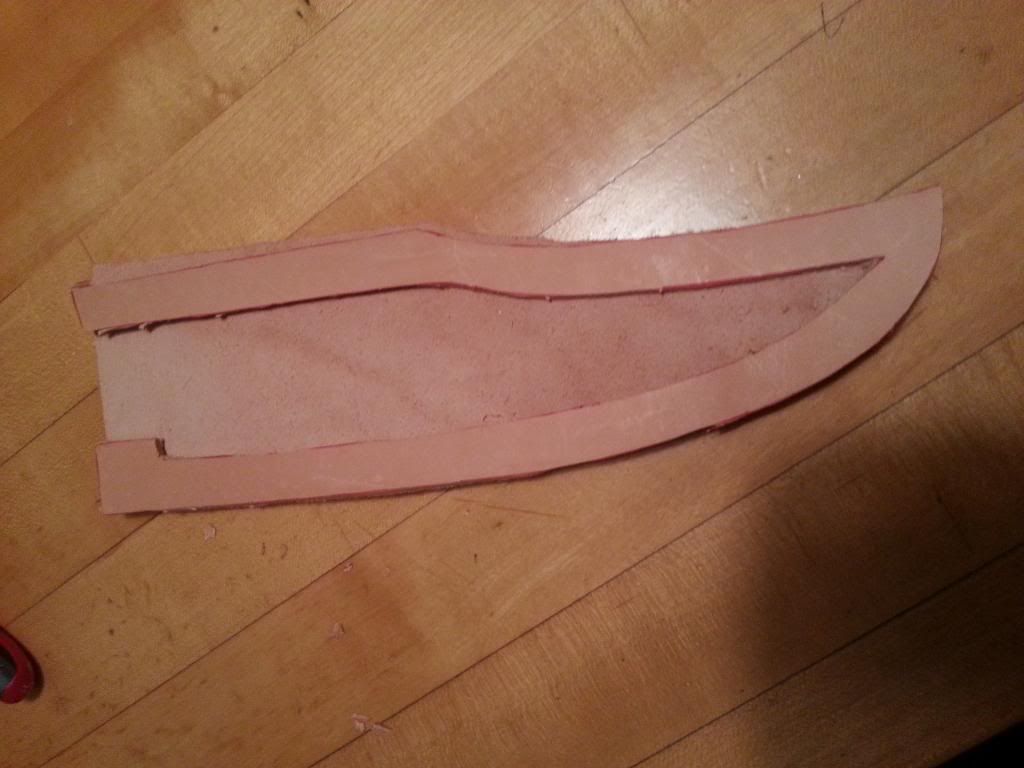
I cut out the back and the welt tonight but haven't glued it up. (Still haven't found that video so I'm kinda winging it). I've only ever made a pouch sheath and I'm not sure but I should keep that "square" part at the top of the sheath by the blade in there right? Since I don't think I'm going to put a strap on it that goes over the guard I'm assuming that is going to be what helps the knife stay locked in the sheath isn't it? I just have to monkey with the welt to make sure everything fits tight around the blade. before I glue it up.

- Joined
- Sep 29, 2009
- Messages
- 1,614
Your throat has to be as wide as the widest part of the knife. If you assembled it how it is you wouldnt be able to insert the knife
So basically I need to follow the edge of the blade up to the top of the sheath then right?
- Joined
- Sep 29, 2009
- Messages
- 1,614
So I don't screw it up, what about the construction makes the knife sit tightly in the sheath?
I know with a pouch sheath I did I wet formed it around it so it held it fairly snug in there. What keeps it tight in a design like this?
I know with a pouch sheath I did I wet formed it around it so it held it fairly snug in there. What keeps it tight in a design like this?

Stacy E. Apelt - Bladesmith
ilmarinen - MODERATOR
Moderator
Knifemaker / Craftsman / Service Provider
- Joined
- Aug 20, 2004
- Messages
- 38,447
Welt thickness and a close fit will make the sheath keep from being loose and slipping off too easily. Make the edge welt thinner than the spine welt. Do this by gluing it up as you have it in the photo, and after the glue (I use leatherweld) is dry, sand or shave down the welt at the edge to half the thickness of the spine. You can wet shape the sheath, too, if needed.
TIP:
Clamp the sheath parts between two boards while drying to assure the sheath doesn't "warp", and to assure a strong and invisible joint. Do the welt and back first, check the blade fit and trim if needed, then glue on the top side. Once the sheath is dry, sand the edges on the belt grinder to get a smooth and even edge. Sand before stitching! Use a sharp 120 grit belt to get it even and then a sharp 400 grit to get it smooth. Burnish with a hardwood slicker. Applying edge dressing after dying the sheath makes a very professional looking edge.
Normally, a properly fitted strap over the guard or around the handle retains the knife in the sheath. On bowies and other large blades that are not really going to be carried, I often make a half sheath like the one you have and call it a blade cover. A thong run through a hole in the spine corner of the sheath can be wrapped/tied around the handle/guard.
As you have been told, the throat has to be as wide as the widest part of the blade. Heavily curved blades need to have the clearance in the sheath worked out, too, or the blade will bind as it inserts/removes and cut the welt and stitching. Your bowie is fine as far as any curvature goes.
TIP:
Clamp the sheath parts between two boards while drying to assure the sheath doesn't "warp", and to assure a strong and invisible joint. Do the welt and back first, check the blade fit and trim if needed, then glue on the top side. Once the sheath is dry, sand the edges on the belt grinder to get a smooth and even edge. Sand before stitching! Use a sharp 120 grit belt to get it even and then a sharp 400 grit to get it smooth. Burnish with a hardwood slicker. Applying edge dressing after dying the sheath makes a very professional looking edge.
Normally, a properly fitted strap over the guard or around the handle retains the knife in the sheath. On bowies and other large blades that are not really going to be carried, I often make a half sheath like the one you have and call it a blade cover. A thong run through a hole in the spine corner of the sheath can be wrapped/tied around the handle/guard.
As you have been told, the throat has to be as wide as the widest part of the blade. Heavily curved blades need to have the clearance in the sheath worked out, too, or the blade will bind as it inserts/removes and cut the welt and stitching. Your bowie is fine as far as any curvature goes.
- Joined
- Sep 29, 2009
- Messages
- 1,614
I have a skive tool I'm assuming I can use that to shave down the welt as well right? Or is it better to sand it?
Stacy E. Apelt - Bladesmith
ilmarinen - MODERATOR
Moderator
Knifemaker / Craftsman / Service Provider
- Joined
- Aug 20, 2004
- Messages
- 38,447
Shave it with a skive or a leather knife, or sand it, ... whichever is easier for you. One note is to carefully blow out the sheath after any sanding to remove possible stray grit. You can imagine the words that people say when they stick a perfectly polished knife in a sheath and pull it out with a big scratch.

- Joined
- Mar 10, 2013
- Messages
- 1,074
You could do a "frog" style sheath ,wherein a half sheath or blade cover is inserted into a special holder that goes on the belt ,known as a "frog"
- Joined
- Sep 29, 2009
- Messages
- 1,614
You could do a "frog" style sheath ,wherein a half sheath or blade cover is inserted into a special holder that goes on the belt ,known as a "frog"
Interesting thought Eric, (had to google that honestly). Two things though:
-I have no idea what that "stud" is called or even where to locate one on Tandy's website. Although I now know why people like Nick puts them on some of the sheaths he makes I never really knew what they were for.
-The other being with the design I have on the sheath with the stingray inlay I'm not sure if I'd be able, or have the skills to allow it to show through. My only other option I think is to bury it in the frog.Or somehow design the frog to show the inlay too.
Although it's a great idea just not sure how to design it.
Stacy E. Apelt - Bladesmith
ilmarinen - MODERATOR
Moderator
Knifemaker / Craftsman / Service Provider
- Joined
- Aug 20, 2004
- Messages
- 38,447
Since this is a display/collectable blade, and frankly will never be carried, a frog or user style sheath isn't really needed. Any sheath you make should stay simple. Also, remember to advise the owner NOT to store the knife in the sheath, as this may lead to rust and corrosion.
With what you've said about the recipient and the knife being a special gift, I wouldn't make a sheath or blade cover at all for this knife. I would purchase a nice "Bill's" case to hold the knife in transport and build a lovely display stand to show it off.
http://www.billscustomcases.com/index.html
With what you've said about the recipient and the knife being a special gift, I wouldn't make a sheath or blade cover at all for this knife. I would purchase a nice "Bill's" case to hold the knife in transport and build a lovely display stand to show it off.
http://www.billscustomcases.com/index.html
- Joined
- Sep 29, 2009
- Messages
- 1,614
Another good thought Stacy, although I'm kinda hell bent on making one partly for "completing" the build, but also just to say to myself that I could build the whole thing the way I envisioned it. I like the fact that he has ones that could hold the knife and has straps to hold the sheath outside the case I might look into that as well. Thanks again to everyone for their help and input on this as I go along a lot of good ideas have come from this, not only for this knife but also for future builds that hopefully wont take me as long
- Joined
- Sep 29, 2009
- Messages
- 1,614
Welt was glued in place tonight. Also cut out the front of the sheath and the cover for the inlay. Still needs to be sanded so the inlay portion is nice nice.
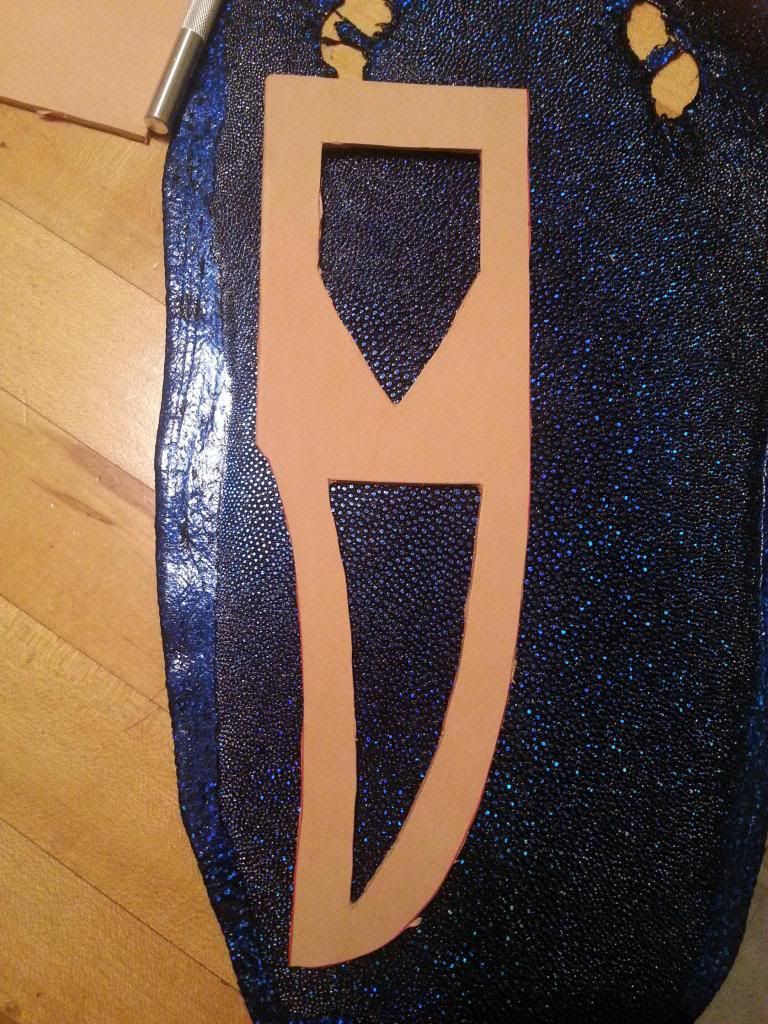
Now I could leave it like that or there is this white piece in the skin that I could center in the bottom part of the sheath like so...Not sure though what do you guy think?
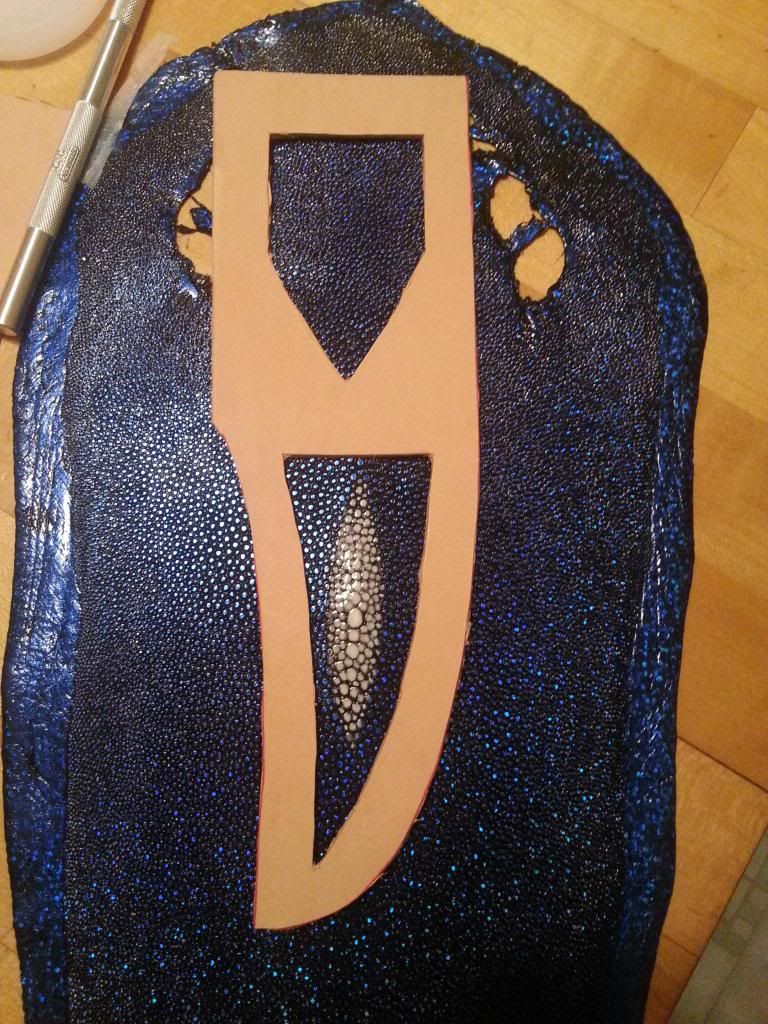
And essentially picture a white star in the top portion like this:
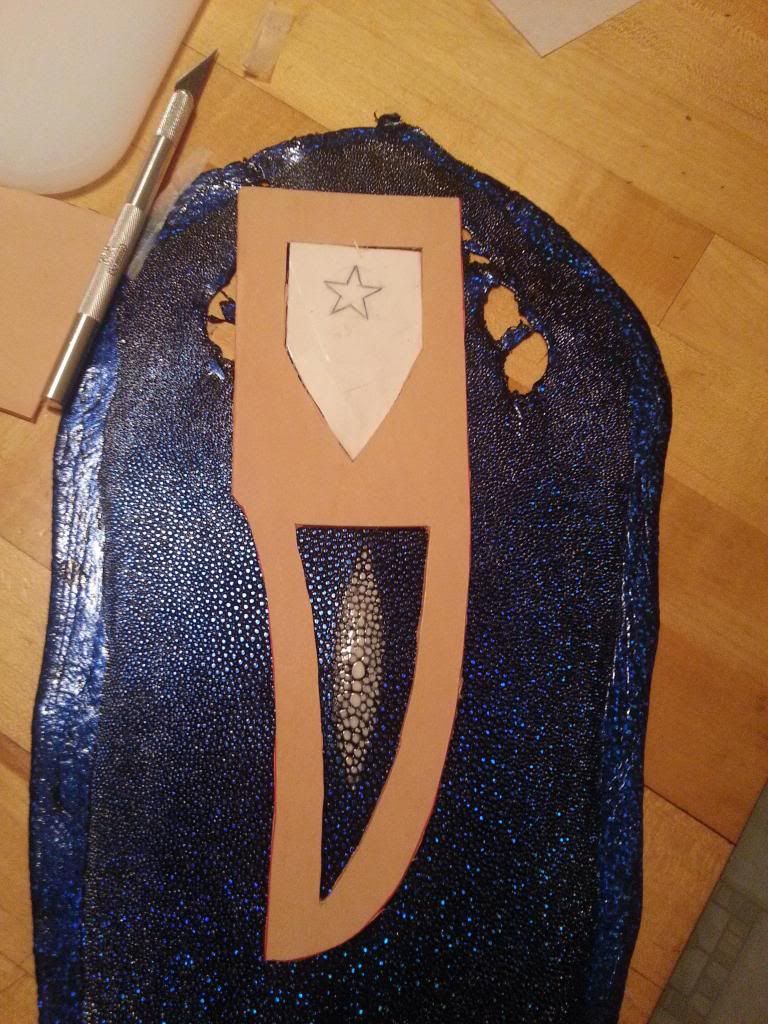
Now when I do the inlay I'm guessing I only need to cut it a wee bit bigger than the opening it's going to sit in correct?
Also all I really have which was recommended to me gluing up most things leather from a girl at Tandy was contact cement. I'm wondering/hoping contact cement will be enough to hold the cover piece to the stingray.... If not I've hit a wall lol.
EDIT: Aaaaand I just realized after un clamping the backing of the sheath there was some contact cement that somehow got on the outside of the sheath and left a glob on the top. Any tricks on how to get this out without screwing up the leather or leaving something that will show after I stain the leather?

Now I could leave it like that or there is this white piece in the skin that I could center in the bottom part of the sheath like so...Not sure though what do you guy think?

And essentially picture a white star in the top portion like this:

Now when I do the inlay I'm guessing I only need to cut it a wee bit bigger than the opening it's going to sit in correct?
Also all I really have which was recommended to me gluing up most things leather from a girl at Tandy was contact cement. I'm wondering/hoping contact cement will be enough to hold the cover piece to the stingray.... If not I've hit a wall lol.
EDIT: Aaaaand I just realized after un clamping the backing of the sheath there was some contact cement that somehow got on the outside of the sheath and left a glob on the top. Any tricks on how to get this out without screwing up the leather or leaving something that will show after I stain the leather?
Last edited:
- Joined
- Sep 29, 2009
- Messages
- 1,614
Lacquer thinner, acetone, and contact cement thinner will all get the blob off.
Will any of them affect the leather? I was looking around online and it seems that regardless the cement will seal the leather and the stain won't take like it will on the rest of the leather, which makes sense. I guess I'm wondering how much of a big deal it will make.
- Joined
- Mar 10, 2013
- Messages
- 1,074
What has made this an interesting thread is Fletch Helicals' willingness to listen and respect others' ideas ,while having ideas of his own as far as the over-all direction he wants the project to take .Refreshing,you might say !