
-
The BladeForums.com 2024 Traditional Knife is available! Price is $250 ea (shipped within CONUS).
Order here: https://www.bladeforums.com/help/2024-traditional/
You are using an out of date browser. It may not display this or other websites correctly.
You should upgrade or use an alternative browser.
You should upgrade or use an alternative browser.
My first knife: as I do each step and post pics, feel free to critique my work.
- Thread starter chemistguy
- Start date
- Joined
- May 28, 2013
- Messages
- 308
What good is chemistry knowledge if you can't apply it.
They sell temperature crayon sticks formulated at many many temp points too
yeah obviously I'm not well acquainted with high temperature stuff. lol, NaCl is just under where I want to be, that's really easy. nice.
Hit it with a hammer
thanks, brilliant....... i was thinking there might be a good way to do a lot of it quickly without making a huge mess and without crushing it it all into dust.
Last edited:


- Joined
- Jul 7, 2013
- Messages
- 2,614
Why would you ask for critique of your project in the title of your post, and then ignore the feedback that you are getting? It seems to me that there are very knowledgable people here that are trying to help you out.
- Joined
- May 28, 2013
- Messages
- 308
I finished the grind down to a nice and thin .04" and then went out to the forge.
The two normalizing cycles went fine. When I dropped it in the snow by accident and had to do the normalizing again, it didn't seem bent at all. Then I hardened and apparently it wasn't hot enough; a file bit into it a little. It's also really hard to get an even heat.
When I stuck it in to harden again (should I have normalized twice again?), it burnt through part of the edge about 2 inches from the tip, making about a quarter inch round notch. Ruined. It also came out extremely bent to one side, which I think happened because I dropped it in the snow at the end by accident when it was still pretty hot - or when I overheated it.
I still tried heating and quenching it, and this time it did get hard (the file pretty much just skated over it), but it didn't seem to sharpen and seemed chippy I think. I used some Kosher salt to estimate the temperature but it was difficult to use right before a quench.
I can probably still save 3 or 4 inches of blade length if I anneal it and cut it again.
At least I saved a plywood template!
My blower wasn't strong enough so I used a shop vac, just pointing it at the hole in the pipe to modulate airflow. I should probably get a cheap 3 speed hairdryer.
The two normalizing cycles went fine. When I dropped it in the snow by accident and had to do the normalizing again, it didn't seem bent at all. Then I hardened and apparently it wasn't hot enough; a file bit into it a little. It's also really hard to get an even heat.
When I stuck it in to harden again (should I have normalized twice again?), it burnt through part of the edge about 2 inches from the tip, making about a quarter inch round notch. Ruined. It also came out extremely bent to one side, which I think happened because I dropped it in the snow at the end by accident when it was still pretty hot - or when I overheated it.
I still tried heating and quenching it, and this time it did get hard (the file pretty much just skated over it), but it didn't seem to sharpen and seemed chippy I think. I used some Kosher salt to estimate the temperature but it was difficult to use right before a quench.
I can probably still save 3 or 4 inches of blade length if I anneal it and cut it again.
At least I saved a plywood template!
My blower wasn't strong enough so I used a shop vac, just pointing it at the hole in the pipe to modulate airflow. I should probably get a cheap 3 speed hairdryer.
Last edited:
- Joined
- May 28, 2013
- Messages
- 308
maybe I should just send out a batch for heat treat...
Where is good? I've heard Peters (Pennsylvania) and Bos (Ohio) are the best.
If you do a batch for a discount do they have to be the same thickness or just the same steel?
There's a local place but I don't know if they do knives or just things like automotive parts.
http://www.elmiraht.com/Home.html
Where is good? I've heard Peters (Pennsylvania) and Bos (Ohio) are the best.
If you do a batch for a discount do they have to be the same thickness or just the same steel?
There's a local place but I don't know if they do knives or just things like automotive parts.
http://www.elmiraht.com/Home.html
Last edited:

- Joined
- Aug 31, 2011
- Messages
- 3,125
so scales are typically each 1/4" thick for a total of about 1/2"?
I guess I'll do a plywood/plastic/whatever mockup of the knife and find out what fits best.
I think I want to do a full flat grind.
also, how thick an edge do you leave before HT? I was thinking about 1.5 mm. I plan to HT myself with my forge. how would you HT the butt with a small forge? I'm worried about softening the blade if I quench the blade first and then reheat at the butt. maybe a torch?
I have been leaving my edge a standard .33 mm before heat treat. That is .013". No problems, but then I have done mostly air quench steels.
With 1/8" bar stock, I like to have 1/4" scales. That is plenty of overall thickness, IMO. Anything more, and I just end up planing off more scale material.
- Joined
- May 28, 2013
- Messages
- 308
Do you send your blades out for heat treat? What kind of planer do you use?
I just learned a planer is called a "thicknesser" in the UK and Australia... oh lawd
I just learned a planer is called a "thicknesser" in the UK and Australia... oh lawd
- Joined
- Aug 31, 2011
- Messages
- 3,125
I just use a block plane: I set the wood on my bench and hand-plane it.
I have size SM hands, so I tend to make perhaps thinner handles than most. I tend to proportion handles according to my own hands, because my hands are right there handy.
I have been sending blades to Paul Bos in Post Falls, Idaho, for heat treatment. His information is on the Buck Knives web site. Before that, I was sending my blades to Texas Knifemakers Supply, but I got some bad results and stopped using their services.
I have size SM hands, so I tend to make perhaps thinner handles than most. I tend to proportion handles according to my own hands, because my hands are right there handy.
I have been sending blades to Paul Bos in Post Falls, Idaho, for heat treatment. His information is on the Buck Knives web site. Before that, I was sending my blades to Texas Knifemakers Supply, but I got some bad results and stopped using their services.

- Joined
- May 2, 2013
- Messages
- 1,711
Based on the above post, and several comments that you have made in other threads, I think you are severely over thinking this whole process. All of this melting salt, fumbling tools, blower not being enough stuff.... Simplify it. First off, melting salt doesn't tell you anything except for the fact your fire is AT LEAST hot enough to melt salt. Nothing about how much hotter than that it could possibly be. A magnet is a much easier, less messy way of telling if your steel is up to temp.
Let's simplify this as much as possible. You need to heat the steel to non-magnetic then just a shade or two more, then quench it quickly. The quench needs to be fairly quick, but not so fast that you should be dropping tools, or dangerously handling the steel. Have your quenchant of choice close to your forge so you don't have to make any extra movements to get it there, and you should be able to do so plenty fast. If you are concerned about the process or think you won't get it done properly, practice with some scrap steel. If you want, you can take a billet of steel, practice annealing, normalizing, hardening, tempering etc etc etc with that. That's the great thing about steel, you can work it over and over and over... Then go to work on the blank you have spent so much time cutting out...
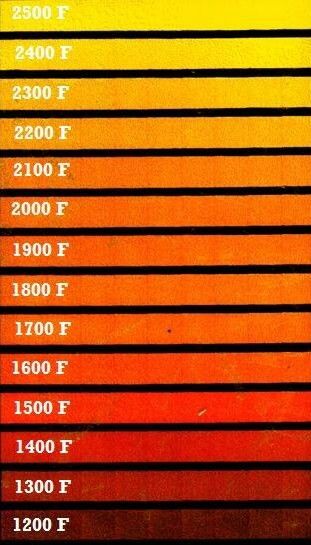
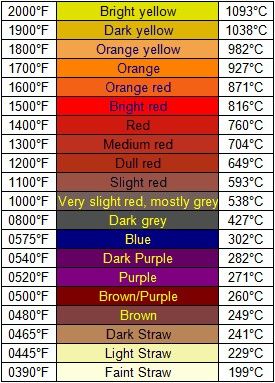
Look, humans have been working steel for ages. Long before there were thermocouples, or really any other way to accurately gauge temperature. They did it by color, and experience. If you are going to insist on knowing the exact temperature of things, and have to make it as scientific as possible, then go get a quality thermocouple and display or multi-meter that will read temps to at least 2000f. There are infrared thermometers that read that high as well, but they are rather pricey. Keep a magnet near your forge, and pull the steel to check it against the magnet. You should be checking it for evenness of color at the same time. Simple...
In my time I have studied literature, music, history, physics, biology, chemistry, mathematics, etc etc etc, hold advanced degrees, and I consider myself a fairly smart guy. I too was insistent on over analyzing the process and needing to know the specifics when I first started. It took simplifying this to its basics for it to click. I posted this chart next to my forge... It isn't perfect, and none of them are, but it at least gives you an idea of the gradient.
Here is one that even has the lower oxidation colors on it. And as you can see, there is some variation between the two charts. This is where you the magnet, scrap steel, and developing your eye comes into play...
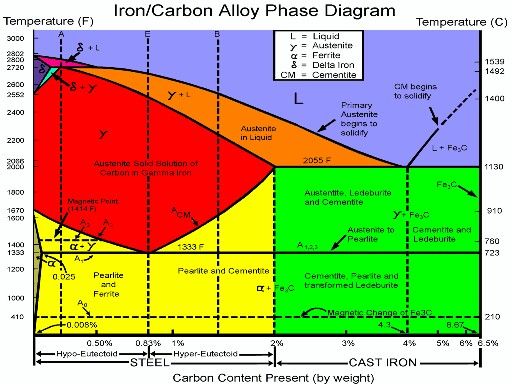
And if you absolutely need a visual way to understand the science of what is going on... Here, this is also posted in my shop...
I can tell you are eager to learn all this, and eager to share some knowledge. But, do yourself a favor and slow down, break it down to the basics, and develop your craft. Traditional education dictates that a foundation of knowledge be laid, and built from. This is the foundation you need to learn if you choose to keep doing the hot-work for yourself. There is no getting around the 'feel' and 'eye' that need to be developed even if the science is committed to memory.
--And just to add, it only takes a small blower to feed oxygen to a coal forge. A shop vac should be way too much. If you aren't getting the heat you need out of a small blower, then you either have an obstruction or the the forge isn't constructed properly.
Let's simplify this as much as possible. You need to heat the steel to non-magnetic then just a shade or two more, then quench it quickly. The quench needs to be fairly quick, but not so fast that you should be dropping tools, or dangerously handling the steel. Have your quenchant of choice close to your forge so you don't have to make any extra movements to get it there, and you should be able to do so plenty fast. If you are concerned about the process or think you won't get it done properly, practice with some scrap steel. If you want, you can take a billet of steel, practice annealing, normalizing, hardening, tempering etc etc etc with that. That's the great thing about steel, you can work it over and over and over... Then go to work on the blank you have spent so much time cutting out...
Look, humans have been working steel for ages. Long before there were thermocouples, or really any other way to accurately gauge temperature. They did it by color, and experience. If you are going to insist on knowing the exact temperature of things, and have to make it as scientific as possible, then go get a quality thermocouple and display or multi-meter that will read temps to at least 2000f. There are infrared thermometers that read that high as well, but they are rather pricey. Keep a magnet near your forge, and pull the steel to check it against the magnet. You should be checking it for evenness of color at the same time. Simple...
In my time I have studied literature, music, history, physics, biology, chemistry, mathematics, etc etc etc, hold advanced degrees, and I consider myself a fairly smart guy. I too was insistent on over analyzing the process and needing to know the specifics when I first started. It took simplifying this to its basics for it to click. I posted this chart next to my forge... It isn't perfect, and none of them are, but it at least gives you an idea of the gradient.
Here is one that even has the lower oxidation colors on it. And as you can see, there is some variation between the two charts. This is where you the magnet, scrap steel, and developing your eye comes into play...
And if you absolutely need a visual way to understand the science of what is going on... Here, this is also posted in my shop...
I can tell you are eager to learn all this, and eager to share some knowledge. But, do yourself a favor and slow down, break it down to the basics, and develop your craft. Traditional education dictates that a foundation of knowledge be laid, and built from. This is the foundation you need to learn if you choose to keep doing the hot-work for yourself. There is no getting around the 'feel' and 'eye' that need to be developed even if the science is committed to memory.
--And just to add, it only takes a small blower to feed oxygen to a coal forge. A shop vac should be way too much. If you aren't getting the heat you need out of a small blower, then you either have an obstruction or the the forge isn't constructed properly.
Also how small should I break my lump charcoal, and is there an easy way to process a lot of it into smaller pieces?
Thanks.[/QUOTE]
There is a reason charcoal cutting is one of the first things an apprentice is taught. Processing fuel efficiently and not reducing it to all to dust for one. Hitting it with a hammer is beyond crude. for heat treating 3/4 inch cubes will be fine, or smaller for such a little blade. Every thing has a use even the fines. The bark is generally discarded. http://www.youtube.com/watch?v=_jwUl3Z2-cc
Thanks.[/QUOTE]
There is a reason charcoal cutting is one of the first things an apprentice is taught. Processing fuel efficiently and not reducing it to all to dust for one. Hitting it with a hammer is beyond crude. for heat treating 3/4 inch cubes will be fine, or smaller for such a little blade. Every thing has a use even the fines. The bark is generally discarded. http://www.youtube.com/watch?v=_jwUl3Z2-cc
- Joined
- May 2, 2013
- Messages
- 1,711
I'm pretty sure the hammer hitting comment was a joke, but... Good video. I guess there really is a video tutorial for everything...  )
)
)
Last edited: