My first knife - Getting closer, what grit to heat treat?

i4Mark,

Thanks for the thoughtful post. When I first got into this fix I thought if I don't get the basics right, how can I fix issues. The thinking was, it takes more skill to fix "issues" than to do the basic work, especially all by hand.

I'll give your ideas some work and see what I can do. I broke a chain saw file getting the choil in there. I'll get some more & be more gentile this time. I like the idea, I just have to do it in a manor that does not angle to the spine again. Maybe the Choil gets bigger so the plunge line is not 1/8" behind it? We will see. I'll work on it and maybe save it.

I'm going to get that tip pointy too!


Stacy,

Thank you too, your insight has been a big help!!
 
I believe the feature you are referring to is a Spanish Notch not a choil. I think the choil is the rear edge of the blade just in front of your finger. First thing to do is get the ricasso thinned down a bit so that the plunge doesn't run off the top then the trick with the chainsaw file is how you apply the pressure. Naturally, you want to go slowly and avoid taking material off the top of the blade. So staying tight to the guide, take small licking strokes concentrating mild pressure mid blade towards cutting edge. Don't hog away at it. take a stroke or two then look to see where the material is being removed and repeat. You don't want to go too far before discovering a mistake. Take a look at these videos to see if it helps at all.

https://www.youtube.com/watch?v=baYu1Yyzr-o

https://www.youtube.com/watch?v=hGhXvjG19CM
 
A Spanish notch is a common name for a choil. Some Spanish notches are very ornate, and even spiraled. A choil is an unsharpened or indented place where the edge meets the tang/ricasso. On a folder blade, the indent where the ricasso meets the round tang is also a choil.

What is often called a choil ...and isn't... is a finger groove at the front of the handle.
 
Those videos were very helpful. I wish I would have found those before starting the filing on this project.

I went to the hardware store today and bought every size chainsaw file they had. I'll get back on the project in a day or two and see if I can get the tang sanded down thinner and then work on the plunge lines with the new files and info.

Thanks again everyone, all the comments have been a big help.
 
Not bad, I'd finish it out.Make a nice handle, make it sharp ,and know one will notice.You're at a cross roads where many quite.Good luck. Lu.
I agree !! I am not too good at this hobby yet, but completing your first knife all the way through is a very important step.
My first couple were defiantly imperfect, but I learned tons. Keep going !!
 
So,

I spent some time (an eternity) draw filing and sanding and finally got the grooves out of the top of the spine from the wreckage I call my plunge lines. I did use the chain saw file and tried to do as I learned in the video. It made things better.

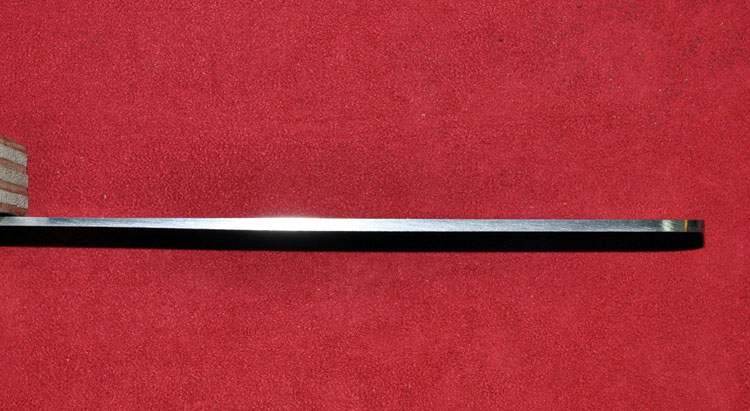
In doing the draw filing, the ricaso and blade are noticeably thinner than the rest of the tang of the knife. I took a few photos of where I had to stop today. I have used almost all of a pack of 100 grit sandpaper and am about finished with a pack of 150 grit sandpaper for one side of the blade. (my grooves run deep!)

My real question for today is, should I try to get the rest of the tang as thin as the ricaso area? I don't have calipers at this point. I did attempt a photo of the two points for reference.

If in fact the rest of the tang needs to be thinned down, how would I best go about it with these choices:

  • File
  • Sandpaper
  • Orbital Sander


I may pick up a dial caliper soon just so I can get some real idea of what I'm doing. For all I know my edge is too thin to survive heat treating. It's 01 steel so I don't know how thin it could be and survive, or how thin it is right now.

I also know there is a ton of work to do still on the blade as well, but had to stop for the day.

Hope these photos give some idea & thanks for any continued input.

zo85reb.jpg
[/IMG]

EvuIU6P.jpg
[/IMG]

9VqUxmH.jpg
[/IMG]

UVy36Eq.jpg
[/IMG]
 
Hmmmmm. This is a tough one. Your plunges are looking pretty good. As far as the tang being thicker now, you can proceed in a couple of ways. If you are obsessive and possess a touch of OCD then you will have to make the tang thinner to match the ricasso. If that is the option you choose, here is what I might do if it were MY project. With the limited tools you have to work with I'd try to get as much work done with the RA sander as possible. But here is how I'd go about it. You want the tang to be flat and even when you're done sanding it. If you just clamp the blade in a vise and attack it with the sander you will get very uneven results with rounded edges. I would use carpet tape which is double sided very strong adhesive and stick the knife down to something solid and flat. Butting up on each side of the tang I would stick down scrap bars of the same steel you're using for your knife in the same thickness. This will keep the sander from rolling over the edges. Use the sander as flat as you can and keep it moving it controlled passes down the tang. Don't press too hard with the sander or it will press into the gaps and soften your edges. Use light pressure and let the sander do the work. Don't run over the ricasso. Do the same number of passes on each side. Stop before the tang gets as thin as the ricasso. You are just trying to remove excess material quickly. Then I'd use double stick tape or spray adhesive to mount sheets of sandpaper to a granite surface plate or large flat marble tile or thick piece of glass. Do your fine sanding on that plate to flatten everything out and make your thicknesses match.

The other option to consider is just to blend the ricasso into the tang under the handle on a flat surface like a thick piece of glass. I don't think you need to worry about the different thicknesses as long as your handle material has a flat mating surface. That way you won't have gaps showing after glue-up. You can aspire to perfection which is a good thing. But be realistic about your circumstances. You have limited supplies and experience. When you are new to this the main take away is the lessons you learn not the knife.
 
@iMarc4

I have done about all the corrective work that I think I care to on this blade. I did take your advise and take just a small amount of thickness off the tang. Anal and OCD only hint at the level of perfection that I would typically live with. At this point, I feel as if I am playing golf with lawn tools and just keep hitting the ball back and forth over the green.

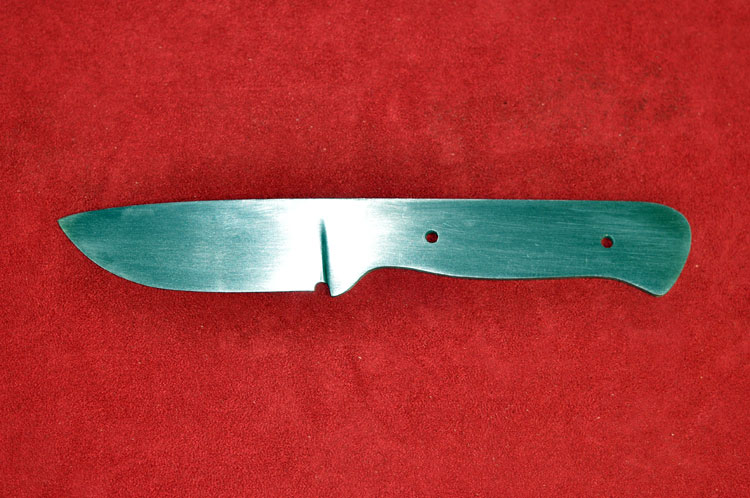
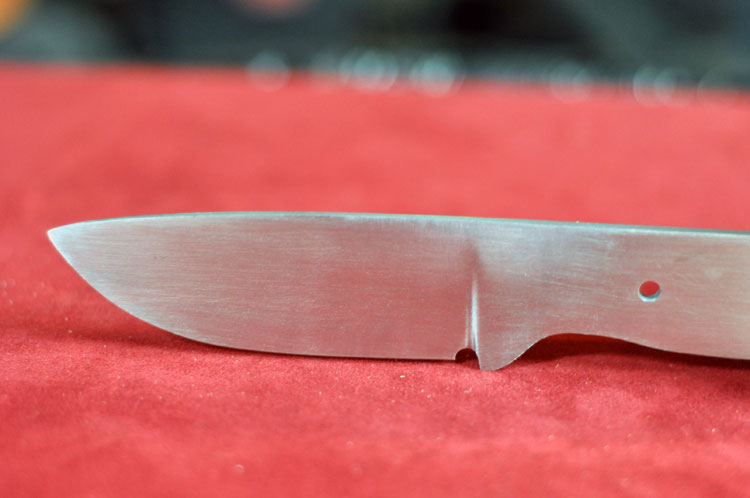
I am not really happy with any aspect of this "blade", but I do realize it is a first attempt with hand tools. My real question at the moment is, what grit sandpaper is appropriate prior to heat treating this - given the state of things.

From the ricaso to the tip, I have used 150 grit. I initially went lengthwise, then did a round from spine to edge. Mostly to get out the lines left when I used the chainsaw file to fix the plunge lines & grooves. I tried to do as Nick Wheeler said and not change any direction until no lines could be seen of the prior direction. Lastly I sanded again lengthwise. This time I also hit the tang, just to have everything flowing the same direction.

Should I move up to 220 grit before HT? Do more sanding at 150? I know the plunges will never look right on this project, but I don't want to leave it too half done either.

Photos are where I stopped today. As always, thanks for the help and any additional input. I do appreciate you putting up with my newbie questions.

8fgE2HQ.jpg


I2oLI6v.jpg


RNTd5ZI.jpg


YdI1WYe.jpg
 
DNickell,

I don't mind your newbie questions and I don't think anyone else does either. That is the circle of life around here. We were all newbs once and we asked most of the same questions you are asking. We learn and gain wisdom and experience then we pass it along to those who come up behind us. They in turn pay it forward to those coming up behind them. You will be helping others in no time.

Some people may advise going a bit higher with the grits before HT, maybe 220-320ish. I think this has a lot to do with it being easier to remove metal pre HT then after the blade is hardened. The more finished you can get it now the better. But realistically you are going to have to grind again after HT anyway. I usually stop at 100x before HT. It's a lot more work after HT but this is MY way. Your blade looks very good now. I know you don't like the way it looks at the moment. Keep in mind, there is a lot more meat on a knife than you think. There is plenty of material on that blade to correct thicknesses, true up plunge lines, make transition lines crisp, change the profile, etc. The fact that some of your edges are soft is probably a good thing because it will cause less stress on the blade during HT. Heat treat the blade the way it is now. You should be fine. Then after the blade is heat treated and tempered you can do all your clean up including making your plunge lines crisp. Don't worry about the different thickness of the tang. Just make sure the surface around the edges is smooth and transitions well with the ricasso. You can even hollow out a pocket in the tang to hold more epoxy. Just stay away from the edges. When you glue up your handle slabs and clamp them, they should follow the contour of the tang and give you a seamless joint. You're doing fine. This will be a very nice knife.
 
Thank you for the tips.

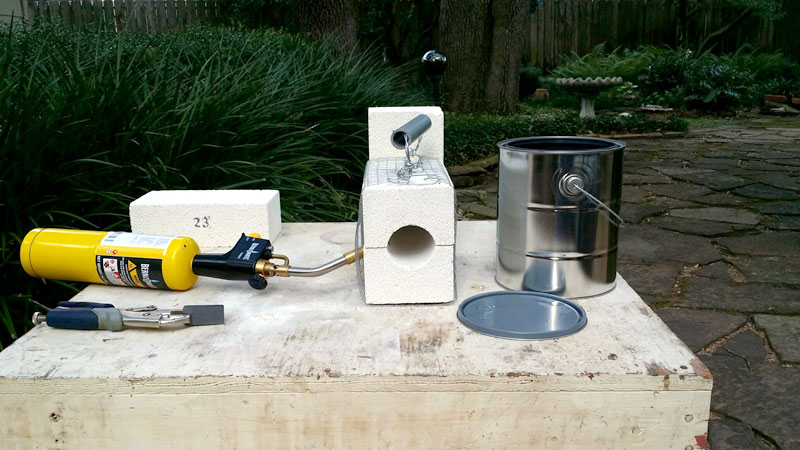
I now have to build my first "forge. I have 4 soft fire bricks and a large propane tank with a hose. I need to get a proper nozzle / torch tip for it. I am again using Aaron Gough's video on a small 2 brick forge for this. Will probably quench in vegetable oil.

After the HT, I'll watch some video's & see where to start back with the blade. I have watched so many video's and read so many articles I find I have to look them up again for each stage. I'm sure I will have more questions. I know I have to grind / file the edge some more. I am hoping there is a way I can clean up the plunge lines with my tools & skill level. Time will tell!

Thank you again...... I'm off to find a torch tip
 
Canola oil at 130 degrees has worked well for myself and others. Having the oil at temp does help. I bought a cheap one coil hotplate to heat the oil in its pan.
 
The oil temperature is somewhat important. The oil volume is very important. A gallon is the minimum to quench in. The temperature I usually recommend is 120F, but anywhere between 110 and 130F will work just fine with canola oil.
 
Thanks for the HT info.

I bought one of those "new never been used silver" paint cans, thinking it has a lid on it & could be sealed and reused. I'm wondering now if it is going to be enough oil to quench in?

Also, if I only ever make one knife, I got over a gallon of funky canola oil to get rid of.

Hmmm
 
You can get away with less oil, but the risk of having an insufficient quench increases. A paint can of oil would be fine for a small blade.

Trust us, this won't likely be your only knife.
 
Make this and file yourself a nice knife.
https://youtu.be/r9iNDRwwBQQ

DNickel , you can make prefect plunge line from both side and choil will be symmetrical and in the right place if you use round file on that tool .Under any angle and length you want ....

214j95.jpg
[/IMG]
28a82op.jpg
[/IMG]

Here are my tools for that . Left in the first picture is tool for final sharpening ,placed in another hole which is closer to stand for knive .
2jee1bn.jpg
[/IMG]
j9wzeu.jpg
[/IMG]
oi9fdx.jpg
[/IMG]
2cptdzo.jpg
[/IMG]

Best thing with this tool is that you can make knive from hardened steel if you use sandpaper .....even from steel like M2 on +64hrc , and you do not have to worry that you'll overheat steel.
You can even file perfect convex blade

34qpsty.jpg


344s374.jpg
[/IMG]

And by filing plunge first you avoiding this situation .. . .

2lifokx.png


PS . sorry , wrong post quote :)
 
Last edited:
Thank you. Do you understand how to use round file in this setup to make plunge line ? So ,after you mark on blank where will be plunge and when you start to grind with file adjust the angle of file .Once you have the right angle to file one side plunge you have the right angle to file the rest of the blade..... only you have to follow the center line ...
 
Natlek,

Yes I pretty sure you a saying what the videos show. i4Marc posted these links to videos showing what you are talking about. I didn't learn it until after my first screw up.

Links:

https://www.youtube.com/watch?v=baYu1Yyzr-o

https://www.youtube.com/watch?v=hGhXvjG19CM[/QUOTE]

I think in addition to this, I need to clamp a couple of pieces of steel to the blade at the place and angle I want my plunge lines. Then use the round / chain saw file to get my plunges cleaned up & to start future filing sessions.

Thanks for the info and photos!
 
Ok,

Yesterday I got the Heat Treating and tempering done.

Today I took a 2x4 and did as Stacey suggested before about using the bolt with wingnuts and sanding down the board to match the profile of the blade.

i4Marc, after sanding the scale off the blade with 150 grit sandpaper, I was looking at it over. The edge of the blade is really thin (to me at least) Right now I could sharpen it with very little effort. I have one (several) of those metal Westcott rulers and the edge of my blade is much thinner than the edge of the rulers.

So I was thinking about how to work on the plunge lines & how much more steel needs to be filed off from where..... and I can't see it at the moment. I have a set of digital calipers in transit to my house, should be here by Thurs evening. I think I'll wait until I get those and then get a better idea of how thick things are. Maybe go from there. I can tell my "grinds" are uneven. More off one side than the other, thanks to my over correcting on the plunge lines.

I also have some layout fluid, respirator, scribe and various things in the shipment. In case I ever do this again, I can try doing it right.

I also need to start thinking about handle material. The Marine in me wants to go all G10 Tacti-cool. But the handles are the only thing that have a chance of coming out right at this point. I have seen the tables full of nice wood they have out at Texas knife makers. I'm not sure which will be easier to work with, given my mostly hand tool stage of the game.

As always, thanks for the insight.. Here is a quick shot of my makeshift mini forge. It worked like a charm.

6WocFEo.jpg
 
Back
Top