Well after shaping the blade sharpening the blade welding the base on find some brass pins just plain pins from braizzing rod i sanded a burl maple block for 3 hours to place the epoxy inside and gently tap in the pins i must of forgot it was not a rail road spike in a hard wood tie and snapped the F___KIN block in half i am going to glue it anyway just to see what it coulda been like . i know where my problem was i never tried both pins at the same time before i epoxy the the handle.you would think i was swingin a 10 pound sledge after my wife cheated on me . F___k PI__ ME OFF. i hope you dont think im swearing cuzz im not . kellyw ps ill show the piece of crap if the epoxy holds

-
The BladeForums.com 2024 Traditional Knife is available! Price is $250 ea (shipped within CONUS).
Order here: https://www.bladeforums.com/help/2024-traditional/
You are using an out of date browser. It may not display this or other websites correctly.
You should upgrade or use an alternative browser.
You should upgrade or use an alternative browser.
my first knife MISTAKE
- Thread starter hellgap
- Start date


Stacy E. Apelt - Bladesmith
ilmarinen - MODERATOR
Moderator
Knifemaker / Craftsman / Service Provider
- Joined
- Aug 20, 2004
- Messages
- 38,694
This problem can be eliminated in the drilling stage.The trick is to temporally put in one pin, then run the drill through the second hole. This will allow the pins to be exact when glued up. The other thing is to have some extra room in the tang hole. I drill the blade tang with 3/16 to 1/4" holes for 1/8" pins. The pins should slide through the holes in the wood with very little binding. The epoxy will lock them in tight. I rarely ever peen pins.
Take the broken handle off and make a new one. It will be easier the second time.
Stacy
Take the broken handle off and make a new one. It will be easier the second time.
Stacy
Second what stacy said. gotta have one pin in when you drill the second hole. I drill mine before I shape the handles. I stack both scales under the knife with the tang holes already drilled, then drill through the tang holes down through both scales. No need to peen the pins.
well i did that i drilled the first hole then placed a pin in while i drilled the second hole . my problem was i needed a finger gaurd so i found some aluminum slab drilled it shaped it nice then had to accomidate the thickness of the gaurd so i had to sand the end of the handle an 1/8 of an inch so the pins would line up and i didnt check both pins at the smae time with the finger gaurd on so when i went to put the second pin in whenb it was full of epoxcy so then i tapped the pin and it was making contact with the maple and snapped on my third hit. oh well . the handle was really really nice but not now lol
the handle was drilled blind with the help of calipers and a lazer drill press it was a solid block with finger groves ill show it just a min i have stages in the making ill show pretty much just befor i broke it. i had it sanded down to 400 grit polished the blade some and was sharp
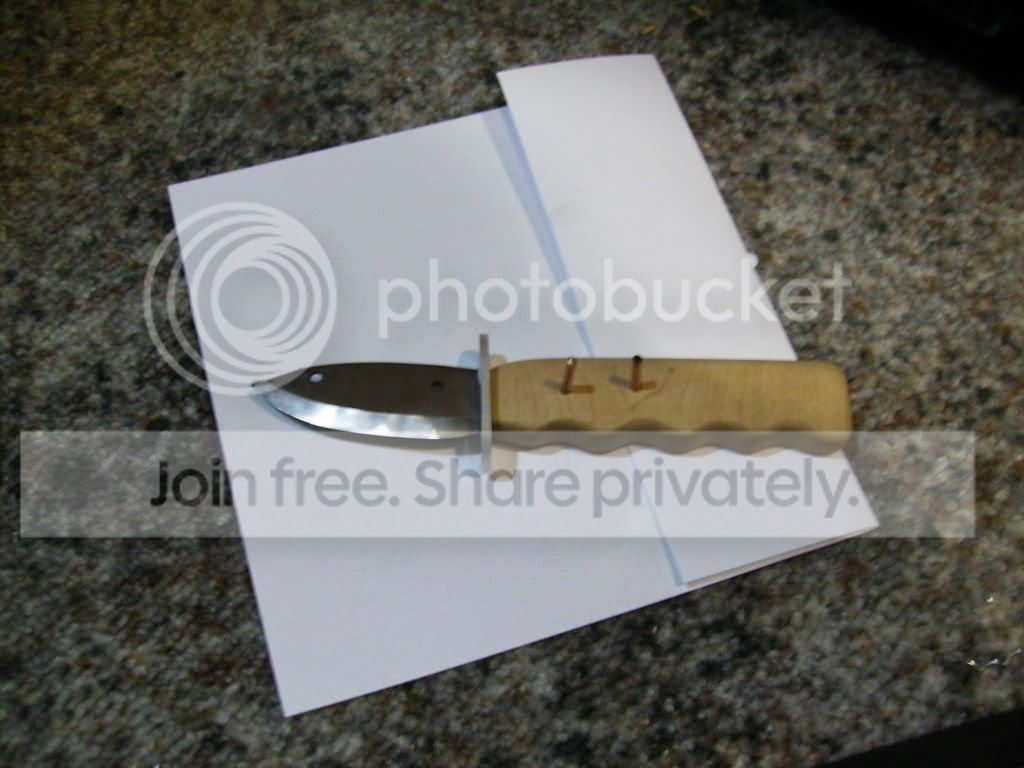
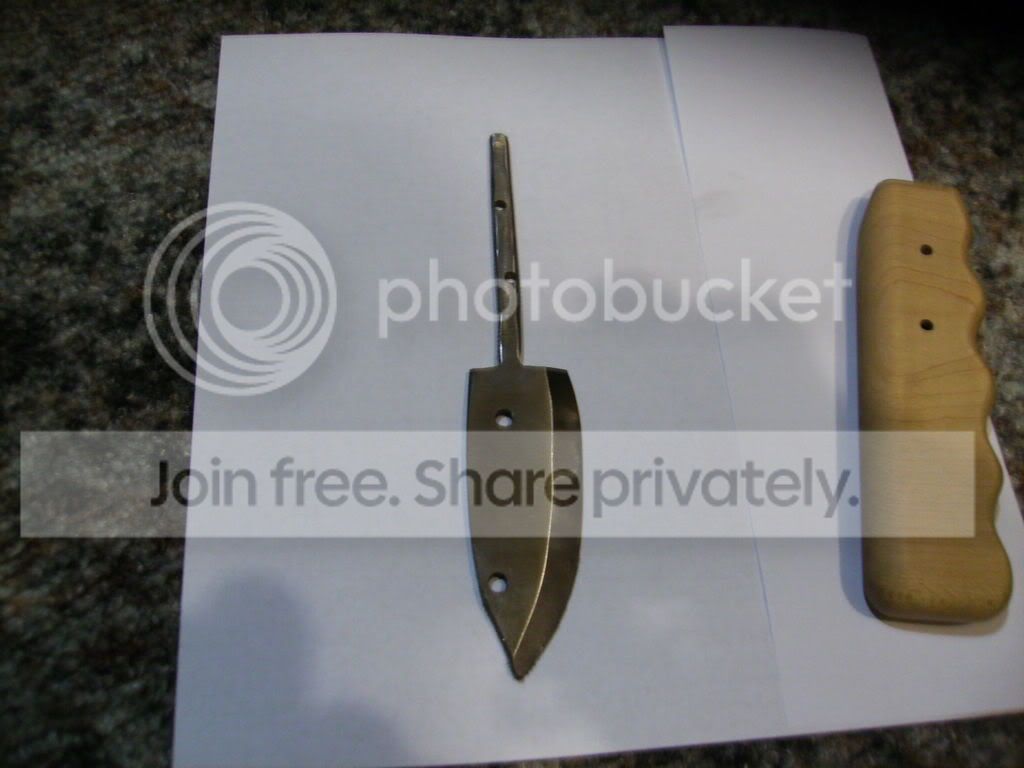
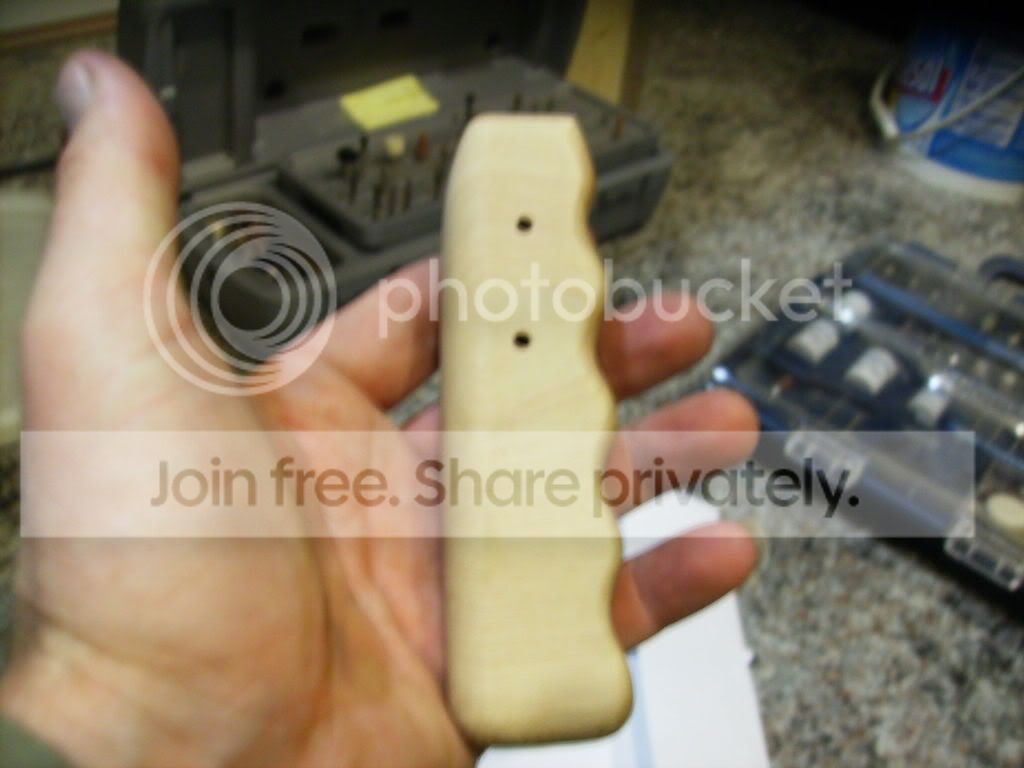
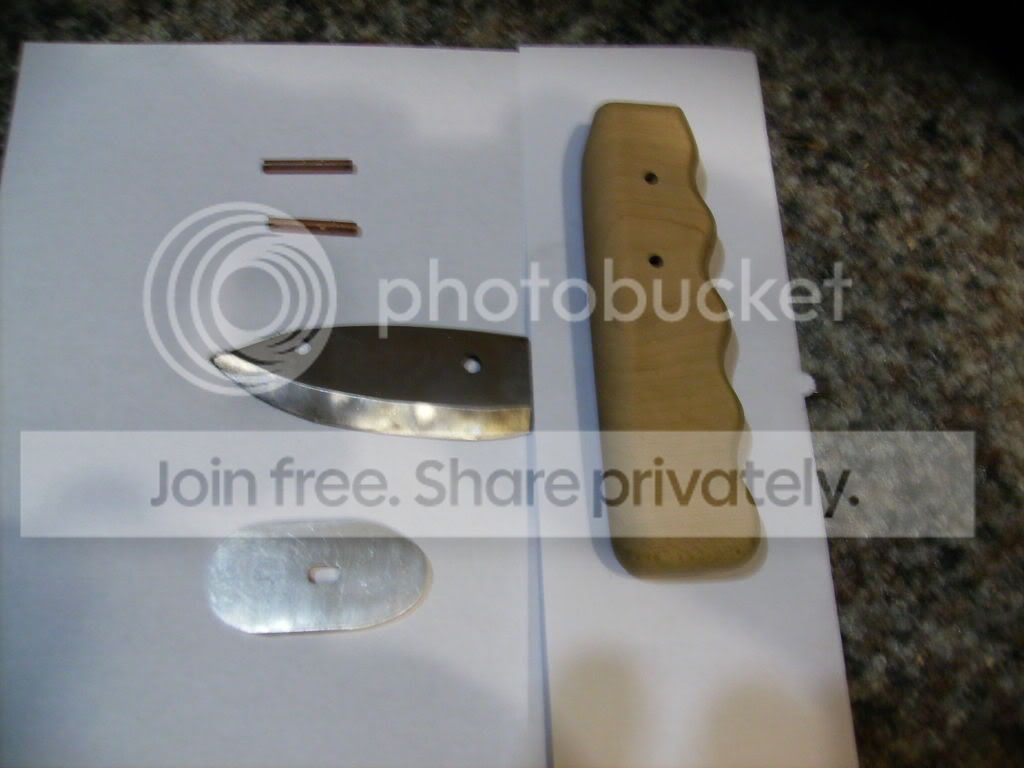
Bummer on cracking you handle man! It happens to the best of us though!  It'll be easier next time.
One thing I did note though is that you said you sharpened the blade first. Really, sharpening should be the LAST thing you do. It's far too easy to really hurt yourself badly working on a sharpened blade. If I'm working on something that is even just a little too close to sharp I grind the edge off first.
Take care and show us the new handle when it's done!
-d
It'll be easier next time.One thing I did note though is that you said you sharpened the blade first. Really, sharpening should be the LAST thing you do. It's far too easy to really hurt yourself badly working on a sharpened blade. If I'm working on something that is even just a little too close to sharp I grind the edge off first.
Take care and show us the new handle when it's done!
-d
- Joined
- Jul 28, 2006
- Messages
- 3,953
Well I would say it's your second mistake, your first was becoming a knifemaker!!!!  You KNOW it's a disease and yet you thought you could master the addiction.... HAH!!!!
How about cutting the block in half, gluing it back together or gluing it back together with some spacer material.
You KNOW it's a disease and yet you thought you could master the addiction.... HAH!!!! How about cutting the block in half, gluing it back together or gluing it back together with some spacer material.
Yeah I got a good size scar on my arm from working with a sharpened blank. For hidden tang knife like this I drill the holes to the pin diameter in the metal tang first, than drill holes into the inletted but unshapen(still square) scale, pinning each hole as compleated. Then I flip it over and drill the other scale wile keeping the previouse side still pinned, you need 3 pins or more for it to work well and a drill press. I have yet to have to drill an over size hole, everything goes together fairly tight though.
Last edited:


- Joined
- Mar 28, 2007
- Messages
- 1,171
Dang sorry to hear about that, but look on the brite side, It wasn't a high dollar piece of Ivory.
Keep making knives and you will keep making mistakes. The key is to learn from them.
Keep making knives and you will keep making mistakes. The key is to learn from them.

thanks for all the comments good or bad i need the truth and im not affraid to hear it. AK it wont bother me i made 2 knives the same ill give this one away and i have 4 blanks coming in the mail one is a damascus gut hook and the others are drop points and a skinner . some one say i caught the fever. i never jump in with one foot lol . here is another thing i have a grinder that i could attatch a felt buffing wheel too and use a buffing compound. i think the brown compound would be good ? would the grinder spin it to fast? i also have a dremel with a small buffer and some compound. i know you all are right i could shave with the blade and had to be carefull but it wasnt honed as sharp as it coulda been. ill have a look at the knife in the morning and see if i gotta give up on it or make a new handle. i think the handle woulda broke if some one was ruff with it anyway
Stacy E. Apelt - Bladesmith
ilmarinen - MODERATOR
Moderator
Knifemaker / Craftsman / Service Provider
- Joined
- Aug 20, 2004
- Messages
- 38,694
Stay away from buffers until you understand more about the knife making process.They are dangerous without the proper training and knowledge. A bench grinder is not the tool to convert into a buffer. It runs too fast and there is not proper clearance to work the blade safely.
Tape the blade with blue painters tape once it is shaped and ready for sharpening. This will protect the blade from scratches and damage......and you from the blade (and accidents and damage to You). Sharpening is the final step....after all else is done.
Generally, the guard is fitted before the handle is fitted.
Once all is ready, dry fit everything and check all joints for gaps and misfits. Pins should never need to be hammered into the holes. That will just about always guarantee a broken piece of wood.
As you read and learn more about knife blade design and heat treating steel, you will understand that there are several things which are problematic with the blade/tang shape and assembly procedures you used. Keep at it and read,read ,read. Posting a set of sketches and assembly procedures ,before you start on the steel ,will garner many good suggestions.....and may help avoid some problems.
Stacy
Tape the blade with blue painters tape once it is shaped and ready for sharpening. This will protect the blade from scratches and damage......and you from the blade (and accidents and damage to You). Sharpening is the final step....after all else is done.
Generally, the guard is fitted before the handle is fitted.
Once all is ready, dry fit everything and check all joints for gaps and misfits. Pins should never need to be hammered into the holes. That will just about always guarantee a broken piece of wood.
As you read and learn more about knife blade design and heat treating steel, you will understand that there are several things which are problematic with the blade/tang shape and assembly procedures you used. Keep at it and read,read ,read. Posting a set of sketches and assembly procedures ,before you start on the steel ,will garner many good suggestions.....and may help avoid some problems.
Stacy
thanks ill look into a buffer with a variable speed and a good plat form to work on I wasnt very prepared to make this knife but know at least i have plain brass pin material and did know better i had the holes lined up prior to making the finger gaurd but got in a panic to finish . the finger gaurd looks like shit to say the least and i never centred theknife to set in the epoxy . one good thing my friend owns a huge fabricating shop said go ahead and make a forge he said i got lots of scrap pipe. i think 12 inch diameter by 24 inches would be a good size i might make one off indian georges pattern with his permission i coppy it. my friend also has a bag or 2 of refractor cement hmmm hope he has a couple bricks too.thanks for the tips kellyw
- Joined
- Jul 28, 2006
- Messages
- 3,953
I do understand the anger part.... I've thown many a partially finished blade across the shop. But remember you do this as a craft and a hobby. Sometimes the best thing I find to do is take a deep breath or 10 (trying not to hyperventilate) and maybe a short walk or I'll clean up the shop or all 3 . Anger and frustration will only cloud your thinking and being a wreck mentally is a sure fire way to continue to wreck your work. I will keep repeating this. We're knife finishers, lots of people start, few finish.
. Anger and frustration will only cloud your thinking and being a wreck mentally is a sure fire way to continue to wreck your work. I will keep repeating this. We're knife finishers, lots of people start, few finish.
- Joined
- Oct 2, 2006
- Messages
- 3,238
thanks ill look into a buffer with a variable speed and a good plat form to work on I wasnt very prepared to make this knife but know at least i have plain brass pin material and did know better i had the holes lined up prior to making the finger gaurd but got in a panic to finish . the finger gaurd looks like shit to say the least and i never centred theknife to set in the epoxy . one good thing my friend owns a huge fabricating shop said go ahead and make a forge he said i got lots of scrap pipe. i think 12 inch diameter by 24 inches would be a good size i might make one off indian georges pattern with his permission i coppy it. my friend also has a bag or 2 of refractor cement hmmm hope he has a couple bricks too.thanks for the tips kellyw
Stay the heck away from a buffer!
Pay attention to Stacy on this one. Stacy and I are both professional goldsmiths in addition to knifemaking, we work with buffers every day, and believe me when I tell you that second to the knifemaker himself, they are the most dangerous tool in the shop. They can grab and throw something faster than you could possibly believe. It's a good way to lose a finger, or your 'nads , or end up with a chunk of sharpened steel stuck into your belly. Read the stickies, fill in important stuff in your profile like what town in Canada you live in, you could be just down the street from someone who could really help you out.
proofreading your posts for readability wouldn't hurt either

-Page