My first knife "order"

Im almost finished a very similiar blade in s35-vn right now. I am about 12 hours into it, that is with a "belt finish on the blade". It is taking me 15 to 20 passes with moderate pressure to remove a mere .001 from the bevels. Do yourself a favor and take the edge down to .01 to .015 before heat treat. Another issue I am having is the steel will heat up very very fast once you get it real thin, so it really is painfully slow. Sharp belts are an absolute must.
 
While clearance is a big thing in dedicated choppers, it isn't the end all in general use kitchen knives.

What I tell people to do is look at your favorite kitchen knife (or go to a store and look at some) and use that as a pattern.
 
Please pardon my ignorance, but before I start grinding I'd like to know what is the standard grind for a chef's knife? I looked at the knives we have and some are chisel ground (right side) and others are flat ground (both sides). Bearing in mind this will be used by a left handed guy, I want to make sure I don't grind it for right handed use.

I have, by the way, cut out one blank. Given that similar knives in my kitchen have no more knuckle clearance than what I have on this one, I think I'm fine in that regard.
 
I have done full flat grinds with a convex edge. I did one with the edge offset to the left, and I really like how it felt (I am right handed.) I will probably do a few more like that. I take the edge below .010, to .005 or .007 at the thickest.
 
Good point, 12345678910. If you mentioned "pinch grip" to most of my friends who cook but don't read "Chefs Beautiful" magazine, they would probably look at you with a blank look and wonder what planet you came from. My 87 yr. old mother, who I tried to teach the "pinch grip" thought it was the silliest thing she had ever seen. Although I sometimes use the "pinch grip" I prefer a modified "standard" grip with three fingers and thumb wrapped around the handle and the forefinger on top of the blade. To each his own.
Tim
 
Things are going pretty well so far. I have two blanks cut, and I've spent two hours (and two belts) getting one of the blanks down to what I think is about a .015 edge on full flat grind. Taking it real slow and easy, doing a dip after each pass, and matching the passes one for one. No obvious gouges to work out, so I'll probably switch to hand sanding on that one so I can slow it down even more. On the whole I'm pleased. Feels good to be back at it again.
 
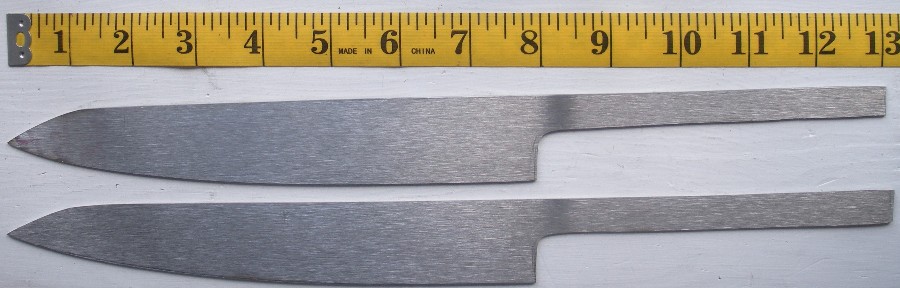
The two blanks cut from the bar stock.

DSCN8788s.JPG


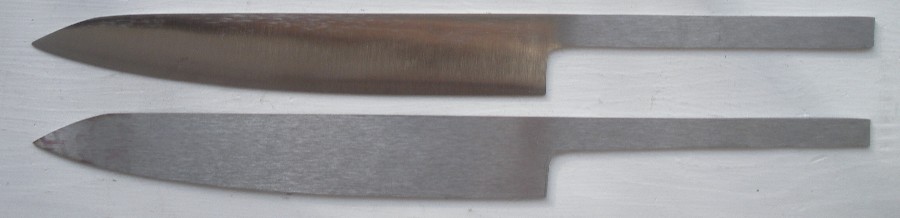
One off its two hour grind session.

DSCN8790s.JPG


DSCN8791s.JPG


Since then I have started the hand sanding and have drilled the pin hole in each of the blanks.
 
Today, after opening the gifts, I spent some time at the grinder pulling the second blade through that step. By comparison with the first, it shows more problems at this stage, so it will take more work during the hand sanding stage. I don't think either blade has any irreparable problems, though, so I should end up with two usable blades.
 
I like your sketch. Some clearance comes from the edge angling up toward the tip. If the edge and bottom of the tip are parallel (they should not be) you need more clearance. Wa handles are usually about 5-5.5 inches long but four inches of from the choil is about right for the tang length.


I personally would start with stock wider than 1.25 inches. I would say 1.75 to 2 inches for an all around knife. 1.25 makes more of a meat slicer than all around chef knife. Since this is going to be a big project, the cost of additional steel is probably not a huge factor. (and plus Stacy is going to hook you up!!:cool:
 
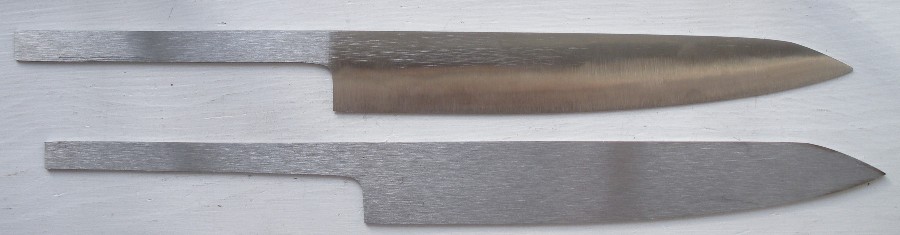
Both blades have been hand sanded to 180 grit, and I believe both remain viable.

DSCN8796s.JPG


DSCN8798s.JPG


Blade B had a lot more gouges to work out than blade A, but I think I got them without compromising the blade. They weren't that deep.

Update: I noticed that the profile of these blades would more accurately be described as slicers, not chefs knives. I informed the recipient of my error, and he admitted that he erred as well. His favorite knife is really a 6 inch chef's knife.

So obviously I'll need to start over again as far as he's concerned. As far as I'm concerned I'll finish these first. Also, I checked on Aldo's site and it seems they are out of CPM S35VN. So for now I'm stuck with what I have anyway.

Stacy, is the offer for the blank still open?
 
Last edited:
Oops, I did not see the second page and that you have already started. They look good so far.

I like your sketch. Some clearance comes from the edge angling up toward the tip. If the edge and bottom of the tip are parallel (they should not be) you need more clearance. Wa handles are usually about 5-5.5 inches long but four inches of from the choil is about right for the tang length.


I personally would start with stock wider than 1.25 inches. I would say 1.75 to 2 inches for an all around knife. 1.25 makes more of a meat slicer than all around chef knife. Since this is going to be a big project, the cost of additional steel is probably not a huge factor. (and plus Stacy is going to hook you up!!:cool:
 
This morning I spent some time sanding the blades a bit more, using a technique passed on by Nick, sanding at different directions with each change of grit. Good thing, too. I found a number of small but annoying scratches that needed to be removed. They would have stayed invisible for far too long if I was always sanding in the same direction. Now they are gone and I am realistically up to 280 grit on one, still at 180 on the other. I've also shifted from dry sanding to wet.

DSCN8800s.JPG
 
Looking good so far. When you think you have eliminated all the sand scratches.......... carry it out into the sunshine and view it from all angles. You will usually find something that needs a little more work.

Keep it up and continue showing us your progress.

Robert
 
I decided to take a different look at the blades before getting too deep into preparations for HT. I intentionally ground the second blade more than I did the first, thinking that if I went too far on one at least I'd have the other to fall back on. In looking at the angles now, I'm concerned that I might have left the first one too thick.

By eyeballing, I'd estimate the B blade is about half the thickness at the edge of the A blade. I have a micrometer around somewhere, but I never got the hang of accurately measuring thickness on beveled edges, so I haven't really measured either one. That said, I believe the A blade to be about a quarter the thickness at the edge compared to the spine. I'd estimate the B blade edge thickness to be about half that.

Here's the A blade.
DSCN8804.JPG


This is the B Blade.
DSCN8803.JPG


- Greg
 
Back
Top