My first RWL34 project.

Joined
Jan 19, 2007
Messages
288
DSCF3819.jpg


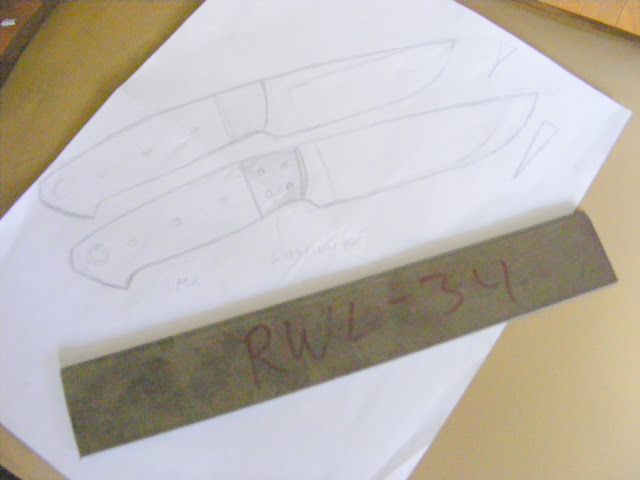
I finally got a piece ot RWL34. 4mm thick, 250 long, 38mm wide.
I have an intention to make a outdoor knife. Something like middle sized bushcraft-camping allrownd tool. 12-13cm blade and the handle will be from wood and buffalo horn bolster, or just wood.

Other thing to ask is what type of HT to use form the technical datasheet. I will aim to 59-60HRC. 1050C quench and 220C tempering for 2 hrs.

http://www.damasteel.com/pdf/rwl34-datasheet.pdf

What is your expirience with that steel? Thanks for looking.
 
RWL-34 is a powder metal steel equivalent to our [USA] CPM154. One of the best alloys for knives !!
Most makers here are using a "plate quench" .The steel is put in a stainless steel foil envelope to protect from oxidation then "plate quenched" by putting it [in the foil] between two pieces of aluminum plate about 25mm thick with some pressure . This gives an excellent quench.
I suggest you hold at temperature about 30 minutes instead of 15 to give the carbides time to dissolve thoroughly. For best performance a cryogenic treatment is done before tempering . Dry ice for -70 C or liquid nitrogen for - 180 C.
You'll be very happy with the performance !
 
Very nice stuff. The only thing bad about it is the price tag for the barstock. Doubled in the last couple of years and its why I went to CPM154.
 
Cryo reduces the amount of retained austenite .While other claims have been made they have not been proven.
 
Well, the piece of steel is from Ingemar Nordell's site, yes, Emre. But here is a two guys here in Bulgaria, that in the future will become a distributors of damasteel materials and other knifemaker supplys from Finland on a price of the site, without the enormous transporting taxes. I will let you know when they make their steel prices low. Now it is 510SEK(swedish krones) for one meter of 4mm x 38mm barstock and 340SEK mailing to Bulgaria...blaaah. I hope in the future we will pay only for the steel here.

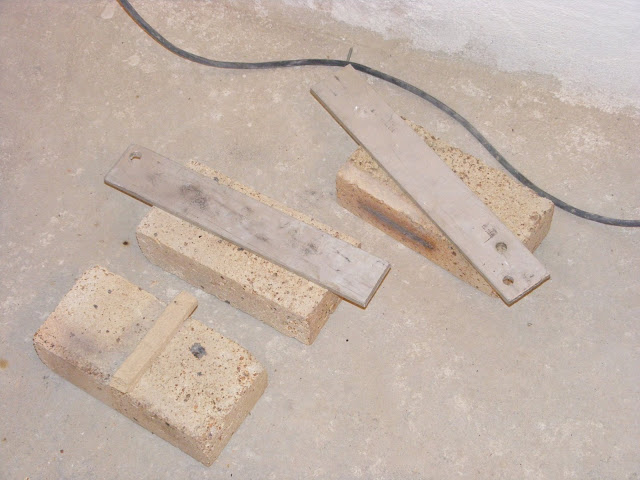
So, you recommend me a 30 min soak time. :thumbup: But there is a problem with the foil now. I have an intention to cover the blade with high temperature clay for heat treating, and perform interrupted oil quench for two seconds. Right after that I will use the plates to avoid bending. I have two pieces of aluminium, I hope that works.

DSCF3483.jpg


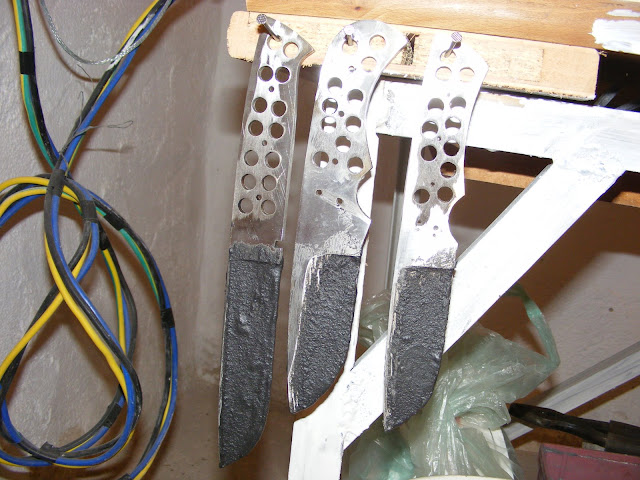
This is how I cover my blades with the clay. Will it works, or I will have to cover it all the way?

DSCF3515.jpg
 
Last edited:
At those high temperatures oxidation and decarburization occur rapidly so cover the whole blade to save yourself a lot of work !
 
Some more asking on HT, guys? A maker here told me about the danger of increasing the steel grain and make it brittle with long soaks. I will make some experiments with the excess pieces of the steel and braking them to see the grain structure with long and short soaks.
What is your opinion about that. Thanks. :)
 
It's excessive temperature that is the danger not time .As long as you have accurate temperature control there is no problem of grain growth.. But too short a time and you won't dissolve as much carbide as you should , and you won't get full performance.
 
The clay may not work good for HT these kind of steels. You have to soak long. If you have a temp. controlled kiln don't be shy to let it soak above 30 mins. 40 - 60 min is good... But the clay will have some cracks, and these cracks will cause you too much trouble. If you have HT foil use it without a doubt... Also to clay coat only a part of the knife is not a way to go. You will have deep decarb + oxidation layers on unprotected places. Those will be very hard to get rid of...

The Al plates you posted are not big enough as far as I see. You need 2 - 3 cm thick, at least 40 x 20 cm plates. Don't bother with oil quench, I tried and it doens't do any good, instead warpage issues are PITA. Also to polish the surfaces of plates helps a lot. Steel cools much faster if the Al plates contacts better to the foil...

BTW nice work on the blades :)

p.s. 520 SEK is the price tag, it is about 75 $. I buy also handle materials, tools etc from there so the shipment doesnt hurt much. I suspect it would be much worse if I bought ATS34 or CPM154 from USA :eek:. Price is somewhat is the same there but the shipment would be much pricey. I dont know though, I have to inspect this issue...
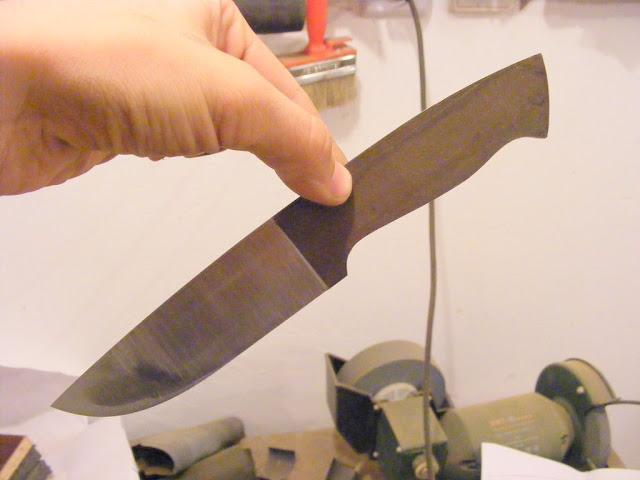
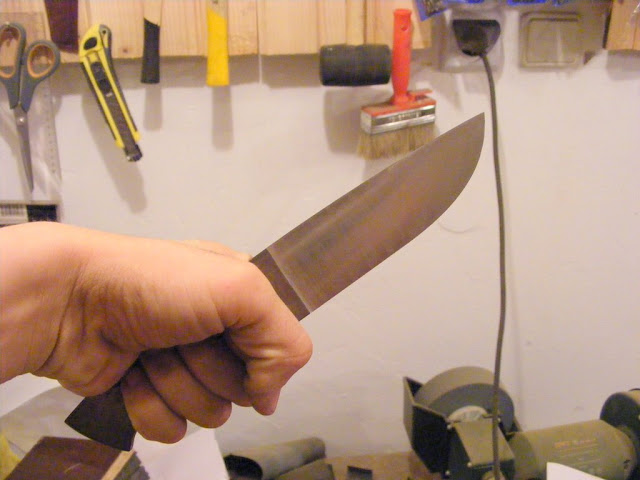
 
Last edited:
Thanks, Emre. I don't have stainless foil, and I don't know where to purchase from Europe. I will clay the whole blade. It is proven clay. Didn't crack so far at 1050C. That is why I will do the interrupted oil quench for 2 sec, and than put it between the plates to keep it straight, not for quench. Hope will do the job. I will make some tests with the cutoff pieces to see if everything works fine. Clay, grain size, hardness, ect.
Do you know company in Europe for HT foil?
 
Flat ground to the back. Here I must say about my satisfaction from Norton 60 grit ceramic hogger belts. Only 20 mins to rough grind the bevels on slow speed, and this was not a fresh belt! Atleast 4 knives of 1.4116 stainless steel was rough grond on it before that one. After that I touched with 100grit blue zirc belt and Norax X100. RWL34 is the most grindable steel I have ever used. It is a dream.
DSCF3898.jpg


DSCF3899.jpg

Sorry, I am slow maker. I only have one day in the weekend for my knives. :(
 
Thanks, Emre. I don't have stainless foil, and I don't know where to purchase from Europe. I will clay the whole blade. It is proven clay. Didn't crack so far at 1050C. That is why I will do the interrupted oil quench for 2 sec, and than put it between the plates to keep it straight, not for quench. Hope will do the job. I will make some tests with the cutoff pieces to see if everything works fine. Clay, grain size, hardness, ect.
Do you know company in Europe for HT foil?

I bought a lot from Nordell Knives. Their foil is very large in size and it is quite fair in price, next time you order from there buy foil also. About 3 or 5 mt of it will serve you long time. I use an envelope 2 - 3 times...
 
Could not find the product on their site.... :o Maybe they stopped selling it.

Yes I remember it was not listed on their web site, I just emailed them that I needed HT foil and they sent the prices. I always order by email from them not their online store as the online store doesn't function well. List the products you need and quantities and email them. Add product codes if it is listed on their web site. They reply emails in a day or so. I fax my credit card no to them and they send the order after taking the money....
 
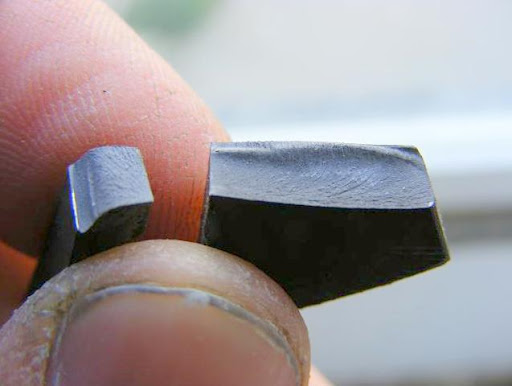
Now those are the excess pieces after HT. 15 min on 800C and than 40 min on 1050 and oil quench. They were protected with clay. After that 2 hrs on 220C. Is that supposed to be the look of the broken steel RWL34?

Brackage.JPG
 
looks very good, one time I have learned how grain growth would be (by mistake of course) when this happens crystals are easily visible, as far as I can see it is not happened on your sample. And also I have broke lots of HT'ed RWL34 and inspected. First, when it is fully hard it is lot easy to break (like most of the steels) and the edges are very sharp. Also it is a good indication that there is a concave inner section is broke. When it is as hard as it can get it breaks mostly that way (like obsidian flakes). Also you might polish a side of it and spray salty water over it. After a day it should not develop any patina at all. This way you can be sure the chromium also diffused well and it has become stainless...
 
Great, Emre. Thanks for the tips. It is good to know that I am on the right path. I will make the stainless test with salty water. Small piece I broke before tempering, and big - after that. It is realy brittle right after quench. It snaped like glass. After temper I had to use double and up force to brake it.
 
Back
Top