my grinder's ticker needs surgery...

Joined
Sep 21, 2006
Messages
1,472
I have been noticing this squealing noise the past couple times I have used my grinder. I stopped using it thinking for whatever reason it was the wheel bearings. After purchasing and replacing my wheel bearings (the whole time I was thinking there's no way these bearings could be bad, it's only been a year and a half...) The noise was still there. I got off to the side and got close to the motor. Yup, it's the bearings in the motor. NOW I am perplexed cause this motor is also only a year and a half old, and I take my belts off after use. And when I do use it I run it full speed maybe 60% of the time.

Before any of you start with the shouldve gotten a baldor or leeson, I could not afford it at the time. It's a Reliance electric. I guess I could check out the local rebuild shop and see how much they want. I have this sneaking suspicion the repair will cost the price of the motor, and I will end up buying a brand new motor anyhow.:grumpy:


EDIT The motor is TEFC
 
Last edited:
Changing bearings in ANY electric motor is real easy. Take it apart,(usually only 4 motor length bolts)(remove the pully) blow all the dust that is in there out (there will be dust even if it is enclosed), most have a snap ring holding the bearings in, remove it/them, replace bearings and reassemble. I could do it in about an hour. No point in paying for something you can do yourself. The only pain in the butt part if yours has brushes is getting them to stay in during reassemble, take a real small Allen wrench and hold them in while you slip it back together. Electric motors really are very simple. Pay attention to how you take it apart and just put it back together that way. I have rebuilt probably 50 of the things in all sizes for jobs I have worked in the past, so if you have problems let me know and I can probably tell you how to fix it. Even if the armature/rotor is messed up they can be fixed real easy. I had one that the armatures grooves where melted because they were rubbing on the stator, took a grinder and made new grooves, soldered a broken wire and that motor still is working today and that was about 8 years ago and it is used daily for several hours.

I'd take the bearings down to the bearing store and buy some better ones, odds are they will have some that are better than the garbage that came from the factory.
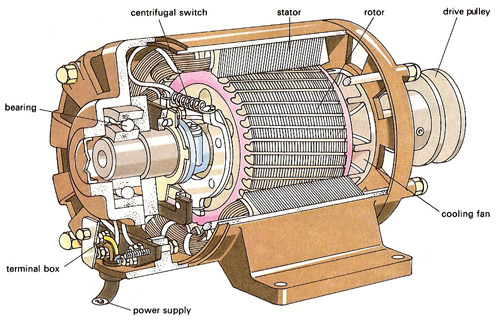
electric_motor.jpg
 
I'm going to try and remember this about your skill set Montana Guy. I run into this k,ind of stuff from time to time. For instance I have three motors that need help (I guess that's how I ended up with them :)), but I'm not sure if this is the place to discuss them, as I don't want to hijack the thread?!

Good luck with your motor gixxer. Keep us posted as to what you do to resolve the issue.

Thanks, Phil
 
I'm going to try and remember this about your skill set Montana Guy. I run into this k,ind of stuff from time to time. For instance I have three motors that need help (I guess that's how I ended up with them :)), but I'm not sure if this is the place to discuss them, as I don't want to hijack the thread?!

Good luck with your motor gixxer. Keep us posted as to what you do to resolve the issue.

Thanks, Phil

Be glad to help out should you want to get them up and running. Just let me know with a visitor message or something.
 
Be glad to help out should you want to get them up and running. Just let me know with a visitor message or something.

So bearings are easy??? Nice to know if I need to replace them.

What about repairing the windings? I have a tefc motor that I thought just needed the capacitor replaced. It wouldn't start. After the new cap it will start but only under no load. It is in a drill press and if you spin the chuck on start up it continues to run great. I was told it is the starting windings that are "bad" and the running windings are fine. It also has the click as it is slowing down that seems to indicate the centrifugal switch is fine. Any input?

I have a replacement motor and was thinking of turning the one with the problem into a disc sander because it doesn't have as much of a load on start up.
 
Is it a brushless motor or does it have brushes? What you describe sounds like the brushes are bad. They often just make the connection after an assisted start but will fail under a load. Post up a make and model number for me.
 
Montana, I guess it would not hurt to take it apart to take a look. Where would one acquire the proper bearings for this endeavor?
 
Bearings are pretty basic, if you have a bearing supply store nearby take them in and they can match them up pretty easily. They should have numbers on them that the bearing dealer can cross reference to their brand. If the numbers are gone from being worn off or burned off from excessive heat they can take a caliper, measure them up and have a match for you. Don't buy the cheapest ones you can find, middle to upper range are usually better quality. Never hurts to do a review search of your potential purchase either. You being in Tampa there are several of them. http://www.google.com/search?hl=&q=...avclient-ff&rlz=1B3MOZA_enUS362US362&ie=UTF-8

Let me know if you need anymore help with it, always glad to help people save a buck or two.
Ronnie

Just thought of this: Make sure (if they do not ask) to tell them the application (variable speed use electric motor), some bearings are better under the stress of heat and changing speeds. If they do not ask, that throws red flags for me, any good bearing guy will ask. If they say a bearing is a bearing, they are all the same, go somewhere else cause that guy is an idiot.
 
Last edited:
I just wanted to make sure it was not some special thing. I can get them out (hopefully) before the end of the week and get a hold of one of those guys. It may take a couple days, but I will post up with pics again for everybody to see.
 
gixxer,

This thread got me in action to take my motor apart. Getting to the bearings should be fairly easy if yours is set up like mine. A few pointers.

1. Mark one screw hole so you can line everything up when you have to put it all back together. I am not sure if rotation of the back or front of the case matters a lot but I did just to be sure.

2. mark the shaft at the level that the centrifugal switch is before you unscrew it so you don't have to guess at how high it was and tinker with it. (ask me how I know)

and as long as you have it all apart look at everything to make sure stuff isn't worn or broken. It turns out mine had a few pieces that were misaligned and possibly causing my motor to loose some power needed to start up?

Here are some pics:
This is the middle. Not sure if it is supposed to look this beat up. Looks like it came that way but the motor was made in 1986 so who knows?
1000881m.jpg


Then I found some of the ??? whatever you call em had been bumped from maybe the rotor and they were out of place

1000882.jpg


Here are some more
1000883v.jpg


So I put them back in place by pushing them with a screwdriver and put it all back together and now for some reason it is running fine. Maybe those pieces being out of alignment was disrupting the current flow through the coils and causing it not to start easily? Montana guy???

I will run it like this until it blows up I guess. I was going to replace the motor anyway. :p:thumbup:
 
I have seen them a lot worse than that, the one I repaired 8 years ago was way way worse. How did your bearings feel Wloch248? Was there any slop in them or did they roll real smoothly? If I took it apart I probably would have replaced the bearings because the motor when it is on will put pressure on those bearings that you as a human simply cannot create with your hands. They might feel ok to the human hand, but when the motor is on it (if it is there) will reveal the slop/play in the bearing. Usually that kind of wear is from a bad bearing. If they felt good/are good then the misalignment would defiantly cause a disruption in the magnetic field. For a motor to run right the magnetic field they create must be even all the way around the armature/rotor. With it hitting the stator like that it is going to disrupt the field and create extra heat which will cause a very noticeable drop in power. If your bearings are good and everything is aligned right I would bet that motor will run for a very long time for you.
 
more likely the centrifical switch had some gunk or other problems, that got cleared up when you tore it down. That switch engages the startup windings at stand still and kicks them out at low rpm as the motor ramps up to speed. The symptom you discribed of running fine after you hand start it is typical of a failure in that switch.
On brushed motors, watch out for a strange shaped peice of metal that appears to serve no purpose. This peice is used to hold the brushes in position during assembly and just pushes out of the way as the rotor slides in and allows the brushes to make contact.
 
Unless the centrifugal switch was not set at the proper place on the shaft it was def not the culprit. It was almost clean as a whistle and when operating the arms it appeared to be doing the job it was supposed to.

The bearings seemed ok. They didn't make any noise, they were very well lubed, and "felt" very smooth while spinning them by hand. If I encounter any other problems I think it would be fairly easy to take it off and all apart again and replace the bearings. Now that I know how to take it apart it will not be intimidating if I know it has to be done at some point.

Thanks for the help. Now gixxer just has to take his apart too. :D
 
Glad it is working for you. They really are very simple to work on. What got me to take my 1st one apart was the quote from the repair shop just to take it apart and look at it. Thought forget that, it was $50 just for them to look at it 13 years ago. I'll never take one to a repair shop now that I know how to fix them for the most part, still not an expert on the subject but I have yet to meet one I could not make work again.

If I can ever help anyone with a motor I am more than happy to help out because shops charge ridiculous fees for their services.
Ronnie
 
If, the motor doesn't start on its own it could be the start capacitor (s) that are in the humped side cover (s). When your motor starts and stops you can often hear the centrifugal contact sw click in and out. If the centrifugal contacts do not click out it will fry the cap. You can adjust this with the springs. I learned when I had a brand new 2 hp motor that wouldn't start, replaced the cap and it started a couple times then stopped. fried the cap thats when I found out about the switch.
 
Alright, I finally got one project done time to tackle this one.

Here is the shroud removed. It only had two bolts holding it on. you have to remove this to get a wrench on the 4 bolts holding the endcaps in.
shroudremoved.jpg


I then removed the nuts on the shaft side.
nutsremoved.jpg


I then gently tapped the endcap off on the shaft side with a screwdriver and a small hammer. My endcaps have little tabs to put the screwdriver on so I did not have to dig to get the screwdriver on something to get the cap off.
endcapremoved.jpg


After a bit of poking and such (the bearings "felt" fine when I rolled em, but like stated earlier the hands are not as strong as the forces during use.
So, knocked out the other endcap (still attached to the shaft) and removed the whole assembly.
gutsremoved.jpg


Then, like previously posted, I have rubbing here.
rubbinghere.jpg


and here.
andhere.jpg
 
So is all that from play in the bearings? Kinda confused here cause the forces on the shaft from the wheel and belt pull the shaft about 130 degrees away from where the rub is, which is more or less at bottom dead center. Make sense?
 
The more I think about it the more I think my problem was from play in the bearings causing the play and causing the middle to hit the sides. I think at the first sign of new trouble I will be replacing the bearings. Or sooner if I get around to it.

I think you should replace yours while it is apart. I didn't have any squealing like you did but that leads me to think it is your bearings even more.
 
Back
Top