Mystery steel-romantic or simply a bad idea?

. But if you want the *best* then you can pretty much drop simple steels like 10xx series.

I think that you will get a lot of makers that will argue this point with you. Many will tell you that the best blade that you can make is out of the steel that you are best at H/T'ing.

My point was that H/T'ing a mystery steel includes to some degree a bit of guesswork where the H/T'ing of a known steel is much more an exact science with more consistant results.

Gary
 
Anyone take in consideration that this old steel might be better than the new stuff. I bet those tiller tines I'm using now are virgin steel. Most modern steel is made from scrap and old steel. I've got to admit I am addicted to using old rusty steel. Every knife I make I hand forge. During the hand forging process you get to know the steel pretty good. After a few hundred knives you can tell if you have good steel or not. I've got to admit this is the first time I have ever run into O-1 that has come to me as mystery steel. The first blade I forged I could tell it was good steel. As for the first blade I did what I normally do when I'm working with steel I have questions about. I'll normalize 3 times. When I go to harden the blade I'll start at 1500 degrees and quench in slow oil. I tempered at 400 degrees for 1 hour twice. This was before I knew it was O-1. If the slow oil doesn't work I'll try fast. Last resort is water.

I got 3 racks of 1932 Studebaker leaf spring a few months ago. First thing that popped in to my mind was 9260. Had my fingers crossed that it was. 9260 oil hardens. The test blade I made I quenched in oil. Didn't harden at all. Got me thinking that this car was made in the Depression years and most likely they used a much cheaper spring steel. I wasn't able to harden this first blade even in water. Still more testing to do with that steel.
 
Great thread. Kudos to Steven for starting it, and to everyone else for keeping it civil.

Not much to add, except that I'm not sure heat treat is the only unknown variable. Even if it were theoretically possible to nail the heat treat, what about stress fractures or other minor cracks/flaws not visible to the naked eye, etc.? In other words, even if you do know exactly what steel a leaf spring or saw blade is made of, you probably do not know how that spring/blade was used and/or abused over the decades before you acquired it.

OTOH, if the buyer knows what he's getting, and likes it, no problem. People like Ray and Tai are very professional, and very up front about the materials they use, and why. Only if a maker were to recycle materials yet pass them off as "new" would there be a real problem.
 
If you are willing to do the testing and take the risks found steels can and do make great knives. As John mentioned, there are risks of stress fractures and such from found materials. I did a blade from a D-9 cat spring. Do not know exactly what material it was be it heat treated well and cut great. That was pre-finish testing. Once I got above 600 grit I began to see a spider web pattern coming up in the finish. It had been over stressed at some point and was full of micro cracks. It was a definite learning experience. I do on occasion use Historical steel with a cool story. A friend brought over some old farriers rasps that his uncle used. I did some testing and they were probably w-1 or at the least 1095. Made some knives and he is very happy to have his uncles memories with him while using the knives.
 
I think that you will get a lot of makers that will argue this point with you. Many will tell you that the best blade that you can make is out of the steel that you are best at H/T'ing.

My point was that H/T'ing a mystery steel includes to some degree a bit of guesswork where the H/T'ing of a known steel is much more an exact science with more consistant results.

Gary

First off please don't take this as me arguing with you, I also use a forge and 10xx series steel, I'm simply playing devils advocate here and offering a differing view.

I completely agree there is a bit of guesswork with mystery steel. But I also think there is a bit of guess work in most forges. Theres a fair amount of things that can go wrong in knifemaking.... Did the steel pick up too much carbon from the coal forge? Did the steel lose too much carbon in my propane forge? Were my normalizing temps correct? Was I a bit high/low in my heat treat temp? Did I hammer the steel too cold? Could I have gained an extra rc point with a faster quench? etc etc.

Most experienced smiths can probably give a fairly accurate answer to these questions because of experience. The same thing applies to mystery steel. You pick a ht schedule, you do it, you test and based on the results of your test you can try different quenchants, dif tempering temps, etc. Someone with experience can make a very usable knife. On a performance level, will it be able to beat out a properly ht'd steel like 3v? I sincerely doubt it...just as I sincerely doubt a properly ht'd 1080 would beat out 3v. You may come closer with the 1080 (or you may not), but in either situation performance-wise its going to be lower performing.

Mystery steel does open up more guess work, and it does open up the possibility for more things to go wrong....but then so does using a forge. A maker could cut out a lot of variables by grinding a steel like 3v, and sending it to a professional heat treater, or using a digital oven of their own. You'd get more consistent results at a higher performance level(depending on the steel of course). I think if asked many makers would say their reason for not going this route would be something along the lines of "some of the magic is gone" from the process. A maker may use the forge because its more fun, more traditional, more magical, etc....just as some smiths choose mystery steel for the same reasons.
 
I almost always use Aldo 10xx steel for my core edge material except in the most historical of pieces that I do. I've been happy with the testing I've done with these steels.. especially the 1084 and W2... but 1075 does the job too. But myy everyday carry.. that I use around the house... is pure wrought iron that I hammer hardened. I love the iron because it came from a Lake Superior shipwreck. There are inclusions in it that suggest it's high in phosphorus which enables it to be hammer/work hardened. I cut limbs, rope, cardboard.. all the stuff you use something like this for. I don't use it for prying as it would take a set. I sharpen it after use with a little jeweler's file. It's a type of knife that folks have been using for centuries upon centuries and it works fine! I'm not saying it's better than anything else... although it's pretty easy to sharpen. But I love it and it does it's job and it means something.
 
I use probably 98% new, virgin, known steel, because I simply like to limit variables. But also because I like to choose compositions to suit intended use and the client's preferences; for instance one client may love a nice patina that develops over time and likes something easy to sharpen. While another may request much higher edge retention and a low-maintenance knife in general. In both cases I can recommend specific steels that fit their parameters and with which I'm familiar.

I do make file knives occasionally - thin light blades meant only for cutting and slicing, not "hard use". When I do, I make it very clear that I can't fully guarantee the HT, and leave some of the original file marks showing so there's no doubt it used to be a file. This should give some potential second or third owner a heads-up that it's a "recycled" or "repurposed" blade.
 
As an addendum to this, keep in mind that armies have been equipped with, battles fought with, countries won, civilizations preserved and eras of Mankind won with "steels" that barely qualified as steel today.
There's good stuff out there many, many decades old.
Just 'cause it may have an unknown chemistry and origin, does not mean it can't perform quite well in the hands of someone like, say, Ray Richard!! :thumbup:
 
If you see something like this its most likely Mystery Steel. Turn around and walk away.............

IMG_4894.JPG
 
As an addendum to this, keep in mind that armies have been equipped with, battles fought with, countries won, civilizations preserved and eras of Mankind won with "steels" that barely qualified as steel today.
There's good stuff out there many, many decades old.
Just 'cause it may have an unknown chemistry and origin, does not mean it can't perform quite well in the hands of someone like, say, Ray Richard!! :thumbup:

You can forge a knife out of mild steel and put an edge on it, and battles would have been fought with it...so what? What does that have to do with anything? Does mild steel make a good performing knife? If my plane when down in the wilderness and all I had was mild steel.....I could make a knife that helped to keep my alive and fed....but there is so much better available, so that mild steel knife isn't really necessary if I have well-suited options.

You want to forge with steel that you don't know the composition of, as long as you tell your customer(they might not care, I didn't in the case of the knife I got from Raymond) it's all good.

But unless you have tested the work of another maker, personally, to destruction or have seen it done, it seems a bit cheerleaderish to be saying that it can perform quite well. By what metric? How many 2 x 4 cuts does it make compared to Cruwear, M4 or 3V? How many 1" rope bundles can it cut? What about bending, what about stabbing ping pong balls or cutting coke cans?

I don't see any of that as an absolute signifier of a "better" knife....but they are very specific tests designed for both the knife and the knife handler.

When a maker starts getting that misty look in their eyes talking about the mystery of the forge and harkening back to the days of yore, I start nervously looking around for the door.

Any neat materials like wrought iron or shear steel add some interesting elements to a knife, but if I want a story, it will be back in the hotel room after a show, or back at home on my bookshelf. The knives tell their own story....and they speak loud and clearly.

Best Regards,

STeven Garsson

 
I see this as a science vs. art debate. Some prefer the science and performance aspect of knives, using them to the fullest of their abilities, while others are more casual users who enjoy the fact that their knife as repurposed from plow steel, or leaf springs, or great grandads scythe. They will not be the ones to complain about edge holding abilities or exact Rc numbers, in short they just don't care. As long as it does what they need it to do within their (assumed reasonable) expectations.

Now, this does not apply to the 15 year old mall ninja who takes the blade off dads mower and files a bevel into it and says he can cut down the forrest in a few chops then shave. We all know exagerrated claims to be false.

Personally, I say keep on using found steel, make knives, hawks, spears and whatever from it. Just be sure disclose the steels unknown origin and composition. Do the required testing to narrow down the basic family of steel, but don't call it something it isn't unless it has been documented as such.


-Xander
 
I started knife making using saw blade steel, made many (1000+) serviceable knives from it. And was all I used for a number of years. I used 'Saw Steel' as a selling feature. :)

I didn't know what steel it was, but learned how to heat treat it. Also learned it wasn't L6, which is what most said it was. But it acted more like a 10XX with nickel added. I learned old, large circular blades made very tough knives, large band saw blades made very good knives, old cross cut saws made fine cutting, thin blades, that held an edge very well.

When I stared making pattern welded steel, I learned it was more efficient to start with known steels and the outcome was/is much more predictable.

Then I discovered W2! :D
 
Last edited:
Any neat materials like wrought iron or shear steel add some interesting elements to a knife, but if I want a story, it will be back in the hotel room after a show, or back at home on my bookshelf. The knives tell their own story....and they speak loud and clearly.

Again that's just a personal thing. If the history and story behind the blade materials doesn't do it for you then that's fine. It does for some people. But when you say the knives tell their own story..... which ones? I mean there is a reason why people pay big money for custom knives. How many people brag to their friends that the knife they just spent X grand on has a X,000 yr old piece of artifact walrus ivory or a XX,000 yr old piece of bog oak? I mean the stuff looks good... but who isn't impressed with where it came from? For me.. I don't see any difference between that and beautifully grained shear steel from some historical source.

I like the look of old iron and steel, I like the historical context and am fascinated by how it was made. Even though the world as we know it was, in many ways, shaped by it... I'm not all that impressed with how it performs next to the modern steels that I use. Once again.. that is why I laminate! :-)

Wouldn't it be boring if everybody liked the same thing? ;-)
 
the coolest thing about forging steel is the shapes you can start out with and the shapes you can end up with.

I'm going to go out on a limb here, and speak from my experience selling bicycles. MOST people who buy high performance products NEVER will use them to their limit.

What the hell does it matter to a custom knife maker? The BEST steel is unforgeable anyway. You do the best with whatcha got and if you're good enough, you'll sell knives, and not because they work great necessarily, but because people WANT them.
 
I do make file knives occasionally - thin light blades meant only for cutting and slicing, not "hard use". When I do, I make it very clear that I can't fully guarantee the HT, and leave some of the original file marks showing so there's no doubt it used to be a file. This should give some potential second or third owner a heads-up that it's a "recycled" or "repurposed" blade.

I'm a knife guy who likes to know what I am getting when I purchase a custom knife. I'll usually pass on a knife I might really like if the seller or I do not know the blade steel (purveyor sites don't always know what they have, but if they do, I like it when they include the blade steel). If I were a regular maker, I would want to know the stats of the steel I was making my blades with. But, I can sure see how it is fun and mysterious for a maker to revive a previously used 'mystery' steel and see what he can produce.

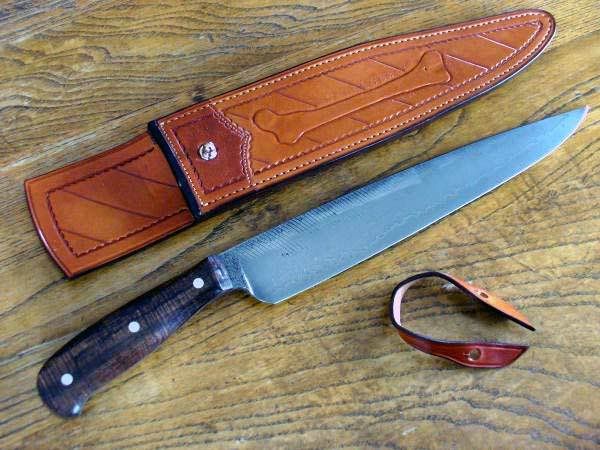
Occasionally, I'll get the urge to stray from my 'need' to know what I am getting. James' comment made me think of this file knife I got from Don at a St. Louis show several years ago. We had a sharpness test among some custom makers that were in attendance that day and this won going away. May be the sharpest knife I own. :eek:

BTTB3.jpg


BTTB5-1.jpg


- Joe
 
maybe i got no dog in this fight but i gotta say something. its probably not a good idea to use mystery steel cause when your out actually using your knife you don't know if your gonna run into some wild 2X4's attacking you out of nowhere. And watch out for those killer ping pong ball that will engage themselves in any orifice. And dammit who made this bridge were the toll is putting your knife in a vise and, oh look there happens to be a cheater bar right here, i better bend my knife so i can cross.


just remember opinions are immunity from being told your wrong:p
 
The ability to make a knife out of a piece of mild steel might not be a bad thing to learn especially how this world had been going.

After spending 10 to 12 hours out in the shop each day, every day or the week for several years I feel I've learned a thing or two. I'll keep doing what I'm doing. The soap box is yours.
 
But unless you have tested the work of another maker, personally, to destruction or have seen it done, it seems a bit cheerleaderish to be saying that it can perform quite well. By what metric? How many 2 x 4 cuts does it make compared to Cruwear, M4 or 3V? How many 1" rope bundles can it cut? What about bending, what about stabbing ping pong balls or cutting coke cans?

I don't see any of that as an absolute signifier of a "better" knife....but they are very specific tests designed for both the knife and the knife handler.

I think the operative words here are "intended tasks"....a knife can perform quite well for its intended task but still be inferior to another knife. Compare it to cars. I've never driven, nor seen driven, a Ferrari Enzo, or Ariel Atom...and I know they both outperform my car, but my car still works quite well for its intended tasks.

In the knife world you can have 2 knives...one made from recycled material, one made from a super steel. A man needs a knife for hunting. Now the super steel one has superior edge retention and can field dress a dozen deer no problem. But the hunter is only shooting a deer at a time and his mystery steel knife easily handles the task he gives it.

In that situation it really makes no difference how well the super steel performs because its never stretched to its limits anyway. Now if someone came up to me and requested the best performing knife they can get their hands on.....mystery steel definitely wouldn't be in the running.

When a maker starts getting that misty look in their eyes talking about the mystery of the forge and harkening back to the days of yore, I start nervously looking around for the door.

:D I feel the same way when discussions about exotic quench formulas, etc come up.

Earlier when I referred to "the magic" of the forge I meant along the lines of sitting around a campfire at night as opposed to cooking food on a portable butane grill. Watching deer materialize out of the fog around you at the river in the morning as opposed to watching a documentary on deer on tv. Watching a kids eyes as they open their Christmas presents as opposed to buying them something when at Walmart. etc. I don't believe the forge imparts any magical qualities to the knives.... Its just more fun to use.

If my main goal is the highest performing, consistent knives possible I would probably bypass the forge completely and just stock remove a modern cpm steel. So why use a forge? Its a lot more fun! I'd much rather hammer hot steel than sit in front of the grinder all day.
 
Last edited:
Back
Top