Need help fast - KMG

Worst case you'll trip a breaker, most likely, the vfd will just beep at you and flash a red light after running for a second.

It will run on a 15amp circuit (which is usually the smallest sized 110 breaker used), assuming the circuit isn't loaded by a bunch of other powered devices. If one outlet doesn't work, try another on the other side of the garage.
 
Your going love the variable speed 1.5 hp KMG. I have the same set up and it is at the heart of all my knifemaking endeavors from profiling blanks to finishing sheath edges and everything in between.
 
Thanks guys. Many highly experienced and knowledgable makers chimed in to give advice. I just hope you guys don't get sick of me down the road when I take my first crack at it and all hell breaks loose and the questions start flying. A special thanks to Dalibor who inadvertently gave me the nudge to try.

The garage is all cleaned out and the work bench is all set up. I just have to do the rewire, get a drill press, and buy some safety gear and some 1084 :)
 
Okay, I bummed. I switched out the plug then proceeded to work on the jumper. The guy I bought it from said it was hooked up to 220 and it did have the different plug (for whatever that's worth) and I saw it running. So, when I went to switch out the jumper i had no real reference as all the diagrams online are for the newer model. After dealing with KB Electronics and receiving a new diagram it turns out all the inards were already set up for 110. Go figure?

However, it doesn't work. It powers on (green) but the status light goes from green then quickly from red to yellow and back again. I checked my breakers and it is currently on a 15 amp. I ran an extension to where my dryer is because that's a 20 amp, and still the same thing. Maybe it's time to read the manual.
 
Last edited:
Dude, don't run from your dryer! That's nearly guaranteed to be 220, and hooking that up with it jumpered for 110 can destroy the vfd.

Take a pic of the inside of the vfd and post it.
 
You also need to make sure its not running on a gfci breaker, outlet, or power strip, and a lot of outdoor circuits, garage circuits and bathroom circuits are. I also wouldn't run from an extension cord, unless you know that it's atleast 14 guage wire or thicker.

Any outlets with a reset or test button on them, or breakers with the same are gfci and can't be used. I cant say for sure that's your prob, I ran one of my vfds on one accidently once and all it did was shock the hell out of me when I touched some other ground, then it tripped the breaker.
 
No to basically all the points above. I have no 220 in the house, no GFCI, no power strip, etc. I can't post a pic until tomorrow but the diagram was straight forward and, like I said the funny thing was I didn't have to change a thing.

There are only two jumpers to move on the unit but the guy I bought it from says he didn't touch them and I know they come set up for 220 so something's fishy.

Thanks
 
I am an electrician, first time post, just joined, maybe I can shed some light on this subject. Everyone here has 220v in thier house, from your telephone pole, you have 3 wires coming to your house...2 legs of insulated 120v...and a return path to the streetside transformer which is twisted bare aluminum...also known as your Neutral. Inside your electrical panel...you have "phase A and phase B". On the left hand side of your panel..if you took your finger and touched each breaker going from top to bottom...it would go like this...top breaker =A phase....2nd breaker B phase....3rd breaker down A phase...4th breaker down B phase so on and so forth. A single pole breaker only contacts A or B...which gives you a 110 volt source. The 110 volts leaves the breaker on your black wire(hot)....goes to your receptacle in your wall and terminates. The white wire inside the jacket is your return path(neutral) for the 110 to get back to the panel and is terminated inside the panel on your neutral bar....at least it should be. Sometimes you will see the white wires and the bare copper grounds on the same bar, sometimes they are separate in the panel....110 needs a single path to your device and and back.

Now 220v is a different story but ridiculously easy to understand once you grasp the concept. 220v is a combination of 110v from A phase and 110v from the other source, B phase. This is why the beaker takes up two spots in your panel.

Lets say you wanted to install a brand new 220v receptacle for your motor. You need to know how many AMPS your motor wants. Super easy. You have a 1.5 HP motor....which is equal to 1119 WATTS(746W X 1.5HP=1119W). 1 HP= 746 WATTS. To find your AMPS you simply divide the WATTS/VOLTAGE.....

1119/110= 10.17 AMPS. This is a good chuck of amperage to run on a 15 amp 110 circuit, most receptacles in houses are 15 NOT 20...

1119/220= 5.08 AMPS. This is better if you have the option on your motor. Less heat. The more amps the more heat.

Here's the fun part. If you know you have a receptacle with no other receptacles on the same circuit in the area where your motor is....you can make a 220v outlet very easily. You just have to identify the white wire in the panel which is the return path from that receptacle. Now you need to know if your wiring is 14 guage or 12 guage...if its a 15 amp circuit it should be 14 guage(AWG). If it is a 20 amp circuit it should be 12 guage(AWG). If the wiring is 14 guage you can use a two pole 15 amp breaker..if its 12 guage you can use a two pole 20 amp breaker.....take the black wire going to the receptacle....terminate it to one of the two spots on the two pole breaker...take the white wire going to the same receptacle and terminate it on the other spot on the two pole breaker. Congrats, you just converted a 110v receptacle to a 220v receptacle.

Yes it is that easy. If he had it running on 220, it should run immediately. if the plug looks different than say, an extension cord end, take a pic and I will help you get it wired up. 220v is a HECK OF ALOT BETTER for motors, compressors etc.. The amps are half of what a 110v circuit needs, which results in alot less heat and your equipment will run smoother and the wiring will last alot longer.

WARNING= DO NOT take 14 guage or 12 guage wires and land then on a 40 amp two pole breaker and say...this should work okay. Its a VIOLATION . AND ITS NOT SAFE. This is how people burn thier house down and DIE.

14 guage romex cable is white and is only good for 15 amps
12 guage romex cable is yellow and is only good for 20 amps
10 guage romex is orange and is only good for 30 amps

Be safe, and do it right. Any help I can give I will gladly do let me know

 
Last edited:
First things first. Hopefully it's just me doing something stupid. Besides being possibly corrected in my jumper settings, the only next bit of troubleshooting I can think of to do is to remove the standard plug I put on the end and reassemble. Thanks Javand!
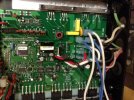
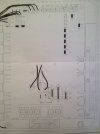
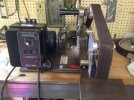
photo-38.jpg General shot
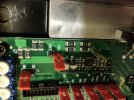
photo-39.jpg Showing it's on the 115 and not the 230 jumper
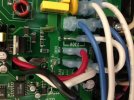
photo-40.jpg Again showing it's on the other 115 jumper
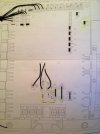
photo-44.jpg Diagram indicating the default 230 jumper set up (highlighted)
Oops, I don't know why these all came out sideways. I should have checked before I uploaded.
 

Attachments

  • photo-41.JPG
    photo-41.JPG
    37.8 KB · Views: 18
Last edited:
Mike - Wow, a first posting! I'm honored, and a very welcome aboard. Not a very noob thing for you to do, answering instead of asking, so props to you.

You put a lot of great information in here so I copied and saved it for a great future reference guide. I always stupidly assumed that you can determine the volts by the shape of the receptacle or plug. Since I have only standard 3-prong receptacles in the house I thought this meant no 220v. Stupid me! I went by your logic above and saw that the breaker assigned to the laundry room is both on the phase A and phase B and rated at 30 amps. The receptacle in the garage is a single phase and 20 amps. But the catch is that the 220 breaker is not actually the laundry room... (sorry, I'm actually typing a sentence then running around and trying different things out then back to typing) I flipped off the only 220v breaker and nothing in my house seems to be off. Then I remembered my pool. I DO have a 220 receptacle near my pool pump but it has never worked so I have that 1 HP motor running to a standard receptacle via an extension cord. I run it 24/7 and have never had a problem with it getting hot but I think I need to get that outlet fixed. So anyway, I think that my 220 is basically doing nothing at the moment.

I still haven't figured out my problem but I know a whole lot more about my electrical then I have did and now maybe I can troubleshoot with a better grasp on things.
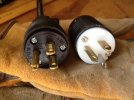
photo-42.jpg Black one is what I changed it to and the white one is what it was.
photo-43.jpg Money shot!
 
Last edited:
AW CRAP! AW CRAP! AW CRAP! After a thorough review of the diagram and my box I noticed the jumper was set to the (default) 2 HP position!!!! Why??? I guess the previous owner got away with it because the he had it running on 220 even though all the jumpers were set to 115. The paperwork says, and I quote, "Motor Horsepower Selection (J3A and J3B): Jumpers J3A and J3B are both factory set to the 2 HP position, for 2 HP motors. set both jumpers J3A and J3B to the corresponding position for the motor being used.... WARNING! To prevent catastrophic failure, do not operate the control above 1.5 HP (5.5 Amps AC) in the 115 Volt setting." (I have the 1.5 HP motor)

I basically threw all my eggs in one basket and spent money on something I can't afford but with my wife's understanding that if things didn't work out I could always get my money back. If I royally screwed this up...

What would a "catastrophic failure" imply? Would the entire VFD be ruined or is there something in the unit that can be replace like a capacitor? The one capacitor I see looks good :(

There is another "catastrophic failure" warning not to run the unit on 220v with the jumpers set to 115v. Apparently this had no ill effects as that is how it was running previously.

I'm sh**ing myself!
 
Last edited:
Re-jumper to 1.5hp. That's the max for 110 input. The newer model kbac 27d will still run with it jumpered 2hp, but that's probably due to software.

I wouldn't be concerned about running it on 110 if its jumpered for 220, it will just not get the power it needs, but definitely don't plug it in to 220 when jumpered for 110, as it'll be taking two hot legs inappropriately.
 
I can't tell from the third pic how those bigger jumpers are set up, but those are the critical ones for changing input voltage on my kbac 27d, not the small jumper. So double check those.
 
I did switch it out to the 1.5 jumper and the same thing happens.

Turn power to on: power light goes to green and status light goes from green to a quick red then yellow then back.
Switch to start: quiet high pitched squeal from the VFD. Status light goes to a constant yellow and the belt shifts just a fraction.

I disconnected my plug and rewired with no success.

Ps - the breaker to the garage is actually 15 amps.
 
Last edited:
Yeah thats a power issue. When I'm changing vfd settings, I usually cut the breaker since my grinders are hardwired. I then flip the switch to run on the vfd, it'll give me the high pitched beep, and then start blinking the red/yellow lights, then after its running out of latent juice, just the red will blink.

I'm going to send you a pm strider, so you can just call me. Too much typing on my tablet.
 
Thanks for the talk Javand.

This motor is obviously not getting the power required to run it off my 110v so I need to have the garage set up for 220v as Mike suggested but I want to have someone who knows what they're doing at least help me out.

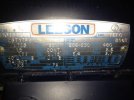
On Sunday I went to a kids football game to watch my daughter chearlead (we won BTW in 3 OT's). At the game I was introduced to a real nice...<wait for it>... electrician!! He came over last night and we formulated a game plan. Long story short - I don't think it will be too hard to run the 220v. But here's the kicker, when I showed him the grinder he looked at the motor plate and said that this motor can only be run on 230v or 460v (I never even heard of 460) and NOT 110v.
photo.jpg
I guess the 3 phase 1.5 HP motor in 2006 was only a 220V. In the long run I know getting the 220v powered to garage will be worth it.
 
Hey man, just wanted to clarify this for you since your electrician understandably doesn't know this; but one of the primary functions of these kb vfds is inverting 110v single ph to 220v 3-phase. It takes either 110 or 220 single phase input, and output's 220v 3 phase, regardless of which voltage input you have.

It's an "inverter" vfd. Explain that to him, and he'll understand. It's essentially doing the same task as a phase converter and a step up transformer, in one unit.

Trust me, all of us are using 220/440V only 3-phase motors, and many of us are running them with vfds off of 110v.
 
Back
Top