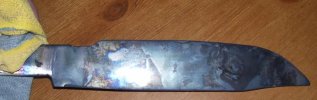
Need help with heat treating

Archer Here

Knifemaker / Craftsman / Service Provider
Joined
Nov 2, 2008
Messages
1,323
Can anyone help me along here. I don’t have anything to tell the temperature of steel, so I went off a “table of colors” I got off the internet. Based off the color, it can tell you how hot it is. The color I got it to matched the color for 1200 degrees. I then pulled it out of the fire and drove it straight into water to cool and pulled it out and it looked like the attached pic. Can anyone tell me why and how I get it back to the color it was?

The steel I’m using is Leaf Spring.
 

Attachments

  • 100_2084.jpg
    100_2084.jpg
    33.5 KB · Views: 109
Couple of ideas....
One, color varies significantly with lighting.
Two, 1200 isn't hot enough.
Three, if it didn't crack, you got lucky.
Four, check it with a file to see if it got hard. Should be a silvery/gray color if it hardened right.
Five, every time you put it in the fire, you're going to have to sand off the scale/soot/decarb to get it back to looking nice.

A better backyard formula would be to heat it until nonmagnetic plus a little bit more, quench in warm oil, and there are better ways than that.
 
Here is bare bones HT for 5160.
Get it to about 1540 or 1550. (not much more to avoid grain growth) It is hard to do this without a forge, but they can be easily made and plans are all over the web, and throughout this forum. Allow it to hang out at about 1550 (non magnetic, I have a magnet on a metal rod that I actually put into the forge to test for this...also a pyrometer to make sure) for a few minutes, then quench in a decent oil. I recommend parks or another commercial quenching oil (parks is a bit fast for 5160), but it works well. Some people use peanut or olive oil, or even ATF, they may work, but commercial quenchants are the best.
Temper at about 400 for 2 cycles of 2 hours.
clean off the scale with sandpaper and refine the shape and do whatever finishing you do.

sharpen,
cut.
 
What type of steel is it?
Ideally, a lot of steels need to reach 1800F - some even hotter than that for complete austenization.
 
Last edited:
Chris, this question is why so many people were curious about what steel you were using when you first started posting on BF.

Firstly, if you don't know what type of steel you're using it really doesn't matter what temperature you're hitting because different steels require different temps and soak times to get all the carbon lined up just right.

Judging temperature by color takes a lot of practice and a very shaded area to do it, most smithys are dark. I forge in the driveway right by my garage door, sunlight doesn't touch this area but the background light still makes it tricky to judge color. I often heat treat in the evening or early morning (when I'm on night shift, neighbors have gotten used to leaving for work and seeing my forge flaming at 0430 :) )

If you don't know what your steel is your best bet is to use a magnet, an old speaker magnet works great. Heat the knife up, if it's dark outside you'll see shadows run across the blade after it gets high orange/yellow (at least that's the color it seems for me) that's called decalence (probably misspelled.) Have the magnet handy and pull the blade out and touch it to the magnet, if the magnet doesn't stick, put the blade back in the fire, let it soak for about 20-30 seconds then quench it. If it sticks, keep heating it up.

After the blade cools down enough to handle, take a new file and try to file the cutting edge, the file should skate off the edge. If it doesn't skate, you have 2 choices, anneal and try to reheat treat under the assumption that you missed the temp or try a faster quench. You're using brine or water right? that's the fastest commonly available quenchant that I can think of. If brine or water isn't getting it hard, it's probably not going to get hard. *** Yes guys, I know that we can have a discussion about vapor jackets and blah blah blah but I'm not getting into that with this post.

Chris, there's a post every week about some mystery metal someone just found and want to know if it makes a good knife. Truth is that the time and effort spent to develop a good heat treat process isn't usually worth the time when "real" knife steel is readily available and fairly cheap. If you were using a known knife steel right now people could probably give you more of a hand but to be honest without knowing what steel you started with it's just a big crap shoot on what is going on.

It'd be like a new bowyer coming to you with a laminated bow that had a snapped limb and was like "I made this out of some wood I found, I don't know what glue I used or what thickness the lams are." It'd be hard for you to figure out what was wrong.

Keep at it though... we'll get it figured out :)

 
Hey, I’m playing with my kids right now, so I’ll check back with you all later on.

I’m using Leaf Spring steel. I was told this was good for making knives. The heat treatment I tried this time was: I got fire bricks and cut out the center, and stuck my oxy accet torch in a hole on the other end and made a small little forge. Seemed to work pretty good. Got hot fast. Nice and red. Once it hit that color I thought, I stuck it straight into the water until it was cool to touch.
 
I want to suggest using a oil solution for quenching the blade in instead of water. Water will only create problems such as warping and cracking. You need to set up some kind of quenching process to do the job. When you start doing that most of your problems will disappear as you practice. You will also need to reaching temperatures greater than 1500 degrees. You can setup a temperature engage to monitor and have better control over the steel that you are working with. :)

I also want to mention that I saw one of your knives in the knives for sale the Rambo knife. That was a good looking knife Archer. I hope this was of help to you. God bless and have a great weekend. :thumbup:

Terry
 
Dude, you need to go talk to Michael Burch. He lives in your town, and is one heck of good knifemaker. He has the proper stuff to heat treat correctly.
 
Mike hit it as far as what kind of steel. You are using "leaf spring" steel which might be 5160. Much of it is, but, it could be 1070, 1080, or 1095 or 9260 or 6150. Each has a slightly different HT. If you follow the instructions of heating until nonmag and a bit higher, meaning the next color change, and quenching in warm oil (type of oil is another topic in itself), you will probably get a serviceable blade. Be sure you temper it after quench 350 for 2 hours x 2 or 3. Also your Ox-Acy setup is pretty hot for the one brick forge or small forge for that matter and needs to be turned way back. If you are HTing by edge heating and quenching out of the forge the Oxy/Acy would work better. To me your blade looks over heated in spots like the torch was held there too long. All of this takes practice and even those of us that have been doing it for years have bad weeks (this had been mine).. Keep trying and good luck.
 
Ahhh…. I’ve become obsessed with knife making. I can’t stop … help. Just kidding … but I really am (unfortunately I still have bows to make too). This is baaaad. Really, I’m going to print this off and go set on the toilet and study all this fine info, so I can put it to good use. Thanks for all the input. The bow forums should take a lesson from this knife forum. Two different worlds totally.
 
Richard Isure do any more. Ok its time for new ? AC Richards said that leaf spring steel can be 1070,1080,1095,9260,or6150 is that ford,chevy, dodge,toyoturd, honda no really is that right or is it 1/2 ton 3/4ton and so on.
 
Yes.......... It could be any. Ford has been known to use 1095 or 5160. Chevy is normally 5160 but then they all have there own propitiatory steel (only known to them). All you can do is test it by heat treating a bunch and seeing which works best. Or sending it out for spectrograph analysis. This is only cost effective if you have a large batch of steel from the same source. It cost between $50-100 so you have to be the judge. This is why most makers discourage using found steels and advertising it to be XX type of steel. It takes so much time and effort to figure out what works best when it cost less than $50 to get enough "known" steel to make 10 or more knives. if you are looking for a "serviceable" knife then follow Mikes directions and you will probably get one. If you want optimum results then go with known steel and tweak it in from published HT parameters. But then you will need to get much more accurate heating, quenching and tempering equipment. My best advice on this I think is play around with what you have and see what works best. Keep notes and see if you can get better. It took me 4 years to get semi repeatable results in my HT. But then i did not have these forums to answer my questions much less any known knifesmiths within 500 miles. So you have the advantage here.
 
did you check on thoes discs i told you about? that steel is 1075. cut a piece of steel out of what you are going to make your knife out of about 2" long and 1" wide but leave a handle so it looks sort of like a popsicle but 6" long and 1/4" wide. with a pair of welding gloves on and holding the piece by the very end, heat it up following the instructions gave to you but set the torch to have a soft light blue flame with the oxygen cut back. dont get too close and if you get any sparks coming off, you are too close. the longer it takes to reach the color you want the better it is. when i heat treated kalama for instance, it took close to 10 minutes to reach the color i wanted but that was ok. like i told you, i heat treat only the edge so i have a soft spine.
 
Well Richard, Iwent to my local John DEER and they didnt have any to sell,so i went to junk yard and got a few springs. Well now i may have the wrong steel again im just going to stop the madness and go to Devill steel and order 5160 think that will be good for what i make ?
 
i never used it so i cant say. the best thing to do is figure out what you want to make, how thick, wide and long and post it so you can get some input on what would work the best and be the easiest to work with the equipment you have.
 
Back
Top