Need some assistance drawing a template

I usually start off with the basics first... once I determine what TYPE of knife I wan't to make, I then plot out the dimensions. For my 8" chef knife for instance, I knew I was gonna be using 2" wide stock, and that the blade was going to be 8". I also think 5" is a great starting point for handle length, so I drew a box 2"x13" and marked the 5" point to divide the blade from the handle.

From there it's more/less just a matter of filling in the rectangles until you have a knife. How high do you want the point? How wide do you want the handle? Do you want it to flare or taper? Start simple.
How much belly do you want in the blade? Should a portion be flat for chopping?

As you start figuring out the smaller details, the larger detail falls into place, and from there you can make minor adjustments until you're happy with it.
 
Every time i try and post a pic here it ends up being too big for the page and won't load. But the knife I drew is very similar to yours knife to a gun fight. The handle is 4 and 1/4'' and the blade is 7'' the blade is 1 3/4'' from spine to edge and I got 1/8'' 154cm steel. The original handle I made was too much for my first knife so I decided to make it a easier. Just an oval type shape with a small pinckey notch. The ricasso is 1/4''. I will draw another template, each one I make is a little better than the last and then I am determined to figure out how to make it small enough to post.
 
Try uploading to photobucket first then copying the image code which is displayed at the right of the picture.
 
attachment.php

This was done with Powerpoint. I guess it's what you become used to but this was done creating simple shapes and lines and then pulling and tweaking 'points' along the lines to get the desired shape. We all use tools. And everyone knows the difference between the right tool for the job and not....For some it's a pencil and paper. Find your right tool for the job.
 
attachment.php

This was done with Powerpoint. I guess it's what you become used to but this was done creating simple shapes and lines and then pulling and tweaking 'points' along the lines to get the desired shape. We all use tools. And everyone knows the difference between the right tool for the job and not....For some it's a pencil and paper. Find your right tool for the job.
that is exactly the kind of thing I am looking to do. Thanks for posting I will check out powerpoint. So far I have tried GIMP, paint, free hand, grid paper, tracing another knife to get an idea and I like the grid paper the best. Ill see how powerpoint works out.
 
Most of my designs start out as very rough sketches that I later refine using French curves, etc.

Honestly, about the only thing I can draw well is a knife.

I then build a template out of plexiglass, wood or cardboard to get a feel for the design.

Afterwards, I'll recreate the design in AutoCAD and add whatever changes or variations I need.

The good thing about having your design is AutoCAD is that you will always have a printable copy of your design.

AutoCAD also makes design changes very quick and easy.
 
You may want to atleast look at the blade profile of a Kramer, a Sabatier, a Masamoto gyuto and other Japanese Gyuto's. How the blade lands on the cutting board is critical. Good luck.
 
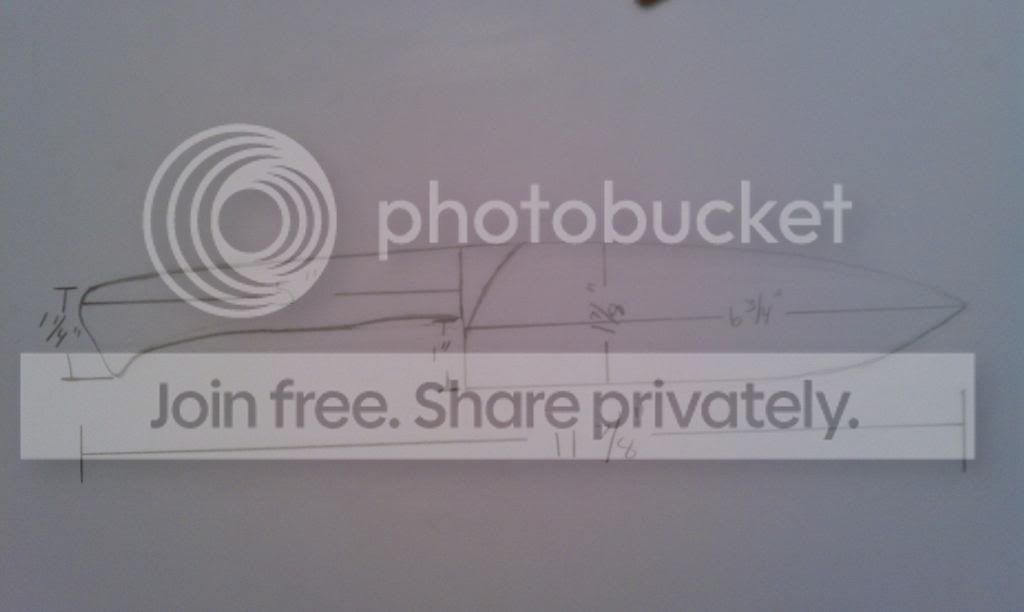
So here it is, critisize it to death, I know my drawing isnt very good but it is the best I have done so far. Here are the dimensions.

-OAL 11 5/8''
-Blade length 6 1/2''
-Handle length excluding ricasso 4 3/4''
-Ricasso is 3/8'' wide from handle to blade and 3/4'' tall
-Thickest part of the handle is 1'' which is at the Butt
-Spine to edge thickest part is 2''....looks kind of funny I think maybe a little smaller???
- 154cm stainless steel 1/8'' thick
If you guys need any other information let me know, Thanks

IMAG0116.jpg
[/IMG]
 
Looks pretty good to me.. You could drop the tip a little bit and stretch the curve on the spine along the entire blade to help the "flow"
I like the blade sketched above it! That looks pretty sweet :D
 
I save all the junk mail envelopes and doodle on them. If I happen to draw something I like I transfer it to a manilla folder. Low tech.
 
I know this won't help much, but I start by noting the dimensions of the billet I will be using, and drawing the outline of the billet several times on a piece of grid paper. This gives me the opportunity to sketch out several designs, knowing that each is possible with the billet. I select the one or two that appeal to me most, and then begin refining the design on a second piece of grid paper with billet outlines.

As for where the inspirations comes from, mostly it comes from staring at the billet and thinking about what would take maximum advantage of the features of the billet. This is particularly true when using a damascus billet, but also applies to monosteel billets (to a lesser degree).

I never bother designing the handle in advance. For me that is a completely separate thought process. I suppose I separate the design steps because I started out making handles for blade blanks. I do think about how much tang I'll need for a handle and what angle I want it to have, but not much beyond that during the blade blank design process.

I guess this could be viewed as breaking down the design process into discrete steps. Design the blank, design the bevels, design the handles... each done separately. Probably not a process anyone else would recommend, but it works for me.
 
So here it is, critisize it to death, I know my drawing isnt very good but it is the best I have done so far. Here are the dimensions.

-OAL 11 5/8''
-Blade length 6 1/2''
-Handle length excluding ricasso 4 3/4''
-Ricasso is 3/8'' wide from handle to blade and 3/4'' tall
-Thickest part of the handle is 1'' which is at the Butt
-Spine to edge thickest part is 2''....looks kind of funny I think maybe a little smaller???
- 154cm stainless steel 1/8'' thick
If you guys need any other information let me know, Thanks

IMAG0116.jpg
[/IMG]


I'm guessing that you mean the Bolster is 3/8" by 3/4"....not the ricasso.
 
My drawing skills aren't all that great, but it might be the bolster. I read the definition of both and I think it is the ricasso, Idk. See the part in my drawing where it is shaded in with a pencil? That part is going to be flat and the bevel will start right where the pencil shaded portions turns to marker. From what I have read I thought a bolster was part of the handle, in the drawing it is going to be flat, but the more I look at it, it does look like it will be part of the handle. I am going to make a new drawing today to refine this one a little. Thanks for the feedback
 
I'm still a big noob too but steel is cheap. If im not quite sure what I want I rough the drawing, cut it out, and see where the grinder takes me (profile wise). If you screw up too bad it can always be a paring knife :D Sometimes the design becomes easier when its in your hand. Course if it were some super fancy high end stainless I might be a bit more careful :foot:
 
Took your advice el0147 I tried to make it flow a little bit better and tweaked it a little bit. Here is a new drawing with dimensions. Also I know chef's knives are supposed to have a longer blade but I am going to see how this smaller blade works. Thanks for the input everyone.

IMAG0117.jpg
 
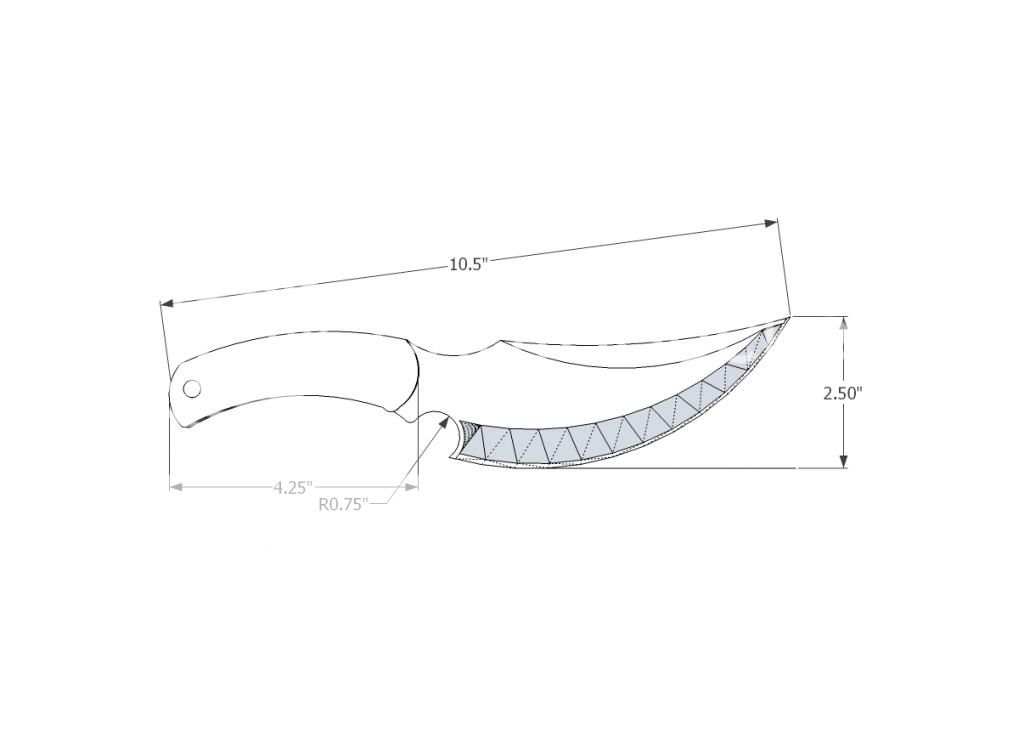
i know it's a bit of an older thread... but i do alot fo freeform design work in google sketchup... it's got a really nice arc tool that lets you plot the ends of your arc then pull it one way or the other to whatever extent you want... lets you mess with deeper or more shallow curves and can be done completely to scale if you want... the free version is really a very powerfull tool...
this was a design i created in there for a knife
knifeideawdimensions.jpg


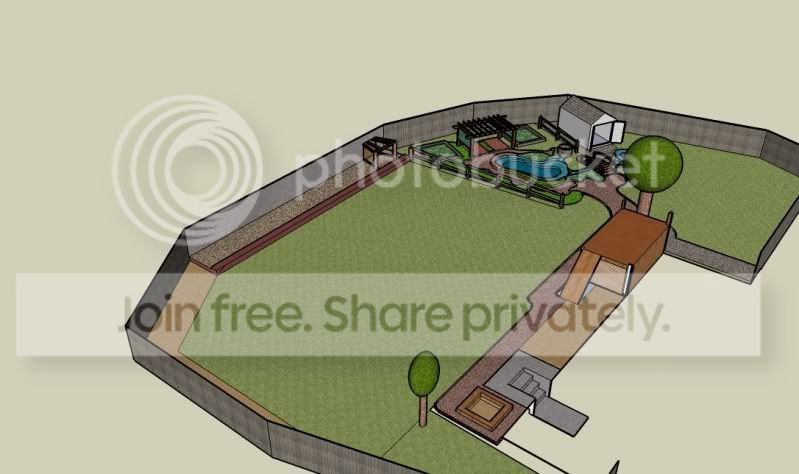
here's a rudimentary layout of my mother-in-law's backyard we were helping her with... show her the final product of sorts so she had something to work towards...
debbiesbackyard-1.jpg


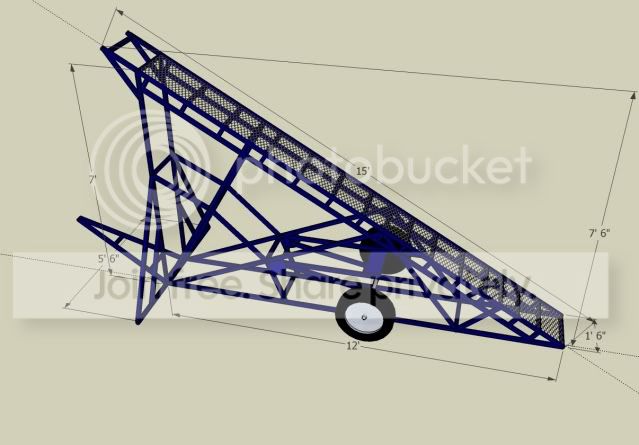
here's a mobile articulation ramp i designed for our offroad club
RTIrampfinalanddimensions.jpg


so alot can be done with it...
 
gotmike, I appreciate it, its funny I was reading your thread and saw the template you made on sketchup, and already started using it. Thanks for posting it here though. It will def help someone else when they search for something like this:thumbup:
 
J. All the 'chefs' knives I see have a slight curve almost the entire edge. This enables a rocking motion when used on the cutting board.
 
Back
Top