Need some help/advice with my flat grinds (pics)

Joined
Dec 15, 2009
Messages
1,008
Hey guys, I've not ground a lot of blades yet, this last batch makes maybe 7-10? Profiling is easy of course, but its the bevel grinds that keep getting me, for a variety of reasons, some of which I'm unaware of. I'm thinking my mistakes are something a lot of you went through, so hopefully you can point them out.

A little about how I grind currently.. it's a BEE 2x72" 2HP variable grinder, 2.5" wide flat platen (new platen -- which I have concerns about), and at the moment my top platen wheel is half gone on one side, which affects slack grinding. I grind edge up, and change hands/directions when it's time to do the other side. With a 2.5" platen, it means a lot of tracking, which is a bit of a pain, but I can live with that or get a 2". I'm using either 60 grit Blaze or 3M Cubitron II belts to start the grinds, then 120 J-Flex (red), and 220, and 400 yellow J-Flex for the finishing. I haven't bothered going higher yet because I'm not very happy with my results. They will be functional knives alright, but not pretty.

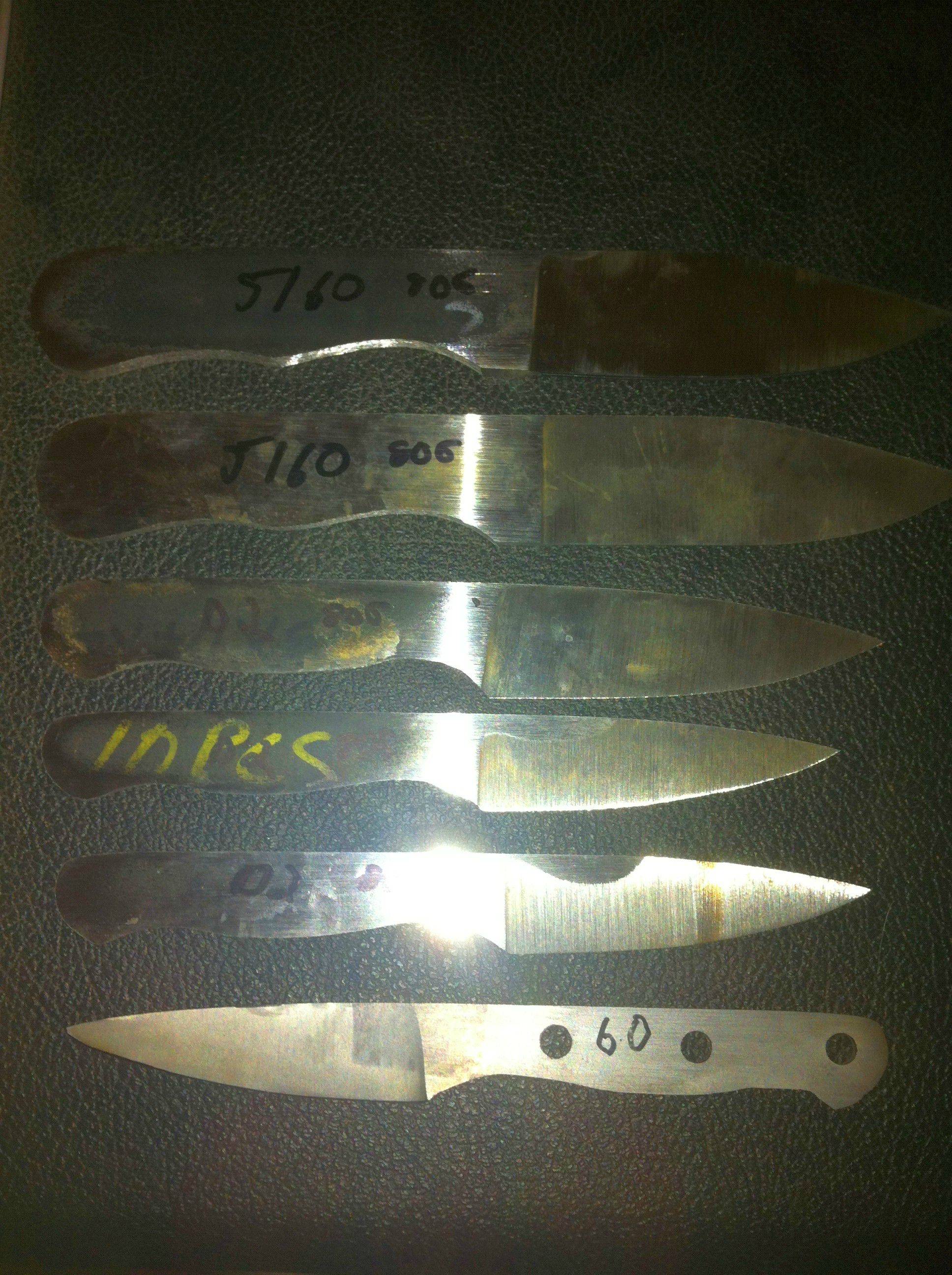
#1 Anyway, problem number one and my biggest problem is running my plunges up off the top of the blade, which forces me to grind lengthwise to flatten it back out and try again at the plunge line. Most of these are paring knives, or very thick (1/4" for the big one) so I don't mind thinning them a little. Which really leads to my second problem, which I don't yet understand. On this batch I used the Bubble Jig to establish the flats, which is going to take some getting used to but it wasn't too bad. I still have some practicing to do with that. I think once I get a handle on using it, the running off the top problem should go away, but after this many blades I'm still not "feeling" it enough.

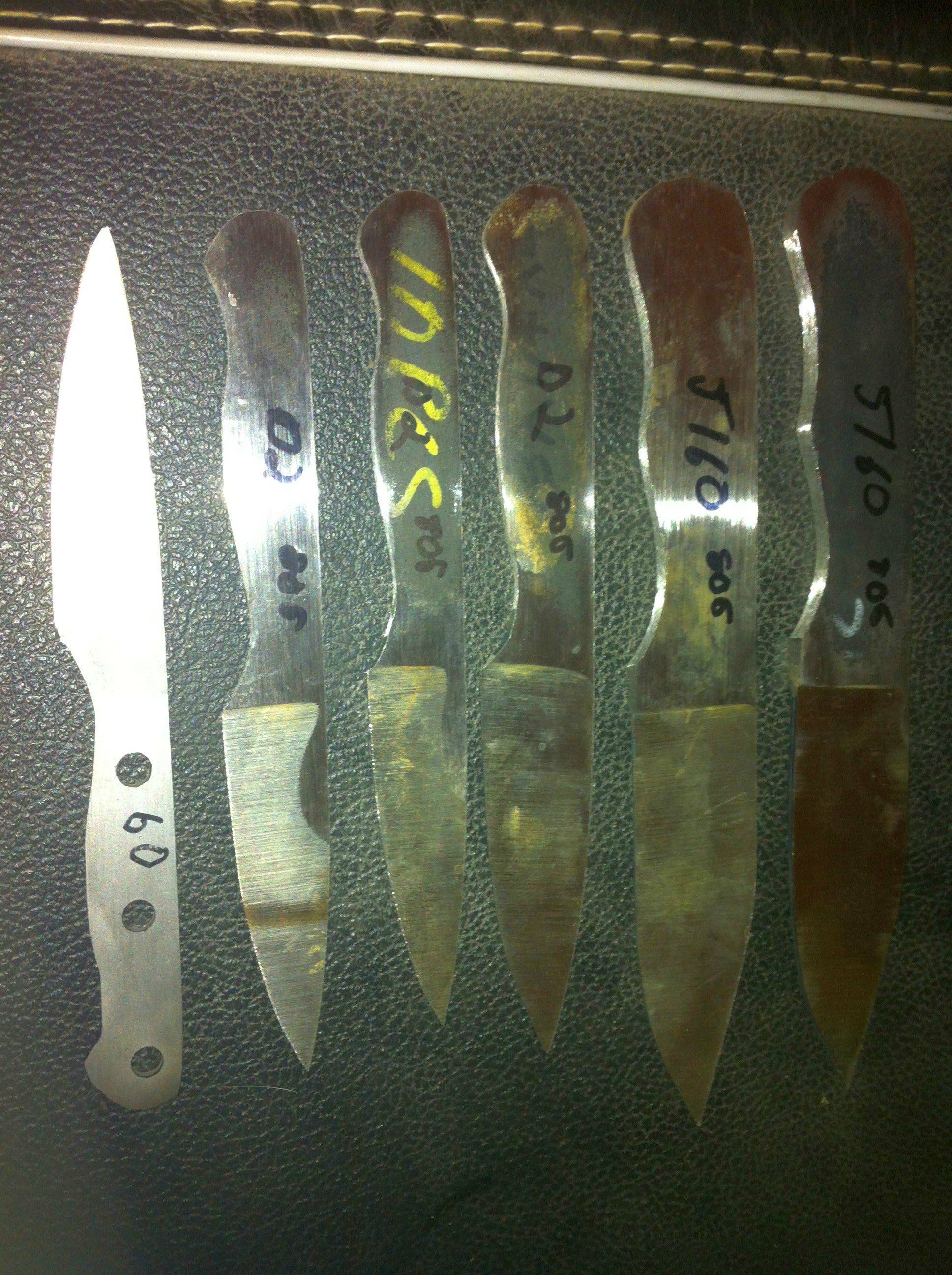
#2 When grinding lengthwise to flatten the blade and ricasso area, or to polish the ricasso on the next grit, the blade is always getting touched by the belt, even when all the pressure is on the ricasso/tang side.

#3 The third problem has just cropped up and I haven't run into it before, and you may not be able to help me with. When grinding smoothly side to side, the blades have started "sticking" in one spot, it almost feels like a strong magnet holding it in place, which ends up making me dish out a spot. I've never run into this before, and it seems to happen more on a larger blade than small paring knives. In the pictures, the two big ones experienced it a lot. I think for whatever reason the belt is digging more on one side and creating a wall that it can't slide past, if that makes sense.

#4 Rust. It happens so fast I can watch it grow almost. I did all these in a batch, and between grits the first ones I put down were already rusted. I was dipping them in water to keep them cool (burned my fingers I don't know how many times). Some are D2 (the paring knives, aside from the one 440C stainless which you can see looks different), and the big ones are 5160.

#5 My platen. It's a new platen, because my last one was dished out horizontally at the top of the work rest. I could have it backwards I have to check still, but it seems that it's dished out lengthwise. If I hold a straight edge horizontally across it, i can see a gap in the middle, but either edge is flat. I'm wondering if this isnt screwing up my grinds and causing the sticking problem. I can lap it on my surface plate but I'm going to check the back side next time I'm in the shop. I thought I'd mention it as it might be relevant to the other problems. I am very much considering getting a whole new platen assembly and putting glass on it, and using it for only knife grinds, and using the old one for everything else. But for now this is what I have.

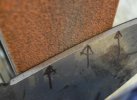
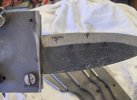
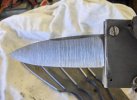
Anyway here are the pictures,you can see the lengthwise grinds on the blade bevel which I described in problem #2. If you need pics of anything specific or close up I can provide them.
OIsEW.jpg

qceKi.jpg


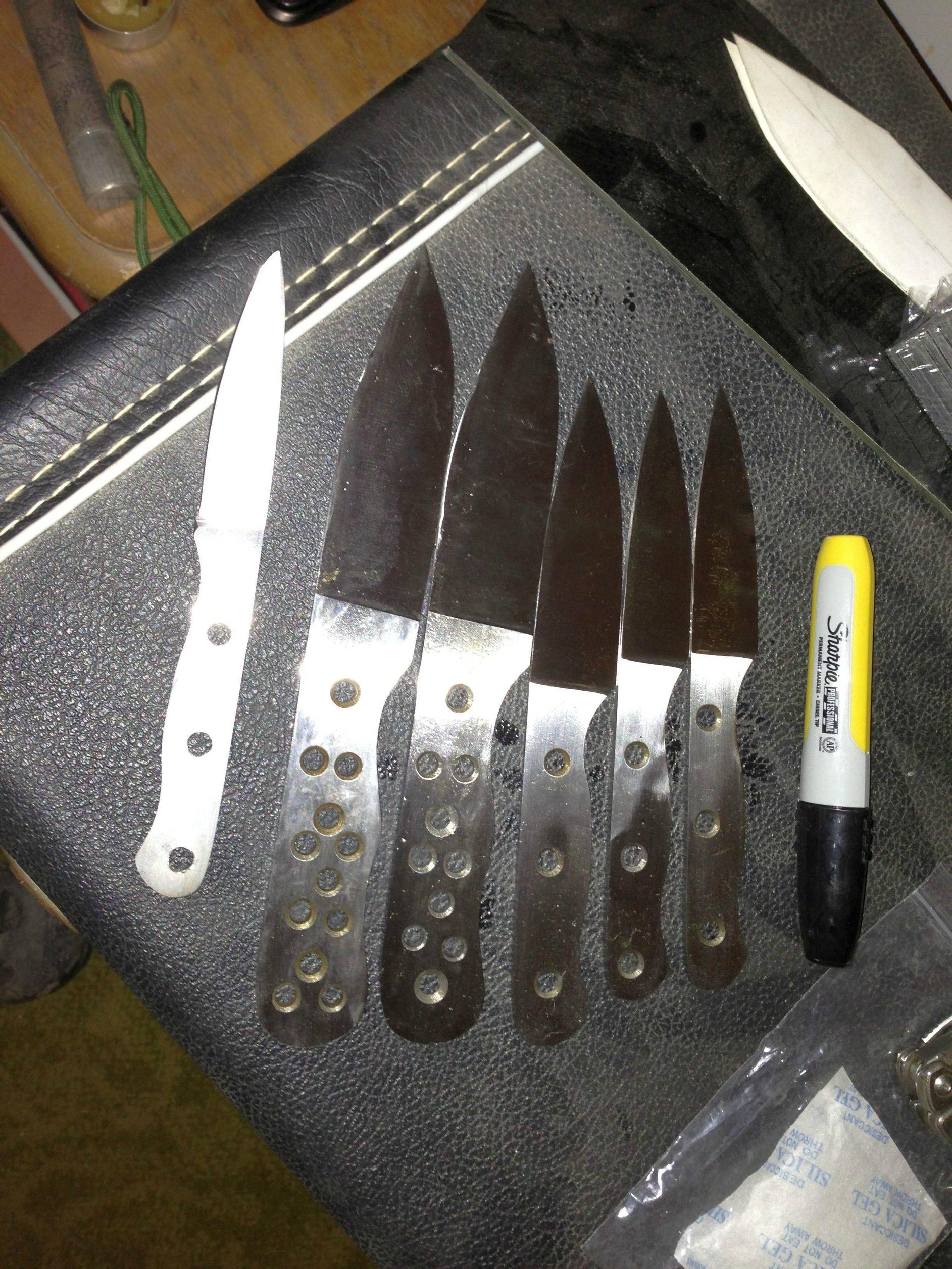
This third pic is at 400G on the blades and ricassos, the holes are drilled (eyeballed these ones, as I forgot to mark them beforehand and I was more concerned with practicing grinds).
ug6WX.jpg


Any help/advice is appreciated. I am clearly missing something.
 
Here's a few thoughts not all in order.

Add some borax to your slack bucket. It will lessen the rusting issue.

Get some 120 belts in cubitron. The stiffer back will help.

When grinding. You say you are setting the bevel with the bubble jig. Are you doing your first grind with the blade at say a 45 to the platen and grinding a first steep bevel, then tilting the blade back slightly the next pass so you see a slight gap between the blade edge and the platen. I use this method to walk the grind up to the spine.

Use Dykem layout fluid or a sharpie.

Get a 2" platen. PM me. I'll send you some 2"x8" Pyroceram free all you pay is shipping.

Hmmmm. That's a start.
 
You could certainly be dished, but another common issue is uneven pressure. You over grind along the plunge line and then further along the blade, but that middle ground right after the plunge gets less belt time/pressure. I do this occasionally and have to pay more careful attention as well as more steady movement along the blade.

I've found I have this problem FAR more with older belts rather than fresh. I attribute it to me trying to force the work. With a fresh belt it cuts so nicely I just focus on my moving smoothly and holding my angle. With a dull one I'm dealing with more heat build up, uneven belt wear causing odd results and the problem of trying to apply more pressure than I can control well. One solution, whether with a fresh belt or not, is to NOT apply pressure against the belt from the sides but from directly in front of the platen. I often hold my off hand steady along the platen, guiding the blade and using my thumb to apply pressure directly into the belt. The main hand is just drawing the blade across and helping hold the right angle, I make sure to focus on keeping it nice and flat on the belt rather than tilting forward or back.

Just keep practicing, use fresh belts and don't work at it so long you start getting impatient or frustrated. Stay focused mentally but physically relaxed.
 
The grinds don't look all that bad,how many blades have you ground total?
I am a slow learner so it probably took me 60-80 blades till I could really feel the grind,and I still screw one up once in a while.:o Also use sharp belts,every knife gets a new belt,maybe 2 blades if they are small.Then use them for profiling a such.
Also on the flash rust,use clean water in your dunk bucket with some dish soap and a couple of tablespoons of baking soda,that will slow it down alot.
Stan
 
Oh yeah. Use a push stick. If you become afraid of burning yourself or hurry a pass on the belt because it's getting HOT, especially on thin knives like fillet knives, you will be likely to mess up the bevels.

I was doing that. Burned my fingers halfway through a grind and would screw up the bevel. Doh!
 
It kind of looks like you are using some heavy pressure on your grinds. When grinding starts to go wrong always put on a new belt, and use light hands letting the belt cut with light to moderate pressure.

If you put dye on your blades and mark your top grind line work your grind up to the line. When you get .25" away throw on a new 120 belt and gently work up the grind line. When you get an 1/8" away from the line put on a good 220 belt and gently walk the grind up to the line. When you get to the line stop. Then put on your 400 belt and lightly refine the bevel.

As for rust I put on pb blaster garage door lubricant available at HD and Pepboys. It will keep the rust off while the blades are on the bench.
 
If you would like, call me between 9am & 9pm central time and I will go over a few things with you. I think it would be better to talk with you than try to type all this. I have experienced all the problems you described except the wide platen.
 
I only recently started using Fred's Bubble Jig. One thing to remember is that while you are setting the grind angles with the wedges, you are still dealing with geometry. Different angles are going to influence how high your grind goes for different thicknesses of steel as you approach your final edge thickness before HT. Too shallow of an angle, and you can easily break the spine, especially on thinner stock or on a blade that is not all that high.

A while back I found an old post with a pdf file for a grind height chart. You found the thickness of your stock, found the height you wanted your grind to be, and then it gave you the angle you wanted to set your grind. I've only started to grind one knife using the chart to determine the angles, and so far it seems to work out well.
 
Here's a few thoughts not all in order.

Add some borax to your slack bucket. It will lessen the rusting issue.

Get some 120 belts in cubitron. The stiffer back will help.

When grinding. You say you are setting the bevel with the bubble jig. Are you doing your first grind with the blade at say a 45 to the platen and grinding a first steep bevel, then tilting the blade back slightly the next pass so you see a slight gap between the blade edge and the platen. I use this method to walk the grind up to the spine.

Use Dykem layout fluid or a sharpie.

Get a 2" platen. PM me. I'll send you some 2"x8" Pyroceram free all you pay is shipping.

Hmmmm. That's a start.

The borax is a good idea, I have lots which got wet so I don't want to use it for forge welding anymore (without baking it or something), but it will work for that ! I got the red Jflex because they're stiffer than the yellow, but still a little flexible for the plunges.. but after doing a batch I think I am going to take our advice and use stiffer 120s and smooth out the plunges on the finer belts. My first grinds were by hand (with a push stick) and I did the 45 method and kept a small gap to work it up, which I picked up from Mr Loveless' video. I had decent luck that way actually, and I might go back to doing that, but I want to give the jig a fair chance first too. I felt I had more control doing it by hand, but I might have just gotten lucky that time. I might try using the sharpie or fluid to see how my grinds are going, especially when I think a belt might be getting worn. It's frustrating to have a nice clean pass and then the next one gets faceted. 2" platen I'm really leaning towards.. actually I will PM you , thank you for the offer! I was using the push stick at times, and thought that might be the problem with my "sticking", so I switched to free hand.. but it made no difference, except that I could feel the flat a little easier.

You could certainly be dished, but another common issue is uneven pressure. You over grind along the plunge line and then further along the blade, but that middle ground right after the plunge gets less belt time/pressure. I do this occasionally and have to pay more careful attention as well as more steady movement along the blade.

I've found I have this problem FAR more with older belts rather than fresh. I attribute it to me trying to force the work. With a fresh belt it cuts so nicely I just focus on my moving smoothly and holding my angle. With a dull one I'm dealing with more heat build up, uneven belt wear causing odd results and the problem of trying to apply more pressure than I can control well. One solution, whether with a fresh belt or not, is to NOT apply pressure against the belt from the sides but from directly in front of the platen. I often hold my off hand steady along the platen, guiding the blade and using my thumb to apply pressure directly into the belt. The main hand is just drawing the blade across and helping hold the right angle, I make sure to focus on keeping it nice and flat on the belt rather than tilting forward or back.

Just keep practicing, use fresh belts and don't work at it so long you start getting impatient or frustrated. Stay focused mentally but physically relaxed.

Remy thanks for that reminder, I get out to work in the shop to seldom it's hard to pull myself away, and I do get a little frustrated and start making more mistakes. I need to take more breaks. Not only that but I had creases in my face for hours from the respirator :/ I think the sharp belt helps with keeping the pressure even as well, but I am guilty of bearing down and trying to hog a lot of metal at once. I've been holding the tang and using the flat back of my index finger (gloved) to hold the blade at times, which leads to a very burnt finger after a few hours.

The grinds don't look all that bad,how many blades have you ground total?
I am a slow learner so it probably took me 60-80 blades till I could really feel the grind,and I still screw one up once in a while. Also use sharp belts,every knife gets a new belt,maybe 2 blades if they are small.Then use them for profiling a such.
Also on the flash rust,use clean water in your dunk bucket with some dish soap and a couple of tablespoons of baking soda,that will slow it down alot.
Stan

Stan, I think this batch of 6 will make it around 10 ground blades, maybe 8-9. Not a lot by any means, but I feel like my early ones were almost better than these, as if I'm overthinking things and getting worse. Trying a new method of grinding probably has something to do with it though. I do try to use fresh belts, and switch them out when it gets to where I don't think it's cutting right, but it will take me a while to get a handle on when to switch. It's hard not to try to milk that belt for a few more passes to finish up the batch at a particular grit though, especially if it's the last belt you have in that grit. I suppose I just need to buy more belts in each grit, and stop being cheap about it. Clean water is probably a good idea, as mine was a dirty bucket I just put hose water in, and it had no surfactants or cleaners of any kind. I will definitely try that, either borax or dish soap and baking soda. And I will find a dedicated bucket for next time, so I'm not using dirty old containers. THanks Stan!

I was doing that. Burned my fingers halfway through a grind and would screw up the bevel. Doh!
Yep! And I found out that a wet glove/knife conducts heat 25x faster than a dry one.. Burns you very quickly after you've been dunking for a while and your hand is wet.

It kind of looks like you are using some heavy pressure on your grinds. When grinding starts to go wrong always put on a new belt, and use light hands letting the belt cut with light to moderate pressure.

If you put dye on your blades and mark your top grind line work your grind up to the line. When you get .25" away throw on a new 120 belt and gently work up the grind line. When you get an 1/8" away from the line put on a good 220 belt and gently walk the grind up to the line. When you get to the line stop. Then put on your 400 belt and lightly refine the bevel.

As for rust I put on pb blaster garage door lubricant available at HD and Pepboys. It will keep the rust off while the blades are on the bench.

Guilty as charged, I have been grinding pretty heavily to remove metal fast, but on a relatively slow speed (30-40%). I will try to lighten up and let the belt do the work. Do you think a fast speed and light touch are better, or a slow speed as well?
I know in theory that I should be slowly working that line up the bevel, but in practice I get a few good passes and it's looking good, then poof its way too high on the next pass, and I have a facet that I need to work down as well, to bring it back in line with the main bevel. THat's where I run into my biggest problem. I will try the lubricant (would WD40 work short term like that?) if the soaps and baking soda don't help. The rust is okay pre HT I think, as long as it's not too bad, because I'll grind it off after HT anyway, but definitely I don't want it happening at the finishing stages.

Darrin, thank you that is very kind. I may take you up on that! It would help to talk to someone who has overcome these things. As for the platen I think I will take the advice and get a 2" platen, and use my 2.5" D2 for some big choppers eventually, rather than make my own platen.

One thing to remember is that while you are setting the grind angles with the wedges, you are still dealing with geometry. Different angles are going to influence how high your grind goes for different thicknesses of steel as you approach your final edge thickness before HT. Too shallow of an angle, and you can easily break the spine, especially on thinner stock or on a blade that is not all that high.
You're right NS, and I did try changing angles on the blades, but I was having trouble visualizing what was wrong at the time. I think I'll do better on the next batch in that respect. If you come across that PDF though, let me know ;)

Thanks all for your help, and advice. I will try to apply it !
 
A lot of the flash rust you see is ground off metal your picking up out of your dip bucket.The dish soap will let the particles sink and the baking soda will put a little coating on the blades.

Stan
 
Great tips all around.

I think they look really good for the amount of knives you have made, keep practicing and you will keep getting better.
 
Great tips all around.

I think they look really good for the amount of knives you have made, keep practicing and you will keep getting better.

Thanks Daniel, it's reassuring to hear from someone much more experienced. You do very good work.

A lot of the flash rust you see is ground off metal your picking up out of your dip bucket.The dish soap will let the particles sink and the baking soda will put a little coating on the blades.
Stan

Oh that makes sense! Definitely gonna do that! I think I'm going to put a slack bucket under my grinder too, since I'm not really using the work rest anyway.
 
If you grind on a higher speed to hog off material then slow down your grinder as you refine your grind lines it is much easier then grinding slow and pushing hard.
 
If you grind on a higher speed to hog off material then slow down your grinder as you refine your grind lines it is much easier then grinding slow and pushing hard.

I will keep that in mind.. I'm going to try using a lighter touch next time. That is one thing the Bubble Jig was good for, for me, was I was so busy concentrating on the bubble I wasn't getting in a hurry and pushing too hard. As a result my grinds were pretty even up to that point!

And thanks to Darrin, for the advice on the phone, I'm sure that will be very helpful!
 
Last edited:
First off, quit pee'n in your grinder bucket! :eek:


:p :D

A lot of good advice posted here. Having ~10 blades under your belt is WAAAAAAY too soon to be getting down on yourself about your grinding skills.

When I first got started, there were a lot of guys that liked to say you should be fairly comfortable grinding once you got in about 5 blades. :rolleyes: Unless a guy is just super gifted, that theory is total crap and isn't going to happen.

The best advice I can give you, is that you should find a guy who's work you like, and see if you can pay him for a grinding lesson. If you find someone that's good, you will cut years of frustration out of the equation.

And practice, practice, practice... :)
 
First off, quit pee'n in your grinder bucket! :eek:


:p :D

A lot of good advice posted here. Having ~10 blades under your belt is WAAAAAAY too soon to be getting down on yourself about your grinding skills.

When I first got started, there were a lot of guys that liked to say you should be fairly comfortable grinding once you got in about 5 blades. :rolleyes: Unless a guy is just super gifted, that theory is total crap and isn't going to happen.
The best advice I can give you, is that you should find a guy who's work you like, and see if you can pay him for a grinding lesson. If you find someone that's good, you will cut years of frustration out of the equation.

And practice, practice, practice... :)

Hah, thanks Nick :) Unfortunately I can't afford to travel to Castle Rock right now ;) But It's good advice, and if I get a chance I might do that. But thanks mostly for the perspective, it helps to know that I'm not too far off track. I will keep at it!

Much appreciated!
 
Here are some pics that I did for some others when I was showing how I flat grind, I go free hand so this is one way.

Pic 1, I do a 45 on each side of the blade, leaving a dime thickness prior to heat treat (thinner for stainless)
Pic 2 I place the edge of the 45 bevel on the belt and start grinding, throughout this process I will never be making my edge (the dime) thinner

Pic 3 Keep moving the grind up the blade, notice that there is still part of the 45 there protecting the edge (the dime), looking at this it is obvious that I will run out of 45 before I get to the spine of the blade, so I will change the angle slightly and grind where the arrows point. this is a very slight adjustment
Pic 4 I am still moving up the blade making my grind flat,
Pic 5, here I am nearly done, notice that there is still metal at the spine and a tiny bit of my 45 left, I have not run into my dime thickness, at this point I will go to finer belts and with a little luck when the 45 is gone I will be at the top of the spine, and on my fine belt.

You probably didnt know it was so easy?? it is tough and takes time

crap I wish I had used one of my better egde guides this looks pretty bad.

HPIM3588.jpgHPIM3589.jpgHPIM3591.jpgHPIM3595.jpgHPIM3599.jpg
 
You are much farther along than you think. Give yourself a pat on the back for what you have accomplished. I gave away the first fifty knives I made, they weren't good enough to sell and not close to what you are grinding.
Good info all around; but most of all have confidence in yourself. You have talent.
 
Here are some pics that I did for some others when I was showing how I flat grind, I go free hand so this is one way.

Pic 1, I do a 45 on each side of the blade, leaving a dime thickness prior to heat treat (thinner for stainless)
Pic 2 I place the edge of the 45 bevel on the belt and start grinding, throughout this process I will never be making my edge (the dime) thinner

Pic 3 Keep moving the grind up the blade, notice that there is still part of the 45 there protecting the edge (the dime), looking at this it is obvious that I will run out of 45 before I get to the spine of the blade, so I will change the angle slightly and grind where the arrows point. this is a very slight adjustment
Pic 4 I am still moving up the blade making my grind flat,
Pic 5, here I am nearly done, notice that there is still metal at the spine and a tiny bit of my 45 left, I have not run into my dime thickness, at this point I will go to finer belts and with a little luck when the 45 is gone I will be at the top of the spine, and on my fine belt.

You probably didnt know it was so easy?? it is tough and takes time

crap I wish I had used one of my better egde guides this looks pretty bad.

View attachment 312936View attachment 312937View attachment 312938View attachment 312939View attachment 312940

That's cool Patrick, that's sortof how I did my first grind actually, only I didn't leave that tiny little 45 there. I will certainly keep those pics and that post as something to try! Thank you.

Fred.Rowe You are much farther along than you think. Give yourself a pat on the back for what you have accomplished. I gave away the first fifty knives I made, they weren't good enough to sell and not close to what you are grinding.
Good info all around; but most of all have confidence in yourself. You have talent.

Fred, thank you for the kind words, that is very nice of you and means a lot! You're right I am very critical of myself in a lot of ways, it's in my personality I guess. I will certainly keep at it though!

And thanks everyone for all the advice, I do very much appreciate it!
 
As the others have said , practice

I've thrown away steel to be measured in feet, or hundreds of pounds and I'm still no good yet.

My comments are about getting the most out of practice


Start with one knife design, in one steel, in one thickness
and do say, 10 or 20 all the same.

different steels grind harder or softer, different designs have more or less area and such.
That way you will see and feel how the differences in how you grind affect the outcome in the same way.


These other tips are about seeing what each pass did, where the steel came off.

You can eyeball very very slight differences - changes of a few thousands of an inch, but it helps to have a standard reference.


I used layout fluid Dykem and very lightly scratched a series of lines on the blade before profiling basically in a grid.
That way I could eyeball one side to the other to make them match.

Of course I did 3 heavy scratch lines on the edge, one in the centre, two others ..010 on either side of that
I watched that to help keep my centred.

I started with a very fine 400 or 600 belt because my grinder was full speed and that was one way I could slow it down.
It also meant that if I decided it was time to stop grinding I was already at the end grit and didn't have to leave more thickness to run through the rest of the grits.
Turns out Ed Caffrey mentioned doing the same thing at one time so I felt all validated :)


When it comes to throwing out a blade, It's not all or nothing.
Do what you can to fix it like you are by thinning, or trimming the point whatever it takes.
That will help you think about how it went wrong and how to fix or avoid it.

Maybe you start with 10 Bowies and end up with 10 paring knives, if you don't tell anyone they won't know anything except what they have in their hands.
"There are no mistakes only design changes"
 
Back
Top