Need some help/advice with my flat grinds (pics)

As the others have said , practice

I've thrown away steel to be measured in feet, or hundreds of pounds and I'm still no good yet.

My comments are about getting the most out of practice


Start with one knife design, in one steel, in one thickness
and do say, 10 or 20 all the same.

different steels grind harder or softer, different designs have more or less area and such.
That way you will see and feel how the differences in how you grind affect the outcome in the same way.


These other tips are about seeing what each pass did, where the steel came off.

You can eyeball very very slight differences - changes of a few thousands of an inch, but it helps to have a standard reference.


I used layout fluid Dykem and very lightly scratched a series of lines on the blade before profiling basically in a grid.
That way I could eyeball one side to the other to make them match.

Of course I did 3 heavy scratch lines on the edge, one in the centre, two others ..010 on either side of that
I watched that to help keep my centred.

I started with a very fine 400 or 600 belt because my grinder was full speed and that was one way I could slow it down.
It also meant that if I decided it was time to stop grinding I was already at the end grit and didn't have to leave more thickness to run through the rest of the grits.
Turns out Ed Caffrey mentioned doing the same thing at one time so I felt all validated :)


When it comes to throwing out a blade, It's not all or nothing.
Do what you can to fix it like you are by thinning, or trimming the point whatever it takes.
That will help you think about how it went wrong and how to fix or avoid it.

Maybe you start with 10 Bowies and end up with 10 paring knives, if you don't tell anyone they won't know anything except what they have in their hands.
"There are no mistakes only design changes"

Hehe, that is sound advice Count. I agree about doing all the same knives, I intended to but I had those two bigger ones I profiled last year for my boss (was doing two because I figured one might turn out nicely and I'd keep the other). I even had different thicknesses because that's just what 5160 I happened to have on hand at that time. It sure made figuring out the angles to use with the jig a problem, because any changes I made were just one of many variables.

My next batch will be a lot more uniform!

When you say you started with a 400 grit, you mean you actually ground the bevels starting at 400? I'd never considered that..

My first knife I ground I did a center line, and two lines to either side as well, because I'd seen SR Johnson do it, and I like that method as well. This time I just did a center line and tried to eyeball the thickness. I will go back to 3 lines I think though, until I have more practice. I need to figure out what's wrong with my height gauge though, it doesn't seem to gauge accurately. I measured the height it was at with my calipers, and the gauge is totally wrong. I got it from Grizzly, but pretty sure it was made in a foreign country.. the instructions certainly weren't written by someone who speaks English as a first language anyway.

I haven't tried drawing lines for my grinds yet, as I frankly couldn't keep them from going over the top anyway. But after talking to you guys and Darrin I think I have a fighting chance this next time around. I will certainly try it next time.

Ya I am making these for my kitchen anyway, except the big ones I'll give away, so I'm not too concerned if they're perfect from a purely practical standpoint, they will cut food up just fine despite the flaws. But I am trying for perfection of course, simply to improve, which is a lifelong thing.

I definitely appreciate the advice, and making the most of my practice is exactly what I need to do.
 
The 45 is important because it keeps you from grinding away the edge before you get to the spine. Once you get use to eye balling how much of the 45 is left compared with how far you are up the blade, everything goes alot easier.

Good luck
 
The 45 is important because it keeps you from grinding away the edge before you get to the spine. Once you get use to eye balling how much of the 45 is left compared with how far you are up the blade, everything goes alot easier.

Good luck

That's true. How do you wittle down the 45 without raising the bevel grind line? I think it will make sense once I try to do it though.
 
I would stick with 60 - 80 grit for stock removal, that is what most do, I cannot imagine using 400 for stock removal although there are a few knifemaker that do. A light touch with a 80 grit is very controllable.

the only trick is to watch the gap between the dime (what you want to keep) and the belt. If you make a steeper angle, you will remove more of the 45 and less up the spine and the gap will be smaller. If you make a shallow angle, you will move more up the spine, larger gap. never loose the gap, if it is getting small stop and decide where you are going to place the blade against the belt that will not reduce the gap.

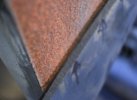
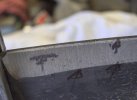
When grinding I do not look and anything but the gap, I make a couple of passes and then review the damage, and decide what I need to do for the next pass. Take a look at this pic, the angle is shallow and there is a large gap between the belt and the edge, this cut will more faster to the spine than to the edge thus moving up the spince. Notice that the grind is starting on the edge of the 45, as the grind moves up you will start the next pass up the spine where the previous left off.

HPIM3590.jpgHPIM3592.jpg
 
Last edited:
I would stick with 60 - 80 grit for stock removal, that is what most do, I cannot imagine using 400 for stock removal although there are a few knifemaker that do. A light touch with a 80 grit is very controllable.

the only trick is to watch the gap between the dime (what you want to keep) and the belt. If you make a steeper angle, you will remove more of the 45 and less up the spine and the gap will be smaller. If you make a shallow angle, you will move more up the spine, larger gap. never loose the gap, if it is getting small stop and decide where you are going to place the blade against the belt that will not reduce the gap.

When grinding I do not look and anything but the gap, I make a couple of passes and then review the damage, and decide what I need to do for the next pass. Take a look at this pic, the angle is shallow and there is a large gap between the belt and the edge, this cut will more faster to the spine than to the edge thus moving up the spince. Notice that the grind is starting on the edge of the 45, as the grind moves up you will start the next pass up the spine where the previous left off.

View attachment 313093View attachment 313094

I think thats what I was trying to do essentially, my first time. It didn't turn out bad either! My "First Damascus" pics in my profile show the results.. but I think it was partly luck. I do think that method has merits though, certainly, and combined with other advice I think will help a lot. Thanks Patrick, especially for the pics, it helps to see things.
 
Btw. Is it a rubber contact wheel that's chewed up?
If so, you can split a 2" belt to 1" wide. Put it on the wheel and hold a file lengthwise across the wheel to basically draw file it smooth. Easy as pie. In fact I had to do that with my 8" wheel when it was new to get it to run smoothly. You can use a 2" belt but the 1" let's you see the wheel better.

Also, again on the belt wandering on the platen when you grind. That's almost always a sign of not enough tension. I bought an old Wilton Square wheel for $200 because the guy though it was broken. He chased a piece of steel ALL OVER the platen to show me. I got it to my friends house and an adjustment to the tension arm and platen and all the wobble went away.
 
Btw. Is it a rubber contact wheel that's chewed up?
If so, you can split a 2" belt to 1" wide. Put it on the wheel and hold a file lengthwise across the wheel to basically draw file it smooth. Easy as pie. In fact I had to do that with my 8" wheel when it was new to get it to run smoothly. You can use a 2" belt but the 1" let's you see the wheel better.

Also, again on the belt wandering on the platen when you grind. That's almost always a sign of not enough tension. I bought an old Wilton Square wheel for $200 because the guy though it was broken. He chased a piece of steel ALL OVER the platen to show me. I got it to my friends house and an adjustment to the tension arm and platen and all the wobble went away.

Thanks Brian. I'm not really having the wandering problem, it's more just that because its 2.5" wide I have to move it half an inch plus overhand each time I change hands and sides of the grind. It does wander when I slack grind because of the top wheel though. Yep it's rubber. I thought about sanding it down like that actually, but it would be about 1mm thick across when I am done.. However I still probably will! I still want to get a second platen assembly just so i can keep the glass safe on one, and use the other for stuff stuff like general shop tasks.

With tension I went too taught on a jflex and ended up grinding the top of the dust guard and causing quite a knocking/wobble effect. Took me a while to realize it was the tension wheel grinding against the top! But normally tension isn't a problem. I did have some belts doing the wobble but not from pressure, just on their own. I think that is the top wheel perhaps. I will try sanding it down though, thanks!
 
Thanks Brian. I'm not really having the wandering problem, it's more just that because its 2.5" wide I have to move it half an inch plus overhand each time I change hands and sides of the grind. It does wander when I slack grind because of the top wheel though. Yep it's rubber.
I thought about sanding it down like that actually, but it would be about 1mm thick across when I am done.. However I still probably will! I still want to get a second platen assembly just so i can keep the glass safe on one, and use the other for stuff stuff like general shop tasks.

With tension I went too taught on a jflex and ended up grinding the top of the dust guard and causing quite a knocking/wobble effect. Took me a while to realize it was the tension wheel grinding against the top! But normally tension isn't a problem. I did have some belts doing the wobble but not from pressure, just on their own. I think that is the top wheel perhaps. I will try sanding it down though, thanks!

With the Bee, the wheel is on an eccentric, once you reduce the diameter, you can adjust the wheel to stick out more so the belt runs flat on the platen.
 
Last edited:
With the Bee, the wheel is on an eccentric, once you reduce the diameter, you can adjust the wheel to stick out mote so the belt runs flat on the platen.

Really? I didn't realize it was adjustable! I will take a look at that, thanks Count.
 
Back
Top