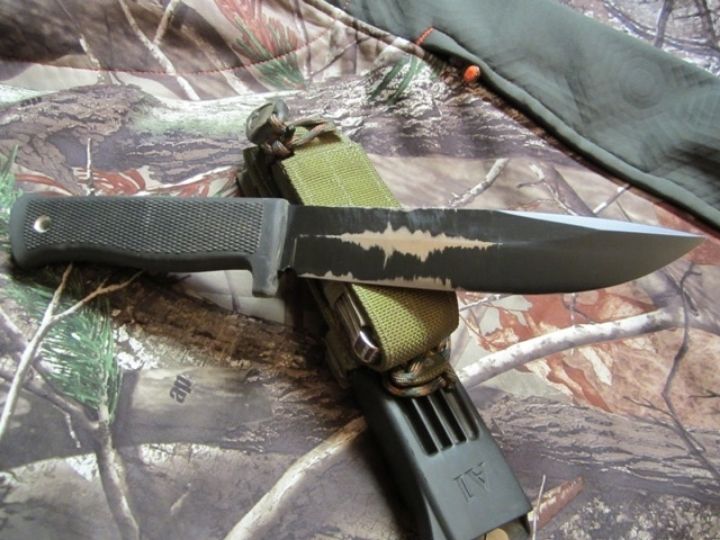
New survival Knife (Bush Craft/BOB)

Love the becker tweeners! But I'm dying to get ahold of a fallkniven also. I doubt you could go wrong either way. I'd personally choose the becker and then invest in a nicer sheath (though the stock sheath is perfectly functional) and you would still do well to pick up a $15 mora and a $25 fiskars hatchet to complement it.

Or... you could get an opinel folder, mora fixed, Fiskars hatchet, SAK multi, and a Bahco saw for less than $100 and be ready for anything. That quintet will take care of any and all outdoors tasks. Not the sexiest tools out there, but capable enough.
 
A lot of good recommendations here but I'm in with Fallkniven camp. The A1 is what defines a survival knife to me. The VG-10 steel they use is amazing. I've beaten mine pretty good and it has yet to fail me in any way.

A12_zps0ykfs5yc.jpg


That looks like it might be a custom sheath? Is it MOLLE compatiable? Would you mind sharing how you did it? I'm still torn between the S1 and BK-10/17, as I'd prefer something with aMOLLE compatible sheath. The S1 looks like an awesome Knife, but I feel like I would need new grips, (Which they don't make blank ones anymore), and a new sheath. So it's dumping more money into an already expensive knife. It would be easier to get the 10/17, ask on the forums how to strip the paint, some patina, and other mods, and buy grips. I'm still pretty new to knives, and it'd be great if I could get the S1, and someone walk me through making a handle :)
 
Last edited:
Or... you could get an opinel folder, mora fixed, Fiskars hatchet, SAK multi, and a Bahco saw for less than $100 and be ready for anything. That quintet will take care of any and all outdoors tasks. Not the sexiest tools out there, but capable enough.

Don't forget to throw in a decent ~$10-15 latin pattern machete!! ie. Tramontina, Imacasa, etc...

Otherwise :thumbup::thumbup: on covering those bases!
 
Also, another point. If you have been following this post, I would really prefer to use exclusively Amazon. The Fallkniven S1 is priced at 170, which is a decent price for that knife. However, I don't believe there are any grip materials, and definitely no sheaths on Amazon. However, the Ka-Bar 10/17 (I don't know which one to choose! Probably 17, as it is lower than 5 inches. Another one of my threads mentions that. GA Laws and such. I could technically carry the 10.) I can get the blade, Handles, and a sharpener, for cheaper than just the base S1. Now I know that sharpeners for a convex edge are cheap, but there still has to be Custom Sheath and Grips t, because it is not as popular for mods as the Becker, making stuff harder to find. I suppose I could live with having to pay more, but if there is no HUGE advantage over the Becker, the S1 might not be worth the hassle. :confused:

(This guy made exactly what I would like. I'm guessing it's still possible to take the grips of the S1, since it isn't blank? https://ougir.wordpress.com/2013/06/26/fallkniven-s1-micarta-custom-handles/)
 
That looks like it might be a custom sheath? Is it MOLLE compatiable? Would you mind sharing how you did it? I'm still torn between the S1 and BK-10/17, as I'd prefer something with aMOLLE compatible sheath. The S1 looks like an awesome Knife, but I feel like I would need new grips, (Which they don't make blank ones anymore), and a new sheath. So it's dumping more money into an already expensive knife. It would be easier to get the 10/17, ask on the forums how to strip the paint, some patina, and other mods, and buy grips. I'm still pretty new to knives, and it'd be great if I could get the S1, and someone walk me through making a handle :)
That is the stock sheath. I simply affixed a Maxpedition mag pouch to it with some velcro and small zip ties. I do however have a custom sheath for it from YellowHawk Custom Kydex on the way.

Curious, why would you want to change the grips on the A1? In my opinion the Kraton handle is part of what makes this knife great. They are very grippy and inspire a lot of confidence in the hand even when soaking wet. In fact, if you're going to change the grips on anything it would be the Becker grips as those are not known for providing a lot of traction.
 
I just think they seem very lack-luster in the width department. I mean, I have small/medium hands, but it just doesn't look like a very big grip. I guess I could keep them. Is there a way to rig up this sheathe to be MOLLE? (Also, I'm looking at the S1, so it has smaller grips)
 
...Should I get the Black coat, or keep the Satin finish?
Black blades are for looks or tactical covert deadly operations. Other than that, most of the black coatings just add drag to the blade and once they start wearing out, the blade looks like crap (to me, some call it character and are pretty happy about it). Also, if you screw up sharpening and slip... you will scratch the finish with the corner of the bench stone.
Blade coatings make sense in non-stainless blades to protect it from rust... so maybe the BK-17 benefits from it. But the S1 definitely NOT.

Obviously, the 17 is 100$ dollars cheaper.
The 17 is a great knife, but the materials are quite different, that's the reason for the different price! You are comparing a basic carbon steel against a laminated (420-VG10-420) stainless blade.

With that money I could get some mods or something.
Mods will not change the nature of the knife.

Also, for either knife, whichever gets the better ratings here, is the Spyderco Triangle 204MF a good sharpener? I have no experience sharpening, so is there something that would work better for me?
You haven't done your homework correctly... but we are here to help. The Sharpmaker is a fantastic semi-guided sharpening system. Meant mostly for touch ups, since the stones have a fairly fine grain (unless you buy the additional diamond coated rods). Not that great for reprofiling or big sharpenning jobs (unless you lay a regular stone agains the rods so as to maintain the same angle during the first phase of gross metal removal!)
Also, the Sharmaker is king for sharpening serrations (provided the dimensions are compatible with the radius of the corner of the stones).

BUT, and this is a big BUT.... they are meant for V edges... while the S1 you are considering has a nice CONVEX EDGE. Which is meant to be sharpenned in a totally different way with different tools. Take a piece of plywood, glue some mouse pad material (or similar hard foam) to it and lay a piece of wet-dry sandpaper on it... done. That's all you need. If you want a polished edge, then you can strop it on leather loaded with compound.

If you put a convex edge to the sharpmaker, you will creat a microvebel... which is not bad, but ruins the idea behind a convex edge.
 
Quite frankly I don't think there is any idea behind a convex edge, besides preserving the self-esteem of the owner in the face of his lack of constant angle motor skills...

Gaston
 
Quite frankly I don't think there is any idea behind a convex edge, besides preserving the self-esteem of the owner in the face of his lack of constant angle motor skills...

Gaston

Interesting postulation considering your track record.
 
Quite frankly I don't think there is any idea behind a convex edge, besides preserving the self-esteem of the owner in the face of his lack of constant angle motor skills...

Gaston

For something being SUPER EASY to perform seems like an advantage to me... If this edge geometry allows people with little or no sharpening equipment or skills to get a nice sharp edge... what is the problem with it?

Besides, even those with the best motor skills... are nowhere near a constant angle while sharpening freehand... We are no milling machines. Somewhere i read that, whether we like it or not, sharpening on a benchstone will always produce convex edges (to some extent).
 
You haven't done your homework correctly... but we are here to help.
Ah yes. You CAN sharpen with that, but it will loose the convex. So, sharpening the Convex ends up being a lot cheaper, as I could just buy some Green Compound and leather. However, It will end up costing about 190$ For the knife, and then I have 30 dollars in Name Tape for my pack and jacket. Also, I found a cheaper, non-custom MOLLE sheath that is 50$. The "Spec-Ops Brand Combat Master Knife Sheath 6-Inch Blade". I would end up having only 20$ left for "Free stuff" With the BK with grips, and sharpener, it's 190$, with 90 to spare. Will the Fallkniven last forever if maintained? Is the stock-sheath MOLLE "Riggable"? In your opinion, is it really worth it over the 17?
 
For something being SUPER EASY to perform seems like an advantage to me... If this edge geometry allows people with little or no sharpening equipment or skills to get a nice sharp edge... what is the problem with it?

Besides, even those with the best motor skills... are nowhere near a constant angle while sharpening freehand... We are no milling machines. Somewhere i read that, whether we like it or not, sharpening on a benchstone will always produce convex edges (to some extent).

Correct on all counts. Its an edge that takes advantage of the fact that, when using a benchstone, you are creating a series of micro bevels.
 
Will the Fallkniven last forever if maintained?
Almost correct but I would go as far as telling that the Fallkniven will last forever EVEN if neglected. Listen, I own a few decent fixed blades (RC4, BRKT Aurora, BRKT Canadian Camp, F1, S1, RAT-7 and a few more). I don't take them out often, and when I store them, I don't always oil them. I don't live in the most humid environment but even though, the A2 on the BRKT and the exposed edge on the RC4 stain with time. The F1 and S1 look like new.

Is the stock-sheath MOLLE "Riggable"?
Nop, it is not. You only get a simple belt loop. If you really need it to be MOLLE compatible, you need to put something together yourself.

In your opinion, is it really worth it over the 17?
Both are going to last a long time, even if you don't maintain them properly. Both are going to cut well, provided you thin the edge of the BK17 a bit. Both share the same overal geometry (saber ground) despite one being convex ground. One is coated, so is going to look worse with time and will drag more when slicing than the satin blade one. BK17 allows for customizing thanks to the screw on handle slabs, the F1 doesn't. None of the seaths are MOLLE compatible, so you need to get an aftermarket one.
One is US made and the other one is made in Japan (even if it sold by a Swedish company!), just in case it matters.

Both will serve you well, I think that now that you have narrowed your choices, it is totally up to you. Is more of a matter of looks.

Just one more question, have you checked the weight of both options (blade+sheath?? With this size of blade I don't think you will be doing much chopping... so everything else being equal, I would probably pick the ligthest one!
 
By riggable, I mean how hard will it be to make it MOLLE?
If you're talking about the A1 or S1 sheath, I suppose you could apoxy a VanQuest molle stick or a Blade-Tech molle lok or something similar to the back of it. You're probably better off just buying a universal nylon sheath from Specops or a custom kydex one from somewhere.
 
Alright. I'm getting the Falk S1 with a spec ops sheath. Thanks for all the help! Should I get some cheap leather, or use cardboard for stropping? And if I'm keeping it factory sharp, which I hear is pretty sharp, should I get Green or White compound? Last question hopefully ;)
 
For something being SUPER EASY to perform seems like an advantage to me... If this edge geometry allows people with little or no sharpening equipment or skills to get a nice sharp edge... what is the problem with it?

The problem is convex edges cut poorly. I have seen them all, including professionally applied re-grinds to a zero edge on a full height flat grind, and they all cut poorly. For chopping they are much closer to a V edge, especially on a heavy knife, or against a thick V-edge on a Full Flat Grind, but with matching thicknesses where it matters, they still tend to be inferior.

Probably the only thing a convex edge does better, when done full height on a Full Flat Grind, is what it was initially intended to do by Bill Moran when he introduced the idea on knives: Cutting free-hanging 1" manila rope...

That is why they should be properly called Moran edges, which is what they were called back then. I know the Japanese were using similar edges for centuries, but they had to give some rigidity to a very flexible edge in battle... Moran really introduced the concept for knife use.

Convex edges also might split wood grain-wise better, but that can hardly be called cutting...

The worst thing about them is that, to give an initial impression of performance, they depend heavily on a pristine and highly polished apex, which is quickly gone. So not only do they cut poorly most materials, especially meat, they lose that limited cutting ability quicker.

They add more material on the edge exactly where you want to remove it... Modern steels that are correctly done, and not damaged at the edge by power tools, as many knives are, do not need that much support.

For crappy steel prone to micro-folds, I can see how the this edge design might fudge the issue, and seem to perform better in edge durability...

Besides, even those with the best motor skills... are nowhere near a constant angle while sharpening freehand... We are no milling machines. Somewhere I read that, whether we like it or not, sharpening on a benchstone will always produce convex edges (to some extent).

Not really true if you sharpen lengthwise parallel to the edge, with a very slight diagonal. All of my hand-applied edges look as if they were machine-milled edges, even down to the regular spacing and parallelism of the very obvious striations, but with an odd diagonal grain that gives them away as not machine-made... And that is how you want them to look.

The other difference is that a truly power-applied edge will sometimes, not always, degrade the apex cohesion, which is obviously not the case with hand-applied edges...

My trick is to use worn Extra-Coarse Dia-Sharp diamond hones (not fresh ones), which unlike stones remain perfectly flat, and to use lengthwise strokes, only barely diagonal, to limit side-to-side rocking. A diagonal movement prevents the coarse striations from weakening the apex by being parallel to it, and these diagonal striations can also create a bit of "teeths" on the apex.

Finishing over that, with a medium stone, working only on the final edge apex, must be as minimal as possible, and mostly intended to remove any remaining wire edge portions. The worn Extra-Coarse striations should show evenly in a diagonal throughout the bevel, reaching as close as possible to the final apex.

The overall bevel angle for chopping wood should be around 10-12 degrees per side (20-24 inclusive). Compared to the ususal 15-20 degrees per side (30-40 inclusive) that is usually used for chopping, the difference in wood can easily be felt in the hand from the more gradual deceleration: Even on Youtube video, you can see a lot of Busse used for chopping making that pat-pat sound, with slow progress that is really painful to watch...

But the biggest difference is of course in slicing performance. The only way 20 degree per side edges remain in use -a mind-boggling forty degree wedge- is that people only test by shaving hairs or cutting paper, or assume from poor knives that they can't hold the edge angle any thinner... And it is true: Most knives can't, in most cases probably because of the extensive use of power tools on the edge finish...

Gaston

 
Gaston, very thought provoking post there. Thank you. Like many here I have several knives both with convex and V-edges and to be totally honest I can't always tell the difference in edge retention between them. I will say though that my Fallkniven A1 (convex edge) does in fact seem to hold an edge just as well, if not better, than a lot of my knives. I know that goes against what you were saying but I swear I beat the heck out of that thing and I just don't have to sharpen it as often as most of my other blades. That's just my experience and I don't for one second doubt yours because you seem to very knowledgeable on this stuff but just stating what I have experienced with my own knives. It could all just be in my head though so who knows.
 
Back
Top