New York Knife Co.- spa treatment- final update

r8shell

Knifemaker / Craftsman / Service Provider
Joined
Jan 16, 2010
Messages
25,928
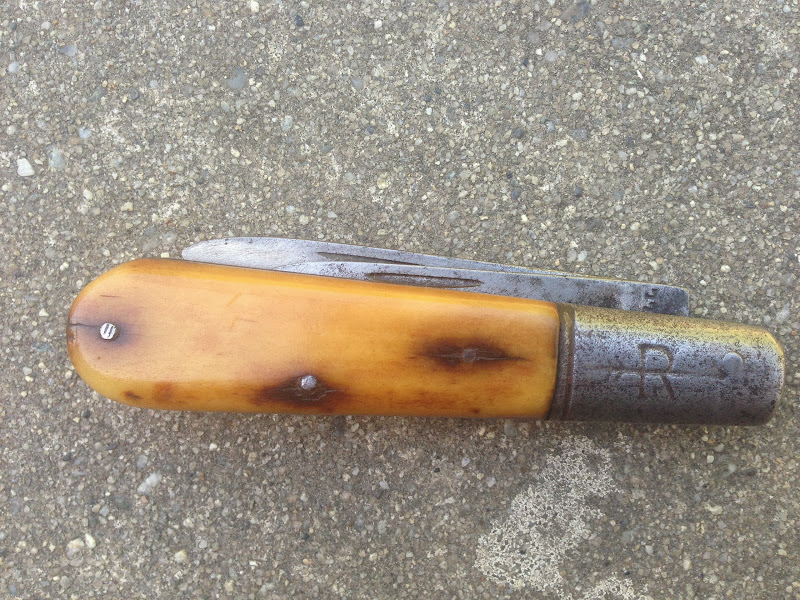
I bought this old knife today. It says New York Knife Co. Walden. I've heard of the brand, but I don't know anything about it. According to the Google, it's between 1856 to 1931. I took some pictures before doing anything to clean it up. The blades are amazingly intact, I wonder if they could be stainless. The covers on the other hand are pretty rough. I'm thinking they might be stag. Lots of little cracks and they have a porous feel to them.

NYKC001_zpscaea3628.jpg
[/URL][/IMG]
NYKC002_zps72793b37.jpg
[/URL][/IMG]
NYKC004_zpsa1db8870.jpg
[/URL][/IMG]

Does stag break down like that? Can it be saved? I'm considering soaking it in mineral oil, but I'm wondering if there's a better way.
 
Last edited:
I am gathering some reference material for this thread for future reference.

History of New york Knife Co:
https://www.nysm.nysed.gov/research/anthropology/crsp/projects/ny_knife_co.html

http://www.collectors-of-schrades-r.us/articles/Schradehistory.pdf

The tang stamp does not look right and the covers look like they have been replaced. The shield looks like one from Ulster or Schrade. I am still trying to find the tang stamp picture that I know exists.
I have a similiar tang stamp to yours but it has lines over and under Walden. Reading the knife it just does not look right to me. It looks like a Schrade stockman to me

This is all "out loud" and I could be totally wrong. I want to know as well.
 
Last edited:
Here is the tang stamp I referenced. On the pen blade. I will try to get a better picture tomorrow.

9981282784_d3dd60e61d_h.jpg
 
That is a modern tang stamp. Looks like Schrade to me too, maybe a commemorative or the like.
I don't know what that handle material is???
 
Thanks for the links, Gevonovich. I get so confused reading the merging and splitting and merging again of these companies!

It does look kind of like a Schrade stockman, and I think it may have swinden key construction. Did Schrade make knives under the New York name at some point? So many questions.

And what is that handle material????
 
Without seeing it in person and/or closeup pictures I would only be guessing. Try the hot pin test. It got us talking and researching so it was worth the price of admission.
 
The mark has been owned by Taylor Brands for some time. All the old ones I have seen have the Hammer marl and "New York" over "Knife Company" over "Walden" in straight lines
 
Here's another clue: The other side of the main clip blade is stamped U.S.A. That seems like a modern thing, though I don't know if it's a Taylor Brands thing.
 
Schrade did make a short series of knives with that nostalgia marking on them. I think it was for SMKW. Several different handle materials were used. I don't remember the year, but maybe someone has the old catalogs and can look them up.

9roi9c.jpg

ncoap5.jpg
 
From looking at the cell structure where the shield once was I would say it is bone. It must have been in a very damp environment as you can see from the rust on the back springs. That would also cause the handles to soak up moisture IMHO.
 
Codger, I think your picture of the Sharpfinger clears things up for me. Thanks.
I finally understand what Mr. Levine meant by 'read the knife, not the stamp'
:o
If it was made by Schrade USA, I don't think I did too badly for $10. :thumbup:
 
It can be cleaned up and custom rehandled... bone, stag or such. No, for $10, you didn't get hurt. And yes, it is another nostalgia marking just like Schrade now is. And Camillus. Northfield, etc.
 
r8shell, thought you might be interested in what you could do with the scales. This sheath was made from interior Moose board that was outside for close to 100 years. It was grey like barnboard outside and pretty punky inside after it was ground flat. If you're interested in saving the scales I'd be happy to help you through the process.

Best regards

Robin
13466337264_1ca6517362.jpg
[/url][/IMG]
13466327584_fbc3e52a90.jpg
[/url][/IMG]
 
Thanks, Robin.
What is moose board? A kind of wood or antler?
My plan, if I get time this weekend is to give it a mineral oil bath and try to get the rust out of the inside of the liners. Then see what I've got. Any reason to avoid the mineral oil? I can't imagine it could make those covers look worse:D
 
Thanks, Robin.
What is moose board? A kind of wood or antler?
My plan, if I get time this weekend is to give it a mineral oil bath and try to get the rust out of the inside of the liners. Then see what I've got. Any reason to avoid the mineral oil? I can't imagine it could make those covers look worse:D

Moose board is the big solid area inside the points on a Moose antler. I wouldn't oil the scales it you're thinking of dying them. For cleaning the rust I would use mineral oil and a bamboo meat screwer shaped like a chisel for the inside of the slot and the backsprings. I think oil on those scales will just make the "colour" a bit darker and likely blotchy. I would get some Fiebings leather dye if you want brown tones but Rits fabrics dyes seem to work very well in the reds, i haven't tried it but others here have. If you decide to use dye, I would dye the scales first, then sand them and see whats underneath. I usually dye and sand and dye and sand and,,, :D

Best regards

Robin
 
I wonder if hair dye would work on antler. I've had great results using it on leather.
homemadepouches008_zps5cfffa36.jpg
[/URL][/IMG]

I suppose we're going a little off topic now, but I'll post some updates in the maintenance/tinkering forum when I get some results. There's definitely enough knife here to be worth tinkering with.
NYKC009_zps1188c328.jpg
[/URL][/IMG]
 
Interesting, A new dye to play with. Hair dye should work ;-) Post the pics in this thread, It's traditional :D
I think it well worthwhile and a fun project.

Best regards

Robin
 
Update:

I figured I had nothing to lose, so I decided to give this old knife a spa treatment. Literally. After a good cleaning, I used those foam backed manicure sanding sticks/buffers on it:


Then I used L'oreal excellence cream 'dark chocolate brown' plus colorstay conditioner. After more buffing and a mineral oil bath, it doesn't look too bad. All this soaking and drying has made one edge of the covers pull away from the liner, though I couldn't get a good picture of it, it's about half a millimeter. Maybe it needs more oil? Unfortunately while I was working on it, I dropped it in the sink with the main blade open, and now there's a bit of blade-wobble. It was a fall of less than a foot. This is why I hate Swinden Key construction!

Some pics of the still oily knife.


I now suppose I'll sharpen it and see how the stainless takes/holds an edge.
 
Any reason to avoid the mineral oil?

> Any reason to avoid the mineral oil?

yes, imho, you should not soak porous material such as stag marrow in oil. Your porous handles look like antler bone to me.

I know its too late for this experimental knife, but I will share my opinion, and pictures, for your future consideration

http://www.bladeforums.com/forums/showthread.php/1161990-Oiling-Slip-Joints/page2
Here are knives that have evidence of oil soaking in unevenly.
On the left is a Russell I immersed in mineral oil, notice how there is a large area of darker color to half the handle. That portion of the bone became softer, and gouged easily when I used a buffing wheel on it.
Next is a "restored" Keen Kutter I got off ebay, notice the extra dark bone along the backspring edge, at the middle pin, and elsewhere
Next is a Boker with porous second cut stag handle, notice the dark spots in the middle of the handle where I put 3 drops of mineral oil that soaked into the pores

IMG_0091.JPG


the "damage" caused by soaking in oil is that the oil changes the color of the bone unevenly. It tends to go in around the pins and under the edges of the scales, more than on other parts. Not all bone handles react the same way, as the density of the bone varies from knife to knife.

Even the two sides of the same knife react differently, for example, the Pile side on the Keen Kutter has much more oil staining than the Mark side
IMG_0001.JPG

IMG_9999.JPG


In the following photo, the Remington on the right shows just a very slight shadow where oil soaked in more than other parts of the bone, on the backspring side between the middle pin and the bolster. It left me with the impression that Remington bone is denser than the bone Russell used. The Charlow on the left showed very little change from oiling. Bone density varies a lot, and some cutleries use higher density bone than others. Gecs Primitive bone is so porous, that they stabilize the material by soaking in acrylic. After which oil will not penetrate at all.

IMG_7737.JPG


In this next photo you can see that the Mark side of the Russell absorbed much less oil than the pile side, mostly only around the pins.
IMG_6962.JPG


I do recommend using mineral oil for the pivot pin and blade of a carbon steel knife. I just no longer soak my handles with it.

http://www.bladeforums.com/forums/showthread.php/1154384-How-do-you-treat-bone/page2
people arguing opposite sides of the mineral oiled handle
http://www.bladeforums.com/forums/s...pros-and-cons-of-mineral-oil-for-bone-handles

Bernard Levine, an author of books about knives, linked in a previous post, and Bill DeShivs, linked above, a cutler, agree that soaking bone or stag in oil is not recommended
 
Back
Top