Not to put too fine an edge on it...

"Death Waits In The Dark??" :D How bout "Rolls Wait On The Edge?"

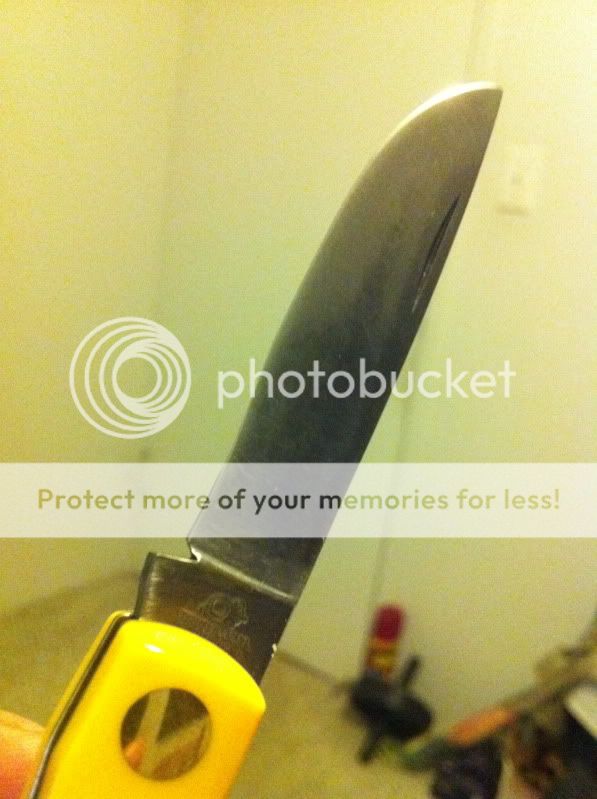
Yeah, this is one of those knives that when someone brings one in to me, I have to work pretty hard not to roll my eyes where they can see me. I try not to be a snob/jerk and nurture their enthusiasm for "the blade". This guy was mortified by the damage on his knife (to him it was a precious piece that he believed to be of superior quality)...and compared to some knives, it is.

To make maters worse, he paid someone else to sharpen it for him and they thinned it down way too much (and exposed the flaw in the steel). Even if the edge had not split like it did, it would have rolled to worthlessness in short order (not sure what that steel is, but it sure can not handle 25 degrees inclusive!)
 
As I'm using it, means grinding the two planes so they meet as cleanly as the grinding surface you're using will allow, and deburring them without rounding or broadening the apex. No wire edges, no burrs, no places where the apex is incomplete, and no enlarging/rounding of the apex due to addressing the aforementioned.

Certainly possible to overstrop an edge, especially if the strop is conformable to any extent and loaded with any sort of abrasive. Polishing is grinding on a smaller scale - that metal has to come from somewhere. No matter how soft you go, there's still going to be a small spike in pressure right at the apex.

Oh wow... Ok, I thought using an old belt looped over a doorknob or something was fine, but you're saying it's not?
 
Oh wow... Ok, I thought using an old belt looped over a doorknob or something was fine, but you're saying it's not?

It is fine, if applied under the right circumstances. Most sharpening nuts (:D) push it WAAAYYY beyond that, simply to see just how sharp it can go (or how far our own skills will allow it to go). But there's nothing at all wrong with keeping it very simple. Sometimes, that's all an edge needs. The simple 'belt hanging on a doorknob' can make all the difference sometimes, if the 'preparation' done prior was good (as explained in HH's earlier reply). The more prepared the edge is for stropping, the more effective it'll be. If an edge isn't prepared for it, such as if the two bevels don't meet along a clean, sharp edge, then stropping will usually be ineffective. Simple stropping with common stropping compounds, or on bare leather, isn't aggressive enough to 'fix' all the flaws from incomplete sharpening beforehand. It's at it's best, when used as the 'finishing touch' to an already good edge. Takes it to another level, if done right.
 
I never discontinue sharpening before 2,000 grit. And my better knives get a minimum of 10,000 before stropping.

IME, the more mirror poished and refined an edge is, the better it cuts.
 
I used to mirror polish every eged I made or owned, but I came to realize it added more to looks and not function. Now I sharpen from 180 to 400 grit on my grinder then diamond stone to de-burr, the arkansaw 800grit(guessing) for honing, then strop to remove any micro burrs. What I discovered is when I stopped at 400 grit on the grinder, rather than 1200+ the edge cut way WAAY better, even before removing the burr, I still don't know why but that is the way it is.
i used to be the same way when i sharpened by hand until a buddy complained his edge failed after cutting a few cardboard boxes up. i had a buddy give me a stone that was somooth as glass. it put a mirror finish on that looked nice like you said but it never would last long. i went back to finishing off with the medium india stone before going to a ceramic rod to remove the burr. the guys i sharpened for liked the coarse edge way better.
 
i used to be the same way when i sharpened by hand until a buddy complained his edge failed after cutting a few cardboard boxes up. i had a buddy give me a stone that was somooth as glass. it put a mirror finish on that looked nice like you said but it never would last long. i went back to finishing off with the medium india stone before going to a ceramic rod to remove the burr. the guys i sharpened for liked the coarse edge way better.

Since you sharpen professionally, I certainly respect your experience.

Nevetheless, while you are undoubtedly correct when sharpening the steels that average owners use, I have the luxury of sharpening only for myself and close friends/associates. We all prefer high end, i.e. highly abrasion resistant steels such as S90V, M390, M-4, Elmax etc. I've found that those steels cut better and retain their sharpness superbly when highly refined. Almost to straight razor standards.

I suppose that I would, in all likelehood, adopt your philophosy were I to be sharpening for "Joe Sixpack!" :)
 
i used to be the same way when i sharpened by hand until a buddy complained his edge failed after cutting a few cardboard boxes up. i had a buddy give me a stone that was somooth as glass. it put a mirror finish on that looked nice like you said but it never would last long. i went back to finishing off with the medium india stone before going to a ceramic rod to remove the burr. the guys i sharpened for liked the coarse edge way better.
Would it not depend on the steel and intended task? A razor edge on D2 or S30V would be a waste of effort. Now something like Shirogami or Aogami Super Blue with only light kitchen use would definitely benefit from a razor edge. As for EDC cutting of plastic zipties, cardboard, and rope, I found a toothy edge helps a lot in reducing edge damage from such cutting.
 
It matters how the knife will be used and what is being cut.

If one is mostly push cutting then a highly refined edge would work the best for them.

If one is slicing then a coarser edge, toother edge would be better, especially for harder more abrasive materials.

The edge finish has to be matched to how the knife is used and the steel.
 
Would it not depend on the steel and intended task? A razor edge on D2 or S30V would be a waste of effort. Now something like Shirogami or Aogami Super Blue with only light kitchen use would definitely benefit from a razor edge. As for EDC cutting of plastic zipties, cardboard, and rope, I found a toothy edge helps a lot in reducing edge damage from such cutting.

I've been very pleased with the D2 edges I've finished to ~2000+ grit. If a finely polished D2 edge failed, it's because it was too thin (which is unrelated to, and independent of the finishing grit); not because it's polished. In particular, a polished convex in D2 is excellent for cutting cardboard, zipties and other tough materials.
 
Last edited:
It matters how the knife will be used and what is being cut.

If one is mostly push cutting then a highly refined edge would work the best for them.

If one is slicing then a coarser edge, toother edge would be better, especially for harder more abrasive materials.

The edge finish has to be matched to how the knife is used and the steel.

While I would like to agree with this common statement, I can't. I have seen with my own eyes too many times a "fine" edge slice meat, rope, cardboard, paper, and even Me. And it did so on a exponentially greater scale than the coarse edge.

There comes a point in the roughness of the edge where cutting force applied and how much sawing is required drastically reduce while cutting power greatly increased. It's the difference between forcing a knife to cut and cutting with a knife. A simple example would be cutting chicken, start with a 300-600 grit edge then try a 8000 grit edge. Cutting pressure vs edge roughness is clearly seen when performing this test.


Now in my own opinion and experience a coarse edge on high grade steels leads to failure in the edge in the form of tear out due to stress risers created by the deep scratch pattern. I have some pictures too if anyone would like to see.
 
Since you sharpen professionally, I certainly respect your experience.

Nevetheless, while you are undoubtedly correct when sharpening the steels that average owners use, I have the luxury of sharpening only for myself and close friends/associates. We all prefer high end, i.e. highly abrasion resistant steels such as S90V, M390, M-4, Elmax etc. I've found that those steels cut better and retain their sharpness superbly when highly refined. Almost to straight razor standards.

I suppose that I would, in all likelehood, adopt your philophosy were I to be sharpening for "Joe Sixpack!" :)

As a general contractor and probably more blue collar these days than I think, it is comforting to know that you will let us card carrying members of the great unwashed sharpen and keep our knives the way we want (in all likelihood). And to let Richard keep his "philosophy" about sharpening for the common man, well... that's mighty generous.

Using knives as working implements for about forty years now, my personal experience concurs with Richard's. While I know quite a few of my colleagues that make a lot of dough, none would think of carrying (except as a pocket folder) knives that have the steels you mentioned to work. Personally, I found just how fragile some of those steels can be when I nicked a large staple used to package equipment with my Kershaw scallion (S110V blade) that I had spent a fair amount of time sharpening into a laser edge. Same thing with a couple of other high end steels. The finer, sharper edge doesn't last as long for me (no, I don't actually open the cans from a six pack with them) for job site duty.

In my personal experience over the years I have found that different steels used for different tasks perform better with different types of edges.

(A tip: if you want to make a snooty remark, make sure you turn on your spell checker so folks will appreciate gravity of your erudite opinion. Misspelling words seems (to me) to lessen the level of the perceived sophistication you intended to convey.)

Might just go for a beer early today...

Robert
 
Well Robert, if all you can find to criticize is my typing, (I am an excellent speller, BTW:thumbup: and my "snootiness" :yawn:) I suppose that my facts must be unimpeachable.

You are certainly entitled to your opinion, sir, but I would hope that in the future, you will be able to think your ideas through well enough that you are able to express that opinion without resorting to ad hominem attacks.:thumbdn:
 
I've been very pleased with the D2 edges I've finished to ~2000+ grit. If a finely polished D2 edge failed, it's because it was too thin (which is unrelated to, and independent of the finishing grit); not because it's polished. In particular, a polished convex in D2 is excellent for cutting cardboard, zipties and other tough materials.
Looking at my Dozier Buffalo River Hunter, I sincerely doubt there's a "too thin" for D2 unless you're cutting hardwood with a Full Flat Zero Edge ground blade. At least, I sincerely hope so when I regrind my Queen Country Cousin Sodbuster to that profile:D.
 
Looking at my Dozier Buffalo River Hunter, I sincerely doubt there's a "too thin" for D2 unless you're cutting hardwood with a Full Flat Zero Edge ground blade. At least, I sincerely hope so when I regrind my Queen Country Cousin Sodbuster to that profile:D.

I am quite curious to see how that works out. :thumbup:

The 'polished convex' I had in mind, which I referred to in my earlier reply, just so happens to be a Queen Country Cousin. Mine's ground thinner than the original factory edge (which ain't sayin' much, when talking about Queen's factory grinds), but I have wondered of the benefits of going even thinner with the convex on it. It's the first convex I did that was able to pop hairs afterward, and I was especially proud of the fact I did it free-hand. Initially ground a V-bevel with a Fine DMT 'Credit Card' hone, then convexed with wet/dry sandpaper up through 2000 grit, and polished afterwards with Simichrome on a strop. That project was the best education on D2 I could've hoped for. Stuff's got great potential, if one is willing to be patient and take it that far. :)
 
While I would like to agree with this common statement, I can't. I have seen with my own eyes too many times a "fine" edge slice meat, rope, cardboard, paper, and even Me. And it did so on a exponentially greater scale than the coarse edge.

There comes a point in the roughness of the edge where cutting force applied and how much sawing is required drastically reduce while cutting power greatly increased. It's the difference between forcing a knife to cut and cutting with a knife. A simple example would be cutting chicken, start with a 300-600 grit edge then try a 8000 grit edge. Cutting pressure vs edge roughness is clearly seen when performing this test.


Now in my own opinion and experience a coarse edge on high grade steels leads to failure in the edge in the form of tear out due to stress risers created by the deep scratch pattern. I have some pictures too if anyone would like to see.

I agree with the bolded section - high RC in my limited experience - leads to microchipping along the apex when sharpened up coarse.

When it comes to longevity I have yet to see any polished edge in a common steel (440C, Aus8, 420HC) that could compare to the same knife done up coarse for tougher tasks. When used with a draw, the amount of pressure required is considerably less. I noticed this quite readily when cutting braided PVC - drawing with a fine edge is unproductive, and direct pressure requires a lot of force. A horrendously rough edge can be drawn with very little pressure, parts the material and finishes the cut with ease. Still, since some steels simply don't take to certain sharpening strategies I cannot make any blanket statements that don't include exceptions.

In general, there is no one edge type that does well across the entire spectrum from efficiency to longevity on all materials and using a well matched edge gives the best results for the longest amount of time. Was just speaking with the father in law and he recounted how certain chop-cutting blades in the binding industry are machine honed to a zero finish and then have 2 mils taken off the apex to reduce the pages shifting during cutting and for best longevity. At the same time, a microtome is useless without a supremely honed edge, though in use it frequently is moved so every cut is made on a different (fresh) stretch of blade. The blade on the lamination guillotine cutter where I work is done up to about a 400 grit edge and it can make tens of thousands of cuts through lamination up 2 millimeters thick. Not sure why anyone would hold absolute views on this topic when there are so many common examples of matching the right edge to the job. A blend of common sense and experimentation with any given steel will tell you if you're using the best edge (grind, inclusive bevel angle) for the job.
 
How to aggressive-cutting steels like M390 & Elmax figure into all of this? I'm new to these steels myself. I get them hair-popping sharp off of my XXF DMT stone (a push cutting type edge) & they still feel very toothy (in a refined way) for a polished edge. Best of both worlds? I've seen them described as having good edge stability & my mental categories are having trouble with what's going on at the cutting edge.
 
jeff, how do they hold up to a lot of cutting like with cardboard? i myself never go over 400 grit and sometimes no higher than 320 on most of the knives i sharpen mainly when convexing an edge but on most v edges i put on knives i'll go coarser. feedback i get from people i sharpen for tell me that kind of edge holds up very well. other members have tested this and found out the same thing too. when properly finished a coarse edge can hold up a long time. check out the link in my post above.
 
I am quite curious to see how that works out. :thumbup:

The 'polished convex' I had in mind, which I referred to in my earlier reply, just so happens to be a Queen Country Cousin. Mine's ground thinner than the original factory edge (which ain't sayin' much, when talking about Queen's factory grinds), but I have wondered of the benefits of going even thinner with the convex on it. It's the first convex I did that was able to pop hairs afterward, and I was especially proud of the fact I did it free-hand. Initially ground a V-bevel with a Fine DMT 'Credit Card' hone, then convexed with wet/dry sandpaper up through 2000 grit, and polished afterwards with Simichrome on a strop. That project was the best education on D2 I could've hoped for. Stuff's got great potential, if one is willing to be patient and take it that far. :)
First try wasn't so great:
IMG_0393.jpg


I ate up the heel in a hurry so it's uneven compared to the rest of the knife, though it looks like that could be sharpened out on its own. Slices my apple up nicely, though I didn't test the performance before the grind, so it's hard to say if cutting performance is improved in any significant degree.

I ground off more metal than I needed to because I forgot that there was a slight swedge on the back, which was mostly ground away as well. I'm thinking I put too much pressure on the belt because of that, causing it to flex into the heel and grind off more than I wanted. I'll be sure to correct that on my second Country Cousin after testing the cutting performance before grinding.

The D2 also takes a scary sharp edge very easily despite being a bear to grind(weird). It's a shame there isn't more of it in a cheap folding package with a decent blade length. I found plenty of fixed blades for around $50, but not much for folding knives for less than $75. My best bet seems to be the composite kershaws in CPM-D2, but I personally wanted something in old fashioned D2.
 
jeff, how do they hold up to a lot of cutting like with cardboard? i myself never go over 400 grit and sometimes no higher than 320 on most of the knives i sharpen mainly when convexing an edge but on most v edges i put on knives i'll go coarser. feedback i get from people i sharpen for tell me that kind of edge holds up very well. other members have tested this and found out the same thing too. when properly finished a coarse edge can hold up a long time. check out the link in my post above.

I'm not sure. Ankerson polished these steels to 6000 in his rope cutting tests & they did great, but thats no statement as to how they would've done at a lower finish. These steels have inherently aggressive edges due to a high percentage of carbides (mostly vanadium) but I keep hearing that they hold their fine, polished edges well too. My limited experiences with them bear this out. I finish them on an 8000 grit DMT stone & they still feel very grabby. They bend my categories by draw-cutting like a finer toothed D2 with a polished push-cutting edge finish. I found myself wondering what the course-edged crowd's take on these weirdo steels would be.
 
Back
Top