In another thread, I said:
Brian Jones Responded:
To which I responded:
Anyway, I am herein responding to Brian's request.
Let me give an example to clarify what I say, above.
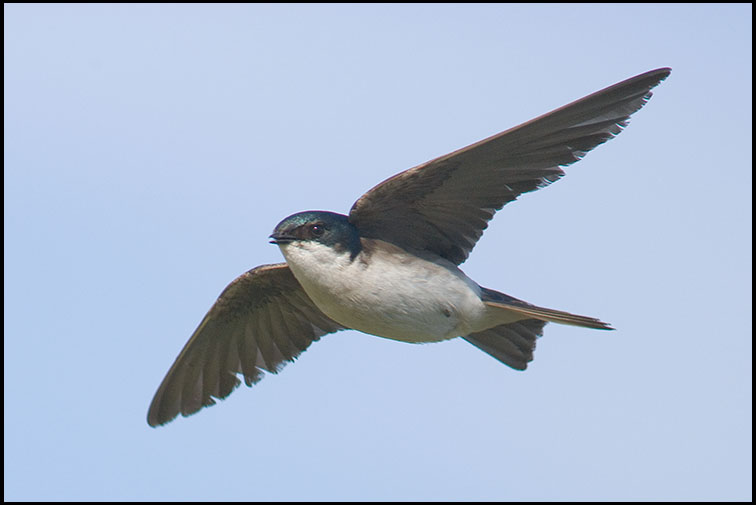
Anyone familiar with tree swallows will probably quickly recognize the problems with photographing them.
1) Birds can fly anywhere they want to, but I want to get within less than ten feet (preferably closer to five feet) of one.
2) Tree swallows are about as small, fast, and erratic in their flight characteristics as birds get. These characteristics border on being beyond human reflex speed and beyond camera autofocus speed (especially at extremely close proximity). To get a properly focused, well composed shot of a tree swallow in flight, it is necessary to find a way around this problem.
Okay, so we've defined the problems; now let's solve them.
In order to solve problem #1, I rely on the plan of figuring out where the tree swallow will want to be, and positioning myself there first. So, where do I know a tree swallow will want to go? To its nest, of course. So, in this case, I positioned myself close to the flight path into the nest. (Note: This is not acceptable to do with many birds. In some species, it will disturb the birds and make them abandon the nest. Don't try this particular technique unless you know your subjects well enough to be able to assure avoiding negative impact.)
Now, for problem #2: I choose a two part strategy: [A] Figure out a situation when the tree swallow has to slow down, and prepare for photographing the tree swallow, then; figure out how to maximize the performance of my gear.
So, what is the situation when the tree swallow must slow down?: Wind. The bird will be slowed down when it must fly against a strong wind to get into its small nest opening.
And how can I maximize my camera's autofocus performance? First, pre-focus to very close to the distance at which I intend to get the shot; second choose an angle to the sun which will display the tree swallow with a lot of contrast (since autofocus relies on contrast).
Once all of that is worked out, find a swallow nest that it is possible to get close to, which is located so as to be subject to wind, then wait for a situation with a strong wind in the right location at the right time of day to get an angle to the sun with lots of contrast on the subject, then get to the right place at the right time, pre-focus, wait, and get the shot.
I hope this example makes clear how I let wildlife come to me, and how I employ observation of cause and effect, along with problem solving strategies, in order to get my shots.
I'll try to add other examples, later, when I have a chance. Right now, I need to get ready for a day with the selasphorous hummingbirds.
Cheers.
Situational awareness is a major part of nature photography, for me. One has to understand what is going on around her/him in order to see the photographic opportunity. Improvisation, as Brian discusses in his response to me (which I also discuss in my sub-article Being Survival Minded), and problem solving, are also major components of nature photography success. Almost every good photo opportunity involves some obstacle which must be analyzed and overcome.
Anyway, I mention this because I think some of you might find nature photography to be a rewarding skill to practice, for the purposes of the skills which transfer over to survival and outdoorsmanship.
Brian Jones Responded:
Mike, I always have meant to ask you to post on how you get in so close and capture the shots you do, actually! Your technical skill is amazing, but just as apparent is your skill for getting in and getting the shots of animals in their natural element, undisturbed by your presence.
To which I responded:
Well... that's a pretty big topic. To give you the short version, I usually try not to approach animals unless absolutely necessary. I prefer to let them approach me. Thus, it becomes a matter of figuring out where an animal will want to be, and positioning myself there, first.
I don't tend to go much for hiding and subterfuge. Generally, trying that on wildlife, with my set up, would be a silly conceit, and would unsettle them. Instead, when I am close to animals, I try to behave in such manner that they will be comfortable with my presence.
Anyway, I am herein responding to Brian's request.
Let me give an example to clarify what I say, above.
Anyone familiar with tree swallows will probably quickly recognize the problems with photographing them.
1) Birds can fly anywhere they want to, but I want to get within less than ten feet (preferably closer to five feet) of one.
2) Tree swallows are about as small, fast, and erratic in their flight characteristics as birds get. These characteristics border on being beyond human reflex speed and beyond camera autofocus speed (especially at extremely close proximity). To get a properly focused, well composed shot of a tree swallow in flight, it is necessary to find a way around this problem.
Okay, so we've defined the problems; now let's solve them.
In order to solve problem #1, I rely on the plan of figuring out where the tree swallow will want to be, and positioning myself there first. So, where do I know a tree swallow will want to go? To its nest, of course. So, in this case, I positioned myself close to the flight path into the nest. (Note: This is not acceptable to do with many birds. In some species, it will disturb the birds and make them abandon the nest. Don't try this particular technique unless you know your subjects well enough to be able to assure avoiding negative impact.)
Now, for problem #2: I choose a two part strategy: [A] Figure out a situation when the tree swallow has to slow down, and prepare for photographing the tree swallow, then; figure out how to maximize the performance of my gear.
So, what is the situation when the tree swallow must slow down?: Wind. The bird will be slowed down when it must fly against a strong wind to get into its small nest opening.
And how can I maximize my camera's autofocus performance? First, pre-focus to very close to the distance at which I intend to get the shot; second choose an angle to the sun which will display the tree swallow with a lot of contrast (since autofocus relies on contrast).
Once all of that is worked out, find a swallow nest that it is possible to get close to, which is located so as to be subject to wind, then wait for a situation with a strong wind in the right location at the right time of day to get an angle to the sun with lots of contrast on the subject, then get to the right place at the right time, pre-focus, wait, and get the shot.
I hope this example makes clear how I let wildlife come to me, and how I employ observation of cause and effect, along with problem solving strategies, in order to get my shots.
I'll try to add other examples, later, when I have a chance. Right now, I need to get ready for a day with the selasphorous hummingbirds.
Cheers.