Observation and Problem Solving in Nature Photography ( was "How I Get Close to...")

Your very slllllowwwwwwwwwwwwww witted wilderness moderator is trying to figure it out....

 
No other guesses? Anybody?

Countdown "3,2,1", ask them all to blink on 1 and take the photo a half second or so after? I think it may work but there has to be a more certain method.


As always, it is a pleasure to see your work, Evolute.
 
Throw a baseball straight in the air and tell everyone to keep their eye on the ball. As the ball starts falling back towards the ground, depress your camera button with the camera set to continuous frames mode.

Look up and make sure that darn ball doesn't hit you and your camera :)
 
Countdown "3,2,1", ask them all to blink on 1 and take the photo a half second or so after? I think it may work but there has to be a more certain method.


As always, it is a pleasure to see your work, Evolute.

Close enough that I'll call this a correct answer.

The problem is involuntary blinking, but people do also have partial control of opening and closing their eyes, so the solution I would look for would involve coming up with a way to emphasize people's voluntary control over their eyelids. So, what I'd try to do is:

Tell everybody to close their eyes. Then tell them to open their eyes on the count of three. Right when everybody opens their eyes, take the picture. (They may not all be looking into the camera, but the chances are good that they'll all have their eyes open.)

(There are likely many other solutions, too, of course.)

Congratulations, roughedges!

Dave (General Specific) also came close to solving the riddle. He had the right idea, that you should try to catch a moment immediately after everybody had closed their eyes. A critical error he made was to unnecessarily introduce a new element, and try to solve a problem that didn't exist. Specifically, he tried to add in a solution to the problem of how/what-tool-to-use to get everyone to blink/close their eyes at once, when people can voluntarily control that, thereby making it as simple as asking. This issue of trying to solve problems which don't exist is common (such as Snakedoc's idea for waterproofing fatwood by putting fatwood shavings in a straw, when fatwood is already waterproof).

Anyway, you all have now seen three instances of cases where one is confronted with a seemingly impossible photo situation... but there is an elegant solution available, if you think it through. This is the way I approach nature photography, every day.

This same type of ability to analyze the situation, improvise, and create a solution with what is available to you is critical to survival.

More stuff coming, later.

Cheers.

P.S. Thanks, roughedges!

P.P.S. Brian, perhaps we should re-name this thread, since it goes beyond how to approach wildlife.
 
Looks pretty good. Or perhaps...

Observation and Problem Solving in Nature Photography

I don't know. I'll leave it up to you, after we see how the thread progresses. I'll be getting more into discussion of observation, when I have time, in a day or two.
 
I like taking closeups. Garter snakes, toads and red efts are particularly accommodating for this. With the snakes, the trick is to move close without it looking like stalking behavior. Two eyes staring at them seem to make them more nervous than the single eye of the camera, which is where the digital cameras with their LCD displays come in handy. You can take a decent picture while holding the camera at arms length.

I like this picture because you can see my hand and camera lens reflected in the snakes eye. Click on the thumbnail for a much bigger picture.

 
Okay, since Mike has taken the time to so generously share his expertise, and has inspired us, it is my duty as moderator not to let this thread disappear into the annals and have so many other members miss out on his outstanding work and tips!
 
Another suggestion for aiding in focus is to increase your depth of field by closing down your aperture in addition to presetting the focus.

I always tell my students never use your camera on auto! Cameras are just a computer programed to average things out. They have no brain, no heart, and no soul, and cannot create an image like the one you can envision; they don't know how you want the picture to turn out.
 
Thanks, everyone.

I happen to fall more into kgd's camp of sometimes just being lucky.
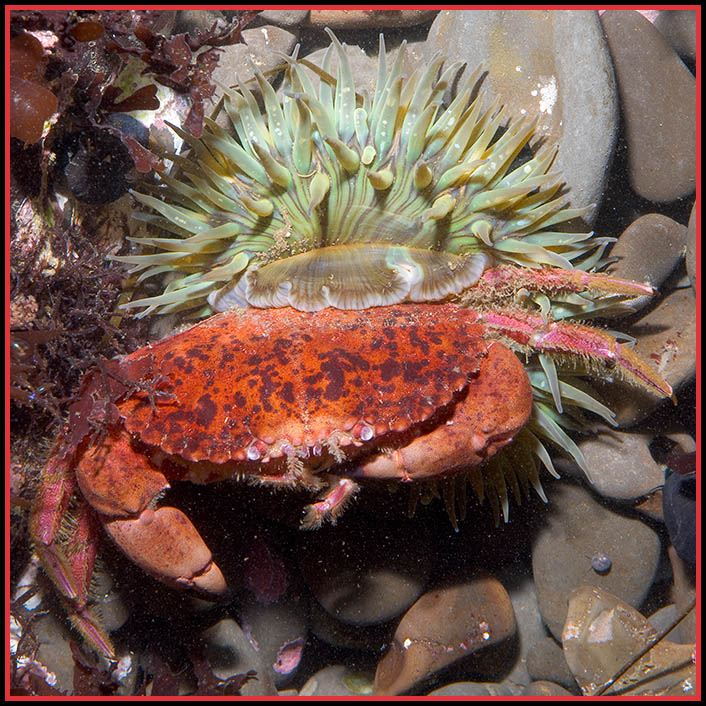
As I've noted elsewhere, one of the big steps to successful nature photography is to strategize and situate yourself so that such moments are no longer rare occurrences you stumble upon, but are chosen, sought, and frequent. This is where careful observation, and making the connections between cause and effect come into play.

To give some examples of this, I'll use pitdog's general area.

In pit's general area, within a reasonable travel distance, are many great nature photo opportunities.

280315681_ec3806943d_o.jpg


One is the tidepools. That whole area has some of the best tidepools to be found anywhere. Tidepools are major wildlife photography opportunities (i.e., creatures in the intertidal zone). However, conditions are not always ideal. Sometimes you go there and there is a huge number and variety of species, and other times comparatively little. You can't photograph wildlife that isn't there.

How do you predict when to go to catch the tidepools at their best?

In your area, pitdog, you should be looking for the circumstances when an offshore storm is immediately followed by a low tide. Why? Because the storm can create a surge which pushes organisms which are normally only in deeper waters up into the intertidal zone, then the low tide temporarily traps them there. And why does the storm have to be offshore? Because an onshore storm will create runoff which will flow into the intertidal zone, making the water murky, and ruining the photo opportunities. Seeing cause and effect in the rhythms of nature is key.

Okay, so let's say that you're now in the right place at the right time... you've come when there are a lot of animals there. How do you find stuff?

You'll want to step right into the tidepools. Many people find this uncomfortably cold, so you might want to use a pair of rubber farmer's boots. Crouch down low, the most spectacular intertidal creatures tend to be rather small. Turn over rocks; a lot of the good stuff is on the underside (especially during the day). Imagine there's a grid in the tidepool, and carefully, systematically search each quadrant. Know what to look for... not so much looking for animals, but looking for "irregularities in the patterns" (easiest to see with the edges of your vision, not the center). Know where to look... look for movement in the patches of seaweed, look for things clinging to the undercut walls of the tidepools, look for things hiding in crevices.

Ahh... I'm getting too sleepy to write. I'll come back and finish, some other time.
 
Mike, thanks! This is great stuff. I'm off to bed myself. I don't know whether you consider my thread bump a blessing or curse time-wise, but thank you again! :thumbup:
 
I like taking closeups. Garter snakes, toads and red efts are particularly accommodating for this. With the snakes, the trick is to move close without it looking like stalking behavior. Two eyes staring at them seem to make them more nervous than the single eye of the camera, which is where the digital cameras with their LCD displays come in handy. You can take a decent picture while holding the camera at arms length.

I like this picture because you can see my hand and camera lens reflected in the snakes eye. Click on the thumbnail for a much bigger picture.
QUOTE]

Joel, can I ask what lens you were using? Doesn't look like a point and shoot shot. I just bought a canon 100mm f/2.8 lens and IT takes great macro pictures, but it's going to take me quite a while to learn what the hell I'm doing with it:)

The other evening in the workshop I was taking a smoke after sanding for several hours and looked around to see an 8" salamander stalking a bug about 4 feet away from me. I was pissed not to have the camera with me, but I don't like to keep it in such a camera-unfriendly environment, plus it was raining outside (thus the salamander). The little booger even let me pick him up for a couple of minutes to move him outside. I didn't want him picking up a bunch of toxic crap, since I believe their skin is very "osmotic?"

Evolute, thanks for the tips and Jedi mind training. It's great to have my 2 favorite hobbies discussed in the same forum.

Regards,

Dave
 
Joel, can I ask what lens you were using? Doesn't look like a point and shoot shot. I just bought a canon 100mm f/2.8 lens and IT takes great macro pictures, but it's going to take me quite a while to learn what the hell I'm doing with it:)

The other evening in the workshop I was taking a smoke after sanding for several hours and looked around to see an 8" salamander stalking a bug about 4 feet away from me. I was pissed not to have the camera with me, but I don't like to keep it in such a camera-unfriendly environment, plus it was raining outside (thus the salamander). The little booger even let me pick him up for a couple of minutes to move him outside. I didn't want him picking up a bunch of toxic crap, since I believe their skin is very "osmotic?"
That particular picture was taken with a Pentax 555 in 'macro' mode. The larger cameras, while taking better pictures, are too bulky for me to want to carry in the woods. About a year ago I upgraded to a Canon A710 IS, which I like very much.

A comment to everyone -- the image stabilization (IS) that can be found in many cameras these days is absolutely worth the extra cost. It will let you take shorter exposures in low light, or zoom in without necessarily having to use a tripod.

With all due respect to Evolute, I've determined that the best way to find excellent photographic subjects is not by being as methodical as he says. All you have to do is go for a walk without your camera and every damn creature within a mile comes out to tease you. I could have predicted your situation with the salamander.

I'm obviously not serious, but I no longer ever go for a walk without the camera on my belt. This is why I like the compact cameras, in spite of their shortcomings compared to the larger SLRs.

BTW Salamanders (and other amphibians) do pick up a lot of toxins through their skins -- it's even bad (especially for very young ones) to handle them, especially if you have applied bug repellent to yourself. However, I've been told if you give your hands a good rubbing on fresh dirt, you can handle them for short periods without harming them.
 
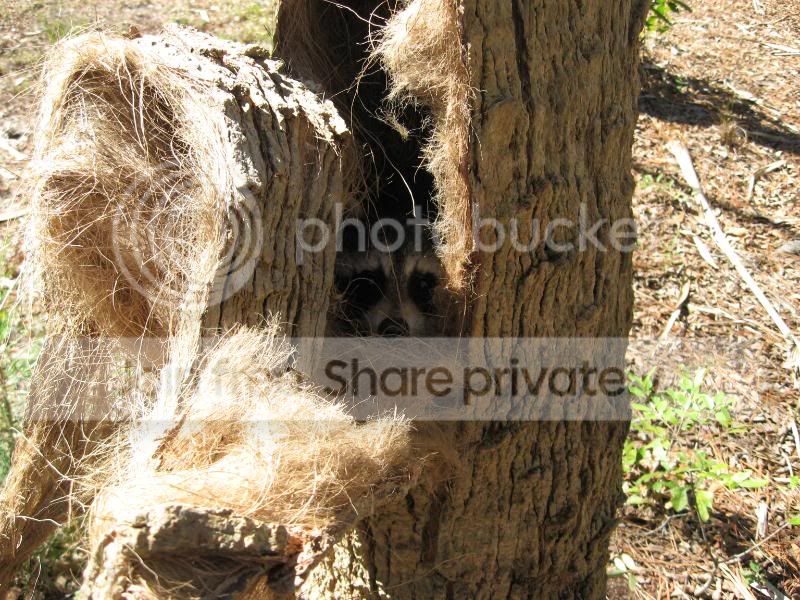
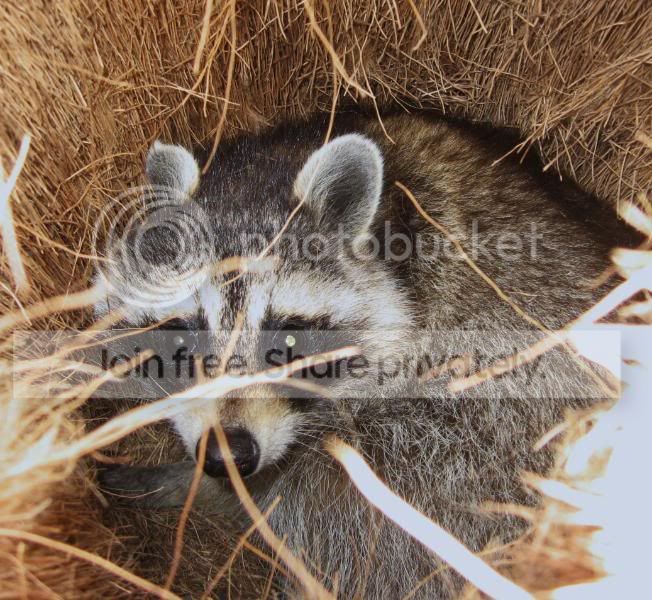
I am amazed at some of the fantastic wildlife pics others take. I don't know jack about photograpy. I'd need a big telephoto lens to get most pics. But today, I used the new technique of disturbing the animal's den by poking it with a knife, and then blinding the animal with a flash. Of, course, it wasn't planned. I was looking for fire making tender.

Coon012.jpg

Coon015.jpg
 
Great comments on the Tidepool Evolute. It strikes me that light conditions can be challenging in this example though. Reflections from the tinyest ripples, turbidity - especially when moving rocks can be difficult to control.

Are there any filters that help - I used to use a polarizing filter on my old film SLR, wondering if it cuts down glare from water surfaces?

Horndog - I'm sure that raccoon was stunned from looking at the worlds ugliest sheath as it was hanging off your belt at the time you took that shot!
 
...
Horndog - I'm sure that raccoon was stunned from looking at the worlds ugliest sheath as it was hanging off your belt at the time you took that shot!

I didn't think of that. You may be right. It is ugly.
 
Great comments on the Tidepool Evolute. It strikes me that light conditions can be challenging in this example though. Reflections from the tinyest ripples, turbidity - especially when moving rocks can be difficult to control.

Are there any filters that help - I used to use a polarizing filter on my old film SLR, wondering if it cuts down glare from water surfaces?

Horndog - I'm sure that raccoon was stunned from looking at the worlds ugliest sheath as it was hanging off your belt at the time you took that shot!

kgd,


Lots to discuss, here. I'll be getting to techniques for dealing with light situations, turbidity, ripples, etc., in tidepool photography, later... maybe tonight, after I get back from my CPR class.

I'll also get to stuff from other commenters.

Cheers, folks!
 
Are there any filters that help - I used to use a polarizing filter on my old film SLR, wondering if it cuts down glare from water surfaces?

There are many filters out there that can do a lot for you and a lot are just gimmicks that can make your images look cheesy. I would recommend always having either a UV Haze or a Skylight 1A filter on your lens (I prefer the UV Haze as a skylight 1A if you are not taking a picture with lots of bright blue sky in it can give you a pinkish tint.) While these filters do have a designed purpose I find what they excel at is being a good lens protector. What would you rather scratch a $15-$20 filter or a $200-$8000 lens?

The fore mentioned Polarizing filter is designed to reduce/remove glare (this is done by rotating the glass element until you see the glare go away.) However if you are using an AF camera you need to use a Circular Polarizer.
 
Back
Top