Oil stones and diamond vs vanadium carbides

Joined
Feb 23, 2012
Messages
302
I haven't seen any recent discussions on this going through pages on end for the past week. The only two that stood out to me were:

Diamond sharpening and Crbides from 2005
VG-10 vs. S30V from 2008.
A brief idea of those two threads with two posts from each:
First thread -

We have discussion on Russian forum and this came up:
"Diamond sharpening rip off carbides from steel and sharpen just steel matrix, as a result at the begining edge is same as for simple carbon steel and after it wear out carbide teeth came out and start cutting - like postponed secondry sharpness."

What do you think?

Especially I am asking Pamela - what do you see in your microscope?

Thought agains this is that:
1. If Carbides are riped off then edge will have holes with size equal or bigger then carbides - fine edge will be hard to form.
2. Diamonds embeded in leather unlikely rip out Carbides embeded in steel.

Thanks, Vassili.

Hmm. Seems like the matrix would be the first to be removed since it is softer and that this would expose more fresh carbides instead of the other way around. It will be interesting to see but there are so many stories of successful sharpening and reprofiling with diamond pads and ceramic that it is hard to believe they do what you suggest.

I would hope that studies and research would have been done before marketing to determine the extent of this. But, you never know.
Second thread -
Would this help:
Carbidehardnesses.jpg


So you are saying that perhaps the toothy edges are left by using a sharpening medium that is softer than the carbides? That seems reasonable to me, although I don't have your user experience with those steels.

Following that hypothesis, this chart would imply that the only way not to get a toothy edge on either S30V or D2 would be to sharpen with diamond. Both S30V and D2 have enough Vanadium in their makeup to form significant amounts of Vanadium Carbide and diamond is the only commonly found sharpening medium that is harder than Vanadium Carbide.

That is along the lines I'm thinking, i.e. that S30V and such are best sharpened with diamond abrasives. Diamond stones should cut the tougher carbides versus the carbides eroding the the stones (say common ceramic stones).

The theory isn't mine, I just keep it mind. It seemed reasonable when I first read it and it would appear to explain some of the sharpening behavior some people (me included) have experienced. Then there is always the PFM factor of heat treatment added in to the mix.

The theory could partially explain why some people observe "inferior" steels performing better than the "superior" steels. Simply using the right media to sharpen the steel could change the resultant perception of which is the better steel.

Just trying to increase my understanding of the theory and see whether it has real-world merit.
Mostly based on seeing the chart, and knarfeng's/orthogonal1's assertions, i've been curious about whether or not vanadium carbides are too hard for anything short of diamond to sharpen the carbides as effectively as the diamond. I know people do fine with oil stones, sandpaper etc. but these posts got me thinking about how people mentioned s30v, s90v, or other high vanadium steels losing the sharp edge fast but retaining a working edge longer than something with less or no vanadium. Could this be due to the edge carbides being stripped rather than sharpened, and the matrix wears down to the lower carbides which hold the working edge longer?

Am i cheating myself by not using diamond? would a lower (maybe 600) grit diamond, then moving to finer grit oil/water stones give good results assuming what i've posted is the case? Or should diamond be used across the board? Would the physical properties of say, a 3 micron diamond sharpener allow for enough of a refined edge to compete with the more traditional stones of similar grit/mesh? I'm of course no metalurgist, but the posts in the second thread about diamond sharpening the carbides makes more sense to me than the first thread.

Thought i would try to start a conversation on this and see if anyone with the resources has put any time into this since the time of those threads. Thanks to anyone who has taken the time to read this blinding wall of text.
 
It's not so much the hardness of the carbide but the amount. The 3% vanadium in my Elmax I can sharpen on most all stones, the 4% in S30V is often too much for lower quality stones/abrasives and depending on the heat treat (S30V can vary a lot) it will either sharpen on lesser stones or laugh at them. When it gets to what is considered super premium steels like S90V with 9% vanadium I have a difficult time saying its not to your advantage to use diamond hones. With enough persistence I'm sure you could sharpen it on pretty much anything though I have always believed in using the right tool for the job.
 
thanks for the response. i haven't had any trouble sharpening s30v, more curious if there's any precedence to whether or not the carbides are sharpened as opposed to stripped away, to see if it's possible to keep a sharp edge longer before it's downgraded to "working." i really never thought, or cared about it till i joined here, and started having a little bit of an interest in some of the super/exotic steels and saw people mentioning "better" steels losing a sharp edge before something like 154cm. i'm just the type of person to research something to death first. if/when i go with a blade made of something like s90v or 20cv, i'll add to the sharpening resources anyway, but i'm one of those why and how people.
 
My own indoctrination to diamond vs. S30V was in the form of re-bevelling the edge on a ZT-0350, using a little ol' Lansky medium diamond hone. Took FOREVER to get it done, and removed quite a lot of the diamond from the hone in the process. I took a LOT of metal off the edge of the blade, carbides and all, to make a more acute bevel. Since then, I sort of have to remind myself of the difference between just 'sharpening' an edge and doing a heavy re-bevelling job. I think diamond is the way to go with S30V, in either case, but some lesser abrasives like SiC or AlOx might do alright, IF it's a relatively light & straightforward, edge-only touch-up. The thing that can make a big difference is total surface area of the hone you're using. My Lansky hones are SMALL; but a more efficient job could likely be done with a large bench hone or a full sheet of wet/dry sandpaper (SiC). I have used the wet/dry on another S30V blade (just lightly convexing an already-established bevel), and it worked faster than I expected it to. But it wasn't as thorough a 'test' of the abrasive itself, as with the other re-bevelling job done with a small diamond hone.
 
Very hard abrasives will cut through the carbides, abrasives not hard enough will wear at the rest of the steel matrix while only polishing the carbides. The resulting edge lacks sharpness and will likely have a burr that's near impossible to remove.

They don't get stripped away they just don't get sharpened.

The common characteristics of high vanadium steels from my experience are, high edge stability, loss of fine sharpness quickly, ability to cut like a much sharper edge when seemingly dull as a door nail, and for the carbides.... IMO new ones are exposed as old ones are worn away. The 154cm will hold fine sharpness longer but cutting ability will fall off long before a high wear steel. It's all due to the steel and the alloy elements mixed in, some are better at keeping sharpness while others are better at holding a edge.
 
thanks for the replies.

any idea why/what properties of (for example) 154cm's makeup give it a longer fine sharpness than s30v. to me the longer working edge seems like a no brainer, but i can't wrap my head around how the totality of the components of 154cm could hold the fine edge longer than a steel like s30v. my only thought before making this thread was carbides being stripped away, but if that's not the case, is there just some element i'm overlooking? doesn't seem like it would be a matter of the matrix wearing down with the carbides sticking around, because the primary components are fairly similar with s30v having higher carbon and a finer grain structure overall (based on the pictures i've seen.) btw, i understand what i'm being told (pretty sure anyway) but i feel i'm wording my questions awkwardly, so you'll have to forgive me.
 
I have seen HRC (hardness Rockwell C) values published for Tungsten carbide (72) and Vanadium carbide (82). According to the Knoop chart listed above, the HRC hardnesses of Al2O3 and SiC (Corundum and Carborundum) would fall somewhere between 72 and 82.
 
thanks for the replies.

any idea why/what properties of (for example) 154cm's makeup give it a longer fine sharpness than s30v. to me the longer working edge seems like a no brainer, but i can't wrap my head around how the totality of the components of 154cm could hold the fine edge longer than a steel like s30v. my only thought before making this thread was carbides being stripped away, but if that's not the case, is there just some element i'm overlooking? doesn't seem like it would be a matter of the matrix wearing down with the carbides sticking around, because the primary components are fairly similar with s30v having higher carbon and a finer grain structure overall (based on the pictures i've seen.) btw, i understand what i'm being told (pretty sure anyway) but i feel i'm wording my questions awkwardly, so you'll have to forgive me.

Between 154cm and S30V, there's a HUGE difference in Vanadium content. 154cm has about 0.4%, S30V is ten times that, at 4%. This makes the carbides in the S30V very, very large. Sort of like pebbles or cobblestones in concrete aggregate, when comparing to just plain cement. The huge carbides in S30V will limit how fine the edge can get, when sharpening exposes them at the edge of the steel. That's at least part of the reason why S30V edges are generally coarser than others, due to the great big carbides. Interesting thing about Vanadium is, at relatively small amounts, it is known to help refine the grain (making finer edges possible). This is likely why the 154cm has a little bit of it. But, above a certain level of content (like in S30V), the excess vanadium is known to create these very big and very hard 'rocks' (vanadium carbides) in the steel matrix, which makes it much more abrasion resistant, but at a trade-off in edge fineness.
 
Between 154cm and S30V, there's a HUGE difference in Vanadium content. 154cm has about 0.4%, S30V is ten times that, at 4%. This makes the carbides in the S30V very, very large. Sort of like pebbles or cobblestones in concrete aggregate, when comparing to just plain cement. The huge carbides in S30V will limit how fine the edge can get, when sharpening exposes them at the edge of the steel. That's at least part of the reason why S30V edges are generally coarser than others, due to the great big carbides. Interesting thing about Vanadium is, at relatively small amounts, it is known to help refine the grain (making finer edges possible). This is likely why the 154cm has a little bit of it. But, above a certain level of content (like in S30V), the excess vanadium is known to create these very big and very hard 'rocks' (vanadium carbides) in the steel matrix, which makes it much more abrasion resistant, but at a trade-off in edge fineness.

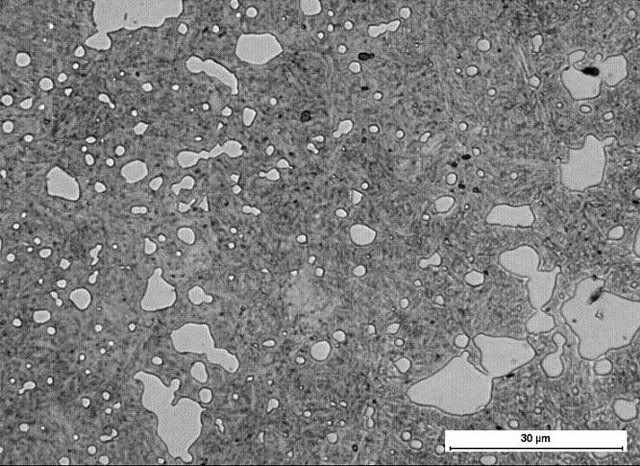
maybe the carbide size is where my confusion comes in. i've been under the impression that the black dots in these micrographs were the carbides, and s30v had smaller but more carbides based on the cpm process...

154cm

154cm.jpg


s30v

s30v.jpg
 
I use Silicon Carbide to sharpen MOST of the time with excellent results, however that is with good quality Norton and Congress stones (I use water or Windex).

That's sharpening and reprofiling steels like S90V, S110V, 10V, K294.

Don't discount the value of ceramics for light touch ups.
 
maybe the carbide size is where my confusion comes in. i've been under the impression that the black dots in these micrographs were the carbides, and s30v had smaller but more carbides based on the cpm process...

154cm

154cm.jpg


s30v

s30v.jpg

It's more about the amount of excess vanadium in the alloy, and the relative size difference between vanadium carbides and the steel grains in the matrix. The excess vanadium will still tend to collect together to form carbides of larger size than the surrounding particles of steel. In comparing these two steels, there is little 'excess' vanadium in the 154CM alloy (the little bit of vanadium found there is said to be only residual, according to Crucible), so there will be much fewer vanadium carbides in the mix, almost nil. Where the vanadium carbides are found, they will still be of larger size than the grains of simple steel in the matrix. In the case of S30V, there's a huge amount of excess vanadium, which means a much greater abundance of the larger vanadium carbides in the matrix.

The CPM process is known to refine the grain size of the carbides themselves, as compared to the carbides in non-CPM steels. But, not all S30V is CPM steel; there's 'S30V' and 'CPM-S30V'. For a more direct comparison of carbide size and distribution, it might be better to compare CPM-S30V to CPM-154 (same elemental makeup as 154CM, but utilizing the CPM process). OR, compare between the non-CPM versions of both (the standard 'S30V' vs. '154CM').
 
Last edited:
Between 154cm and S30V, there's a HUGE difference in Vanadium content. 154cm has about 0.4%, S30V is ten times that, at 4%. This makes the carbides in the S30V very, very large. Sort of like pebbles or cobblestones in concrete aggregate, when comparing to just plain cement. The huge carbides in S30V will limit how fine the edge can get, when sharpening exposes them at the edge of the steel. That's at least part of the reason why S30V edges are generally coarser than others, due to the great big carbides. Interesting thing about Vanadium is, at relatively small amounts, it is known to help refine the grain (making finer edges possible). This is likely why the 154cm has a little bit of it. But, above a certain level of content (like in S30V), the excess vanadium is known to create these very big and very hard 'rocks' (vanadium carbides) in the steel matrix, which makes it much more abrasion resistant, but at a trade-off in edge fineness.

I can agree with all but the Vanadium carbides effecting sharpness.

In my experience PM steels with take a finer edge than most any non-PM steel, it just take forever to get there.
 
I can agree with all but the Vanadium carbides effecting sharpness.

In my experience PM steels with take a finer edge than most any non-PM steel, it just take forever to get there.

For the PM steels specifically, and compared to the non-PM version of S30V, I don't doubt it. I think Sandvik uses a PM process in their steels, and I have been very impressed with the edges coming out of that. Fortunately, not quite so many of the vanadium carbides there, so it doesn't take nearly 'forever' to get it done. :)
 
I use Silicon Carbide to sharpen MOST of the time with excellent results, however that is with good quality Norton and Congress stones (I use water or Windex).

That's sharpening and reprofiling steels like S90V, S110V, 10V, K294.

Don't discount the value of ceramics for light touch ups.
to be honest, i've never tried ceramic (or japanese waterstones for that matter.) i guess i'm trying to get ideas on hypothetical things since i haven't had trouble sharpening s30v, but have never tried any of the higher end steels. if the more knowledgeable/experienced guys (like yourself and others in here) are satisfied with their blades from these suggestions then i'm sure i will be too. thanks.
It's more about the amount of excess vanadium in the alloy, and the relative size difference between vanadium carbides and the steel grains in the matrix. The excess vanadium will still tend to collect together to form carbides of larger size than the surrounding particles of steel. In comparing these two steels, there is little 'excess' vanadium in the 154CM alloy (the little bit of vanadium found there is said to be only residual, according to Crucible), so there will be much fewer vanadium carbides in the mix, almost nil. Where the vanadium carbides are found, they will still be of larger size than the grains of simple steel in the matrix. In the case of S30V, there's a huge amount of excess vanadium, which means a much greater abundance of the larger vanadium carbides in the matrix.

The CPM process is known to refine the grain size of the carbides themselves, as compared to the carbides in non-CPM steels. But, not all S30V is CPM steel; there's 'S30V' and 'CPM-S30V'. For a more direct comparison of carbide size and distribution, it might be better to compare CPM-S30V to CPM-154 (same elemental makeup as 154CM, but utilizing the CPM process). OR, compare between the non-CPM versions of both (the standard 'S30V' vs. '154CM').
i had always been under the impression that all s30v was cpm based on joe talmadge's faq stating "Known Aliases: Crucible - S30V" and giving the same description and proprietary equivalents. i've seen micrographs for 154cm and cpm154, but only the one for s30v.

thanks for input and explanations, i know my questions/statements come off as abrasive, but i like to be thorough. i've been into knives since i could hold one, but only last year got into what makes them do what they do.
 
S30V is made by CPM, there is only one S30V.
 
Ankerson's experience echo mine. I've not encountered a steel with vanadium that I could not sharpen on Norton's SiC stones up to S60V. Nor have I noticed my DMT stones cutting these steels so much faster. However, the diamond will leave a better edge. DM
 
I don't doubt or question that s30v was made by anyone other than Crucible. 154cm and cpm154 are both made by Crucible. Same elemental makeup; one is pm (powder metal), the other isn't. And the 'cpm' version is much more expensive, when you find a knife made with it. Crucible hasn't always produced just pm steels. A few years back, I know some vendors used to make deliberate distinctions between the 's30v' and 'cpm-s30v', which is why I've been under the impression that two versions were out there. Reading lately, there's mention of some quality difficulties with the steel early on (heat treat, maybe other issues), which may have perpetuated the distinction between the two 'aliases', if that's the case. The apparent differences in quality of different vendor's implementations of it may have also contributed to that distinction.

Having said all that, if two distinctions do refer to one steel, I can accept that. There does seem to be much long-running mention here on the forums, of the relative large or coarse nature of the vanadium carbides in S30V, and it's apparent tendency to form relatively coarse edges as a result.

On that note, here's something interesting I found on Crucible's site, about the CPM process and the resulting size of the carbides (bold emphasis added by me):

"The CPM Process

In order to manufacture tool steels with high wear resistance, without encountering these serious drawbacks, powder metallurgy processes are used to produce P/M tool steels having high vanadium content. Molten tool steel is atomized into fine droplets which solidify from the liquid so rapidly that the carbides are prevented from forming into large segregated networks. The solidified droplets form powder, which is then loaded into a steel can and consolidated (the individual powder particles are bonded together under high pressure), and subsequently forged or rolled into steel bars. The carbides formed during the extremely rapid solidification are fine in size (2 to 4 microns), and are uniformly distributed throughout the microstructure. Compare this to the larger carbides (up to 50 microns or more in size), and the characteristic alloy segregation or banding which results from conventional steelmaking methods. The characteristic feature of P/M tool steels is their near complete freedom from carbide segregation.

The 2 to 4 micron size mentioned (even after the cpm process) is obviously much more refined than the ~50 micron size of carbides by conventional steel-making methods. But it still compares a bit coarse to the ~1 micron thickness of a 'shaving edge' we often hear about in discussions of edge fineness or sharpness we see posted around here, on occasion.
 
I don't doubt or question that s30v was made by anyone other than Crucible. 154cm and cpm154 are both made by Crucible. Same elemental makeup; one is pm (powder metal), the other isn't. And the 'cpm' version is much more expensive, when you find a knife made with it. Crucible hasn't always produced just pm steels. A few years back, I know some vendors used to make deliberate distinctions between the 's30v' and 'cpm-s30v', which is why I've been under the impression that two versions were out there. Reading lately, there's mention of some quality difficulties with the steel early on (heat treat, maybe other issues), which may have perpetuated the distinction between the two 'aliases', if that's the case. The apparent differences in quality of different vendor's implementations of it may have also contributed to that distinction.

Having said all that, if two distinctions do refer to one steel, I can accept that. There does seem to be much long-running mention here on the forums, of the relative large or coarse nature of the vanadium carbides in S30V, and it's apparent tendency to form relatively coarse edges as a result.

On that note, here's something interesting I found on Crucible's site, about the CPM process and the resulting size of the carbides (bold emphasis added by me):


The 2 to 4 micron size mentioned (even after the cpm process) is obviously much more refined than the ~50 micron size of carbides by conventional steel-making methods. But it still compares a bit coarse to the ~1 micron thickness of a 'shaving edge' we often hear about in discussions of edge fineness or sharpness we see posted around here, on occasion.

Crucible is the only one who makes CPM S30V (S30V) and there never has been a non PM vers of that steel available.

Yes the Alloy content was changed slightly from the original run, but not the process.
 
S30V only exists in particle metallurgy form because that steel would segregate terribly in ingot form due to the quantity of the alloying elements present.
 
Back
Top