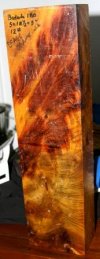
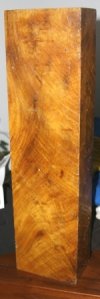
Osage

UV is part of the process in photodegredation, but the primary factor in the darkening of woods like Osage Orange, Purple heart, Paduak, etc. is oxidation. Photo-chemical oxidation (Normally called Photo-oxidation) is often part of that process. Strong light, more UV, higher ozone concentrations, and air flow all will effect the speed and degree of darkness caused by this reaction. Photo-degradation can also be caused by absorption of the light energy ( photons) into the molecules of the pigments, thus causing them to change.This is the reason paintings will darken slowly over hundreds of years. However, chemical oxidation of the same pigments ( often speeded up by light) is a much faster and deeper process. That is why wood can darken in days to months.

The oxygen and ozone in the air is photo-reacted as it combines with the organic compounds in the wood ( oxidation). The result is a darkening of the organic pigments ( photo-oxidation). Since the UV ,which is the main energy source to drive the reaction, can't penetrate very far into the opaque wood surface, the darkening is very shallow. With time, the darkening deepens slightly, due to the slower chemical reaction ( non-photo) of the oxygen and ozone with the organic pigments. This can only occur to a depth determined by the permeability of the surface density. Your suntan is a similar process.

If two blocks of Osage, or similar photo-reactive wood, are cut at the same time, and one is laid in the sun while the other is placed in a dark box with good air flow....both will darken. The sunny block will darken faster due to photo-oxidation, and the shaded block will darken more slowly because it is only chemically oxidizing.

Stacy

Looks like lots of room for everyone's internet searches on the matter. I'm just a simple wood cutter and not a chemist or toxicoligist so have to cut and paste some contributing information. I'll include the source links with mine.

http://www.sciencedirect.com/scienc...serid=10&md5=72ced7674200d539df7f1f111079d432

Abstract
In this article we try to give an overview of the photodegradation of wood and the different ways available to stabilise this complex substrate. The mechanisms of wood photodegradation have been investigated and it appeared that lignin is the key structure because this component is able to absorb in the UV/visible region due to its chromophoric groups. Thus, some solutions can be offered to protect wood against photodegradation. One of the easiest consists in applying finishes such as paints, coatings, varnishes etc., but it is also possible to modify the substrate chemically (e.g. by acetylation) or to stabilise its colour by thermal and photochemical pre-weathering. The use of UV absorbers, HALS, antioxidants and the recent development of new additives help to prevent the degradation of the coated wood system.

Keywords: Wood; Photodegradation; Stabilisation; UV absorbers; HALS


http://www.springerlink.com/content/n2lv612210142114/

Abstract The photodegradation of wood is essentially a surface phenomenon, and although in practical terms it has no effect on strength properties, it does have serious consequences for the surface technologist. A principal concern is photodegradation of the timber surface underlying clear and lightly-pigmented finishes—a problem which can lead to early failure of the coating and to expensive remedial measures. Recent thinking is directed towards the development of pretreatments which could stabilise the timber surface against photodegradation. However, in the absence of detailed investigations on the wood-degrading capabilities of different regions of the solar spectrum such developments have so far been restricted. In this paper, thin strips of Scots pine and lime were irradiated behind filters which transmitted selected regions of the ultraviolet and visible spectrum. Tensile tests on irradiated strips show that ultraviolet light is highly active in degrading wood, but indicate that the visible part of the spectrum also contributes significantly to loss of strength. Throughout the exposure period, samples were taken for SEM observation. The loss of strip strength is associated with a light-induced depolymerisation of lignin and cell wall constituents, and to the subsequent breakdown of the wood microstructure.


http://pop.acd.ucar.edu/
What is Photochemical Oxidation?
Oxidation is the process of combining oxygen with some other substance or a chemical change in which an atom loses electrons. Photochemical oxidation is oxidation caused by Ultraviolet (UV) radiation in the earth's atmosphere. This processes creates the free hydroxl radical (-OH). The high energy of UV radiation can also break the chemical bonds of water (H2O) to yeild *OH and hydrogen (*H) radicals.


The rusting of iron is a common form of oxidation

Ultraviolet radiation is part of the electromagnetic spectrum which ranges from gamma rays at the most energetic end to radio waves at the less energetic end. Most people are familiar with UV radiation b/c it is what causes our skin to sunburn.
 
I usually don't chime in much on here because I don't feel I can add to the conversations. However, I have worked osage quite a bit making bows. Some people like the bright yellow color and want to keep this, but as Stacy so aptly explained above, this can not be done because the wood will eventually darken. The only thing I would like to add is the comment by R.H. Clarke
"If you do get some green get the bark off right away. It contains wood borrers. Use shelac to seal everything or it will check out bad."

If you get some green stuff and can peel the bark off the sap wood (white part) has a lot of moisture compared to the heart wood and will lose moisture quickly and pull and twist the wood (bad for bow staves) and also cause checking as mentioned above. You can shellac everything as suggested above, but if you have a draw knife use it to quickly get rid of the sap wood and then seal the ends of the piece and it should dry evenly without checking. Also, the sap wood is where the larva are that sometime bore into the heart wood. They really want to stay in the sap would but occasionally move down into the heart wood, but will turn back into the sap wood again. Just a few more names for this wonderful wood: Boise d Arc, (The name the French gave the wood the Osage Indians used for there bows), Bodark (slang for above), Hedge Apple (wood was introduced into the Midwest during the Dust Bowl era for windbreak hedges), Horse Apple.
 
I have one blank, 2 x 10 x 24" here in Acworth, but it's destined for acoustic guitar backs. Good quartersawn Osage big enough for 2 piece guitar backs is rare. Osage Orange physical and sonic properties are a drop in substitute for Brazilian rosewood.

Amen! Here's a couple guitars I built this year with osage backs and sides (the fingerboard on one is also osage).

http://www.pattonblades.com/cg-2.jpg

http://www.pattonblades.com/cg-8.jpg

http://www.pattonblades.com/gwip-259.jpg

http://www.pattonblades.com/gwip-274.jpg


Too bad it doesn't look like rosewood...
 
Fiddleback, glad you joined the Georgia Guild and we will look forward to seeing you in Statesboro nest month.
 
Hey Cliff. Its good to hear from you. A truckload huh? dang. That sounds awesome. How long is the drive? Are you coming down for Blade Show this year?

Yeh Andy, I've got a table again, hope to see you around. There are two big brush piles that were all cedar and hedge apple. Been laying there for 7 or 8 years since I pushed them up.

It is unreal the amount of hedge apple I have pushed into piles and burned over the years doing excavating. They are considered a trash tree around here and if you do clearing they want them gone.

While I was typing I just thought of 5 or 6 more pretty good size ones I pushed out on a neighbors farm last year. It's about a 1/2 mile from my house.

It takes me about 7 hours to get to Atlanta. I may be able to try to cut some of that before then to know if its worth fooling with.
 
I purchased a box of handle blanks that Bill Moran had sawn into the profiles for his ST series knives, and marked them with size numbers. They were the templates for marking out his knife handles on curly maple. I thought they were walnut, they were so dark brown. One day I decided to use one. When I ground into it it turned yellow-orange color. It was Osage Orange. The color deepens with age, exposure to the air, and exposure to light.
Stacy
A friend and I fool around with goose calls and one of my custom calls is made from it. It's three years old and it's turning brown, by next year someone probably wouldn't think it was Osage.
 
I usually don't chime in much on here because I don't feel I can add to the conversations. However, I have worked osage quite a bit making bows. Some people like the bright yellow color and want to keep this, but as Stacy so aptly explained above, this can not be done because the wood will eventually darken. The only thing I would like to add is the comment by R.H. Clarke
"If you do get some green get the bark off right away. It contains wood borrers. Use shelac to seal everything or it will check out bad."

If you get some green stuff and can peel the bark off the sap wood (white part) has a lot of moisture compared to the heart wood and will lose moisture quickly and pull and twist the wood (bad for bow staves) and also cause checking as mentioned above. You can shellac everything as suggested above, but if you have a draw knife use it to quickly get rid of the sap wood and then seal the ends of the piece and it should dry evenly without checking. Also, the sap wood is where the larva are that sometime bore into the heart wood. They really want to stay in the sap would but occasionally move down into the heart wood, but will turn back into the sap wood again. Just a few more names for this wonderful wood: Boise d Arc, (The name the French gave the wood the Osage Indians used for there bows), Bodark (slang for above), Hedge Apple (wood was introduced into the Midwest during the Dust Bowl era for windbreak hedges), Horse Apple.

Thank you for adding that.I should have said bark and sap wood as that was what I was thinking in my mind.Usually when we get a stave ready to dry we will seal the ends and the heart that is under the sap wood we just removed.A stave is split out and the rough split part we don't seal because even if it gets small check cracks they will be removed in the bow making process.

Thoes larve are bad news.A friend of mine stored a bunch of Osage with the sap wood left on in his basement and they got into his floor joists.He spent money getting rid of them.
 
A friend and I fool around with goose calls and one of my custom calls is made from it. It's three years old and it's turning brown, by next year someone probably wouldn't think it was Osage.

dont mess with the OO man!! you prob got that der argentine oo for that der duck caller. marekz
 
I think its gorgeous after it browns out also. And its a wood that has beautiful rays if you have it cut right.
 
I cut up a stump a while back and most of it won't be able to be used because I didn't seal it and it checked on me.

Since I am in the excavating business I have pushed up and burned enough of that for a zillion knife handles and still have some to spare. There are a couple brush piles on my in laws farm that I pushed up about ten years ago. I've been thinking about sacrificing a chainsaw chain and cut into one to see if it dried solid. The trouble with it is it's like Locust, once its dry sparks will fly off a chain and it will ruin chainsaw chains.

Andy if what I have in the piles is good you can come up and fill a truck if you want. Just save a little for me.
I'm not far from you at all (Oldham County). Osage is like a weed to me due to the thorns but it is nice strong wood.
 
The Nessmuk I got from you changes its appearance at different angles :thumbup:

Yep. Osage has great chatoyance. Plus, when its quarter sawn the rays are gorgeous.
 
what would you call the reddish markings on this OO. it is supposed to be freshley cut. The fella calls it splating. what do yall think. Ive seen some like this on the 4-sale section--they called it figured. marekz
 

Attachments

  • 00 010.jpg
    00 010.jpg
    16.7 KB · Views: 33
  • 00 011.jpg
    00 011.jpg
    13 KB · Views: 26
I'm not far from you at all (Oldham County). Osage is like a weed to me due to the thorns but it is nice strong wood.

We need to meat up sometime and talk knives. Yeh it's like a weed to most everyone around here now days. Many of the fence posts on a lot of the old farm fences will be Hedge apple or Locust around here. If its an old fence they are the posts that are still intact.
 
Marek, I've seen darker colored wood like that when cutting through knots or figured areas. I don't think this wood will spalt much if at all. Very dense oily wood, last 50 years as a fence post.
 
what would you call the reddish markings on this OO. it is supposed to be freshley cut. The fella calls it splating. what do yall think. Ive seen some like this on the 4-sale section--they called it figured. marekz

Looks like he burnt it a bit when cutting it and then sanded a little, but not all of the burnt wood off. Probably sand right off when youget it.:thumbup:
 
what would you call the reddish markings on this OO. it is supposed to be freshley cut. The fella calls it splating. what do yall think. Ive seen some like this on the 4-sale section--they called it figured. marekz

Spalting is typically a decayed section of wood caused by a fungus. Figured basically means a non-straight grain--from burls, crotch, irregular twists, roots, etc.

Osage is usually a very twisted tree, they seldom grow straight compared to ash, walnut, and others. As it grows it sometimes twists around on itself, growing over and around parts of the trunk that might have died off. From the picture, it looks to me like the wood was cut where a branch was coming off a trunk or larger branch. The reddish area is likely a cross section of the small branch.
 
Back
Top