oven build frustration

Joined
Jul 31, 2015
Messages
3,118
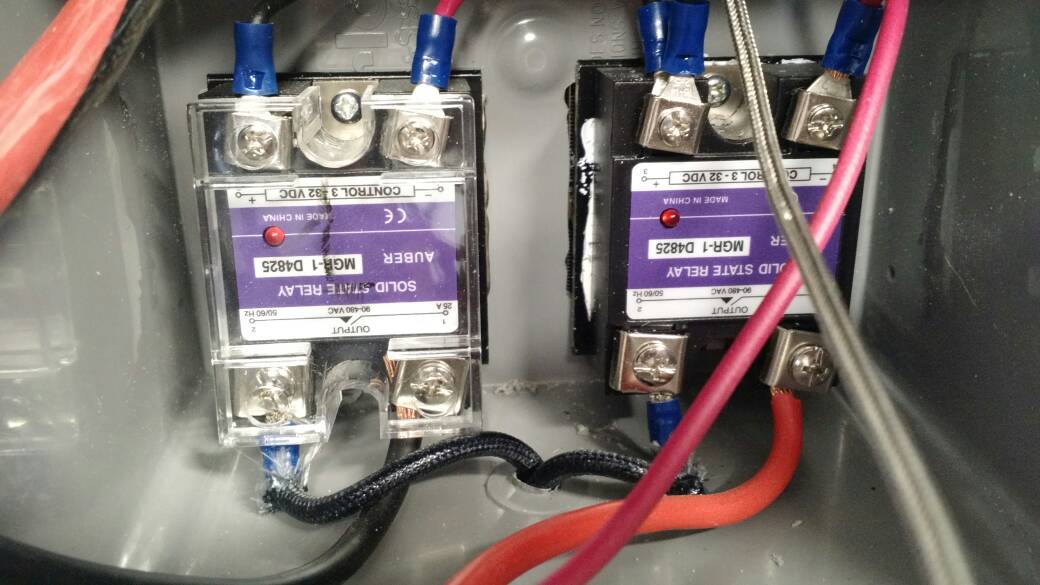
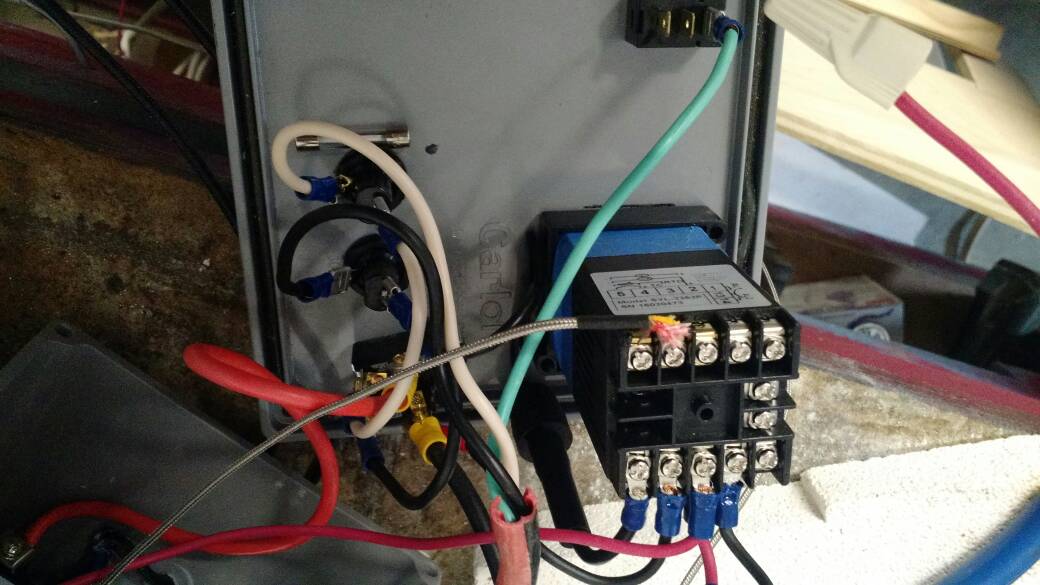
I hit a wall on my build and can't figue out what is wrong. I blew the main line fuse on one of the legs of the 220 feed coming into the oven. I was using a 20amp slow blow and the oven came on and the coils started to heat, SSRs were lit, then it blew. and by blew, I mean the fuse is cracked in half. replacement fuse blew immediately. I triple checked the wiring and the only thing I can think of is that my coil calculation is off and they are demanding way too much juice. there are 2 coils in series (wired together at one end other ends go to SSR 1 and SSR2 outputs. Each coil is 25 feet of 16 guage Kanthal A1. I am thinking the resistance isnt high enough and it is shorting the circuit? I'm at wit's end, and would prefer to not die, so any help would be great.

I wired it according to the diagram in this thread:

http://www.bladeforums.com/forums/s...eat-Treat-Oven-Wiring-Schematic-Future-Sticky
 
According to my math you are sitting at 20 amps if you have a 220v supply. I was tired of redoing all the calculations for wire elaments so I wrote a excell program that calculates it all. And yeah you should be using 50 ft to get your 20 amps. But if your at say 240v your amps are going up. If your voltage is 240v and not 220 then 50ft will pull 22amps. So with that elament I would use around a 30amp fuse that's your problem.

Photo%20Aug%2004%2C%209%2055%2044%20PM.png
 
So can I drop the amps with the existing element? Any way you can post that excel file? That would help tremendously.
 
Strange. For taking 20 A your coils would need a resistance of 11 Ohm (at 220V). But the calculated Resistance for your Coils is

R= l*rho/A = 16,88 Ohm;

with R: Resistance; l: wire length (50ft/15,24m); rho: electrical resistivity(1,45 ohm*mm²/m); A: surface of wire crosssection (1,3087mm²).
If your data regarding the coils is correct, the coils shouldn't be the fault for blowing your fuse. They should draw only 13,03 A (at 220V).

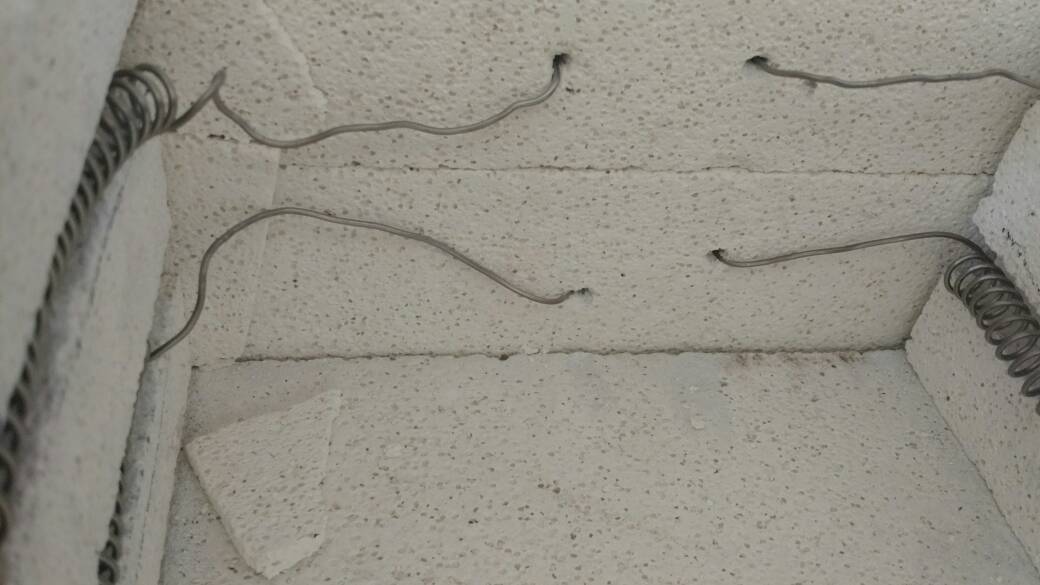
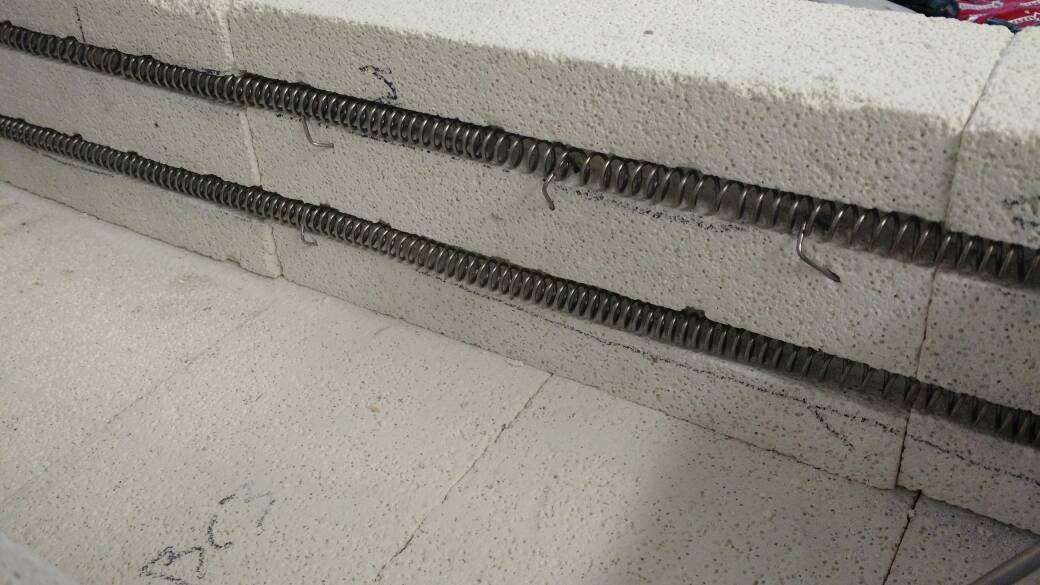
So there might be at any connection or frame a short circuit, lowering the resistance. If you are using staples for holding the coils in place, some might be touching the ones of another coil leg and reducing the resistance by reducing the wire length.
 
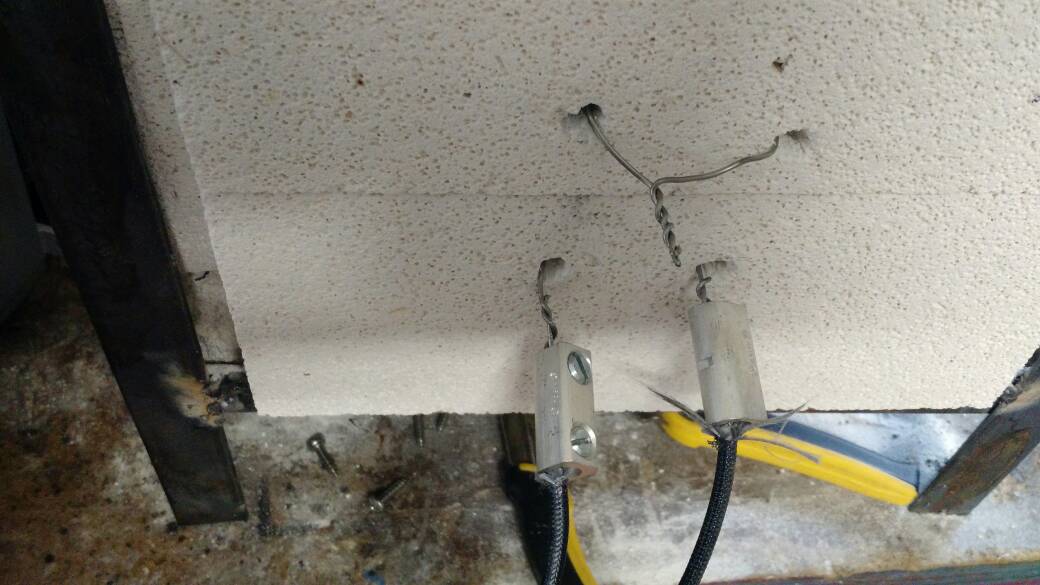
the twisted ends of my coil are only about 1 inch. could that have anything to do with it?

Pigtails

5b35f1d732e9222e4918cf7466a1f848.jpg


Inside

ff4b1179775fca3386bebe5a5d2e295f.jpg

1ad6a389f410b3e0ff8372771d1ea087.jpg


9258895426fdee92318d3c9b38d24730.jpg

6d5ca4580d6765142cbefa5e73bb9bb1.jpg
 
No, making the twisted parts longer (while not changing the length of the elements themself) would lower the resitance (because the crosssection surface would be higher in those few parts).

Have you measured the diameter of your Kanthal wire? If the diameter is likely 1.7mm (0.0669") and not about 1.29mm(0.0508"), the Resistance would be about 11 Ohm and by that drawing 20A.
 
Last edited:
Kevin...do you have access to an ohmmeter? Simply disconnect the coils from the SSR's and measure their resistance. Take the guess work out of it and at least eliminate the coils as a potential problem.
 
blowing a fuse in two leads me to think you have a short to ground somewhere in your wiring. i would disconnect your power leads, check the resistance of your coil, then check coil to ground. here is a link to a good furnace "How To" that includes the math needed, sample wiring diagrams, and different ways to mount your elements.(http://www.joppaglass.com/elements/dudleys_element_paper_2015.pdf) another link that shows how to wire and mount http://www.duralite.com/store/scripts/prodList.asp?idCategory=1 both of these sites also carry all the bits and pieces need to build you furnace.
scott
 
Last edited:
Sorry my numbers where wrong for 16ga. Here is the updated data. I can't share the spread sheet because I wrote it on my iPad not a computer.

Photo%20Aug%2005%2C%207%2004%2007%20AM.png
 
Sorry my numbers where wrong for 16ga. Here is the updated data. I can't share the spread sheet because I wrote it on my iPad not a computer.

Photo%20Aug%2005%2C%207%2004%2007%20AM.png

Just curious, can't you email the spreadsheet to him? The green box icon with the up arrow should allow you to email it if you have email set up on your ipad.
 
At 13amps if your blowing 20 amp fuses then I'm guessing a short or you where given thicker wire. First I would mesure the wire diameter or the ohms and see what you got.
 
Just curious, can't you email the spreadsheet to him? The green box icon with the up arrow should allow you to email it if you have email set up on your ipad.

Hot damn what do you know your right, I can send it and it will even send it as an excell program lol. So just need your email address. Let me clean up my extra garbage on it and I will send it to you
 
Hot damn what do you know your right, I can send it and it will even send it as an excell program lol. So just need your email address. Let me clean up my extra garbage on it and I will send it to you

Hopefully it will keep the calculations you have in it. I have tried it the other way round and my iPhone won't work calculations from a PC, but I would think it will work the other way around. Although I was trying to send a file to my phone with some very hefty recursive formulas that even makes my PC work hard on and it's running with an AMD 4.7GHz 8 core and 32GB ram, so it's not surprising it wouldn't run on my Iphone.
 
Sounds like the draw is too high. All the charts, apps, and calculations in the world will only give you the theoretical draw.

The first thing to do is get a good ohmmeter and read the resistance from the coil ends at the SSRs. Then read the power at your plug with a voltmeter. Use those two readings to calculate the actual draw. This is important before you do any further changes. I=V/R is your friend.


If the draw is truly too high, there is no simple way to lower the draw.

The only basic way is to add more coil length. Adding a "U" of 10 feet of additional coil on the roof would be plenty. Just open the twisted coil wires on the back and put the new section in series there.

The simplest solution would be to install larger fuses --- as long as the circuit the kiln is plugged into is sufficient for that. A fuse 25% higher than the draw would be right. ---- again, AS LONG AS THE CIRCUIT FROM THE BREAKERS IS RATED FOR IT.

Added:
I took a good look at the twist in the coils connection. It looks pretty sloppy. I would replace it with a proper wire connector clamp and not twist at all. Use the same connector you used for the power wires to the coils - one coil in each end.
 
I also found it odd that only one fuse of the two blew and the other showed NO damage. Truth be told, and make sure the kids aren't watching... I bypassed the door switch, heat led and coil switch last night to troubleshoot when I couldn't get current to the coils, but I'm not sure how that would impact it. After the second fuse blew I bypassed them. The bypass connection (I spliced the spade connectors together) arced. The 20 amp breaker tripped and even the main tripped.
 
You are fine with them. Just slip a connector over the twisted joint and screw down tight. Merely twisting a wire that gets hot will have all sorts of problems. It needs a mechanical connector with lots of torque locking them into a solid surface to surface connection.

Added:
I would also slide a piece of fiberglass sleeving over the coil wire ends and connectors.
 
Last edited:
Could the way the PID is programmed have any bearing? I'm thinking not, since at worst it would just turn the coil on. It can't get "more on". It either is on, or it ain't.
 
Correct, the SSR is just an electronic switch.

I am pretty sure when you take the readings I suggested and do the math, the current draw will be the problem.
 
Back
Top