oven build frustration

When I measured the ohms, I believe it was 8-9 ohms per coil, so should be 16-18 ohms total, but I will make the connection improvements Stacy suggested and test the ohms from those points.
 
Yes, if those readings were accurate, you are only pulling 15 amps. Silly as it sounds, check the fuse to make sure it is the right type, size, and voltage.
 
See above. Bypassing the fuse popped the 20 amp breaker. The fuse I was using was a 250v 20a slow blow glass fuse. It didn't just blow, it blew in half.
 
When I measured the ohms, I believe it was 8-9 ohms per coil, so should be 16-18 ohms total, but I will make the connection improvements Stacy suggested and test the ohms from those points.

have you checked coils to ground, coils to the frame, and SSR output to ground? something is shorting big time to blow fuses in two. on connection improvements, there are ceramic wire nuts available that are rated to 2000F.
scott
 
If you are blowing the main breaker, most likely there is a direct short to ground as mentioned or a short between the two lines. Make sure you are unplugged. Disconnect the leads to the coil and test for continuity between ground and coil. You should not have continuity. Then test each 110 leg to ground for continuity, you should not have continuity. You may have to disconnect each wire from everything and test each one to ground.
 
In his initial post he stated it came on, the lights lit, the coils started to heat, and then the 20 amp glass/ceramic Buss fuse blew.

That could not happen with a direct short. In a few milliseconds, the breaker would likely blow as well as the fuses.

With the fuse blowing with such heat as to break the glass/ceramic - after the coils started to heat, it would indicate an over-draw from the coils.

BTW - If you are using glass fuses, they aren't what you want here. Use ceramic fuses.
 
Fwiw, Not directly related to your situation. But...
As a heating element gets hot, Its resistance increases.
 
In his initial post he stated it came on, the lights lit, the coils started to heat, and then the 20 amp glass/ceramic Buss fuse blew.

That could not happen with a direct short. In a few milliseconds, the breaker would likely blow as well as the fuses.

With the fuse blowing with such heat as to break the glass/ceramic - after the coils started to heat, it would indicate an over-draw from the coils.

BTW - If you are using glass fuses, they aren't what you want here. Use ceramic fuses.
To clarify, there was only a delay the very first time, as the coils were smoking, with maybe a few second delay. The subsequent two times, it was immediate.
 
I am on vacation for a week, so when I get back if the testing doesn't give insight, maybe I will do a video to show the wiring.
 
Yeap I read it as now it's as soon as it calls for heat the fuse blows immediately! Un hook heating coils from SSR power up and see what happens. If it blows a fuse you know problem is before elements. If it only happens when coils are hooked up then you know problem is with them. But it sounds like a short to ground on the coils to me with what little you have stated.
 
It only happens with the coils on. If I knew more about the problem, I guess I would know what information would be helpful.
 
My apologies. I looked at the pics on my cellphone, and I didn't figure out the connections right.

Ohmmeter checks, as pointed out, would be the place to start. Keep the electronics out of the analysis at first: measure all combinations of [fase 1, fase 2, neutral, and ground].

If that does not show the problem, my next check would be for a connection happening after the coils dilate due to the heat. That should happen the first time in a matter of a few seconds, and a little bit faster on subsequent tests. Check visually the coils and connections during 110v operation, and you'll get some idea about what may be happening at 220. The current consumption at 110 should be almost half of at 220, and hopefully it won't blow the fuses.
 
Last edited:
There is no neutral, two hot legs and a ground.
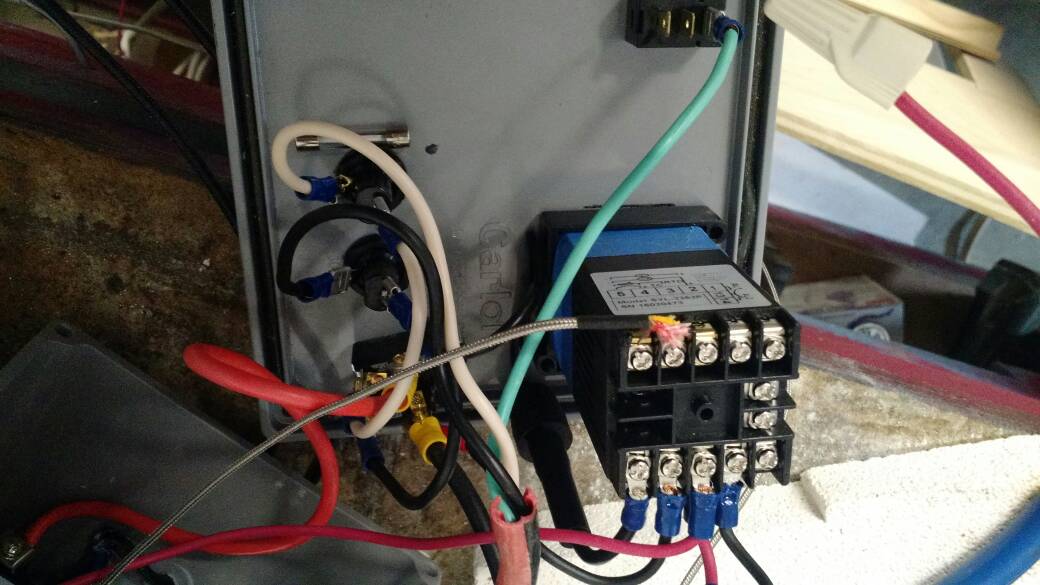
Hmmm.
I hope your PID operates at 240vac...

Anyway, cant see much of the precise wiring here,
I assume that red w/blackstripe cable is incoming power.
What is its green conductor connected to ?
6d5ca4580d6765142cbefa5e73bb9bb1.jpg
 
Sorry, I know the pictures are not great, by I won't be able to take anymore for a week, as I am away. It does operate on 240v and it works fine with the coils disconnected. The green is the ground,
This picture does not show it, but the chassis, that switch, and the heatsinks for the SSRs all get grounded. I grounded everything that had a ground connection, or that I could contact and was made of metal.
 
Back
Top
