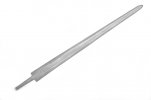
Pattern Welded Sword (WIP)

Also, the resulting bars with interrupted twists and those same bars bundled for welding to make the sword's "core."

Did you use induction heating coils to make your interrupted twists. I watched the use of one last week to make interrupted twists is Damascus bars before they were welded together. That was at the Visalia, CA Hammer-in. It was very cool!

Eric
 
Did you use induction heating coils to make your interrupted twists. I watched the use of one last week to make interrupted twists is Damascus bars before they were welded together. That was at the Visalia, CA Hammer-in. It was very cool!

Eric

Hi Eric,
Thanks for the kind words!
No, I did it the old-fashioned way.:grumpy:;)

Induction coils is a good idea, though! Very clever!:thumbup:
 
Joe, this is a beautiful project, thanks for taking the pictures! Do you know what hilt design you will go with?
 
Joe, this is a beautiful project, thanks for taking the pictures! Do you know what hilt design you will go with?


Thanks Sam!

I'm thinking it will be a Scottish Basket hilt (Fraser style). Obviously it could be 'properly' hilted in any style from Migration though Viking--even later. The thrifty Scots hilted medieval swords in baskets, so there's the connection--that and there's the Celtic connection to this sort of sword construction.
 
That will be fantastic!

I missed where you mentioned it in the first place, duh me.

See if Donnie will be cool with sharing WIP pictures, if the basket is not already made.
 
That will be fantastic!

I missed where you mentioned it in the first place, duh me.

See if Donnie will be cool with sharing WIP pictures, if the basket is not already made.

That is an excellent idea. I'll mention it to him!:thumbup:
Thanks again!
 
Scottish basket hilts are nice but I'm even fonder of the graceful Schiavona style the Scottish ones originated as. I think there are a number of them in Scottish collections so it wouldn't be historically inappropriate.
 
Scottish basket hilts are nice but I'm even fonder of the graceful Schiavona style the Scottish ones originated as. I think there are a number of them in Scottish collections so it wouldn't be historically inappropriate.

The Schiavona is cool. Not sure most folks would recognize it. I'd also like to learn if the Venetians were as prolific at rehilting ancient blades as the Scots ...:confused:
It's a good suggestion, though. I like the lines. Definitely a different flavor!:)
 
Amazing work! What do you mean by homogeneous 1086? That it's one piece the way you bent it around? Or is it a descriptor meaning something specific re the alloy?
 
Amazing work! What do you mean by homogeneous 1086? That it's one piece the way you bent it around? Or is it a descriptor meaning something specific re the alloy?

Thanks!
I say "homogeneous 1086" because the edge is a single piece of 1086 as opposed to an edge that is made of a pattern welded laminate.
In this case, I wanted a really bright blade and to emphasize the transition between edge and core. I figured the best way to make that statement was with a homogenous steel edge vs. a damascus edge, straight welding lines and grind geometry.

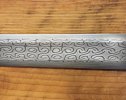
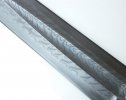
Here are a couple pictures of some previous projects with PW edges.

Obviously the grinds are quite different, but I show these as an example of how the etched PW edges provide a less staccato, darker and more subdued look overall. The new sword is making a slightly different 'statement', if that makes any sense ...

Thanks again for the kind words. :)
 

Attachments

  • SutonHooBlade.jpg
    SutonHooBlade.jpg
    15.5 KB · Views: 40
  • Baileydetailsmall.jpg
    Baileydetailsmall.jpg
    93.5 KB · Views: 55
  • 1bladedetail_1.jpg
    1bladedetail_1.jpg
    44.9 KB · Views: 56
I think the the bright edge looks much better than the damascus edge. The non patterned steel makes the patterned steel jump out, really good contrast
 
I am not really a Damascus freak like a lot of folks seem to but, I darn sure like this!

Now I must say, I think I understand how you arrived at the sandwich, where you have them clamped together.

However I guess I have got to show my ignorance here because, I don't understand how you forged the two materials together and keep the clean line. At that point where the materials are in the clamps, they are just materials laying side by side in clamps. Is that correct? :confused:

I am missing something because the mere act of hammering the two materials together would begin to make the lines between them blur.

I would really love to know more about that part of the process, the joining of the two different materils, if you would care to share! Pics would really be nice too! I am fascinated with the outcome I just seem to not fully understand the process of getting there. You know, (talk really slow for us challanged people)!:D
 
Back
Top