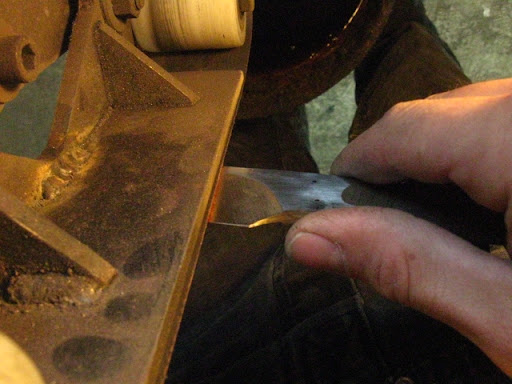
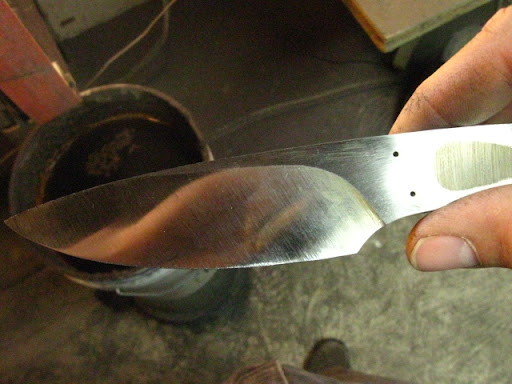
Perfect plunges

Joined
Jun 5, 2008
Messages
3,224
At the show I just did, I had 5 different guild members and 3 mastersmiths give me a good solid knife critique at my request. EVERY SINGLE ONE pointed out that my plunges were not consistently even. A couple also pointed out that the top of the plunge where the bevel meets the flat was also uneven on some of my blades.

Help! Other than just paying more attention to those things, what suggestions do you guys have for getting even plunges?

Overall my knives got good reviews, but this was definitely a sticking point.
 
Best place to start is with a carbide file guide.:thumbup:
 
A good file guide and close inspection as you go will help getting too far off.
Hand sanding the bevels past the basic bulk removal is also the way to get dead perfect results.
 
What kind of platen do you have? Is the radius the same on both sides? What belt do you use for your plunges? A ceramic stiff belt that's broken over the edge, or a j-flex?
I can't do them well yet either.

I have a San-Mai blade Chuck Richards and I(supervisory role) made during a forging lesson. He rough ground the bevels on his disc. The plunges are perfect.
 
Good advice above. Plunges are a pain. They're one of the trickiest parts to get exactly right, and one of the first things that catches people's eyes. I wouldn't even try to set/clean one up without a file-guide... I just don't seem to be accurate enough to get them right on the platen alone.

There's another way... don't use 'em! :D Plungeless designs can be very cool, are a little easier to make, and give you the maximum amount of useful edge.
 
the softer the plung the easer to hide but in truth you will need to do alot of blades to get it right free hand. i agree that file guides make thing much easer
 
When I do flat grinds and go from the belt on the platen to a 9" disc its a little easier to
tell when looking straight down on what you're doing. Hollow grinds and free hand is another
animal completly. All good advise above and practice, practice, practice. Plunges were one
of my write ups when I applied for Guild membership. A lot of belts and steel. Really good
strong light within a couple of inches from what you're doing helps . Lately for me its
L E D's
Ken.
 
Last edited:
This is a skill I am working hard on at the moment. Its now the first thing that draws my eyes when looking at a knife. Its like the welds/brazes on a bicycle. The quality of the workmanship here and attention to detail is what sets a well made knife apart from a functional knife. I have been using jeweler's files then fine sandpaper (220 grit +) on a custom made sanding block to clean them up. A 1x30 isn't stable enough (at least with my skill level) to cut a clean even plunge on both sides.
 
Big +1 for strong lighting close to the work. I have a gooseneck lamp on each side of each grinder. I like to be able to point light right at the work from 6-8" away. Slowing the grinder down helps a lot. I like to grind to about 95% with a roughing belt, stopping about 1/8" short of where I want the plunge to be. If it's a swept plunge or a hollow grind, I tend to finish shape and clean up the plunge with A65 and then A45 gators. If it's a flat grind with a full height conventional plunge, I go to 220 and then 400 grit J-flex, running the belt around the edge of the platen by 1/8" or more, to get all the scratches out.

I find that if I want to do a big swept plunge, i.e. a big radius, it can help to make a pattern. After profiling, trace the blade onto card stock, draw the plunge you want into the tracing, then cut the blade pattern out (only the part from the plunge forward.) You can apply this to each side of the blade and trace the plunge onto the steel with a fine tip marker. Then, with strong light you can use the grinder to "color inside the lines."


Roughed swept plunges, looking at the grind as it comes off the belt.
IMG_6452.JPG


IMG_6453.JPG


Matching plunges finished with J-flex, then hand sanded. A block with a sharp corner helps to get all the way into the inside of the plunge.
IMG_9120.JPG


IMG_9118.JPG
 
Last edited:
If you do choose to clean them up by hand after coming off the grinder, you may find that there's often a few vertical scratches that can be a real pain to get past. It's just plain difficult to sand lengthwise into a tight curve.

Here's a tip I picked up recently from another member here... Cratex polishing tips for your rotary tool. Essentialy, rubber with abrasive mixed throughout them, so as the rubber wears away there's more abrasive. They're much faster, obviously, and leave a pretty decent finish that's easy to hand-sand. I've been using the bullet-shaped ones, 3rd from the right in the picture, and shaping them against a file to the profile I want; they're available in various sizes/shapes/grits.

50-piece-cratex-rotary-set.jpg
 
No such thing as 'perfect' anything.

But a hell of a lot of practice and paying close attention with get you close.
 
I use the cratex bullets for plunge finishing as well. Makes my life much easier. You just have to be careful not to polish a groove into the plunge which is lower than the rest of your flat. I typically start the cratex away from the plunge and push into it, moving back and forth to blend things out.

--nathan
 
Nathan and James... what sizes/grits of cratex bullets do you use? Where do you get them?
Thanks in advance.
Erin
 
Cork belts clean up plunges beautifully. And they are more forgiving as well.

S.R. Johnson uses them and I am very happy with them.
 
I picked up an assorted kit from Enco a while back. The ones I use for plunges are the No. 8 Bullets (1" length x 9/32 diameter). They fit on the mandrels for my dremel tool (1/16" I think), so I use them in my flex-rotary attachment.

I typically hand sand up to around 400 grit, and then I use the cratex bullets to remove any stubborn scratches within the plunge. Really, they work great and actually fairly quickly. If I'm at 400 grit, I'll use the Fine grit. If I'm below that, I'll use the Medium grit. A trick is to not push on them too hard. The mandrel only goes in a little bit, and too much lateral pressure will cause the rubber to break above the mandrel. If you're really unlucky, you can get a scratch from the mandrel tip into your blade; but you'd have to be pushing pretty hard to loose control that bad. I just use light pressure and move in and out of the plunge (tip-to-ricasso movement) with a shaped bullet, working my way up and down the plunge and blending out probably 1" from the plunge toward the tip. Stay in one place too long, and you'll get a groove that you have to sand the rest of the blade down to match. Keep it moving with only brief pauses over your most troublesome spots, and don't put too much pressure, and they work great. After you think you have it, it only takes a few passes with paper to remove all the polishing marks and get your scratch pattern back. I find using a suspension oil for sanding after using the cratex works to re-establish my pattern more quickly with the paper. I especially like the fine grit as it doesn't cut too deep but still works down the stubborn scratches.

Hope that helps.

--nathan
 
Last edited:
The knife edge cratex wheels, in x-fine grit, are also really nice for hand polishing solder or glue joints on the front of the handle. You can blend right into a 600 grit scratch pattern with them, like a little blending eraser. I just hold the wheel by hand or in a pair of needle nose for this.
 
Back
Top