Please Critique My Design

Joined
Apr 19, 2012
Messages
519
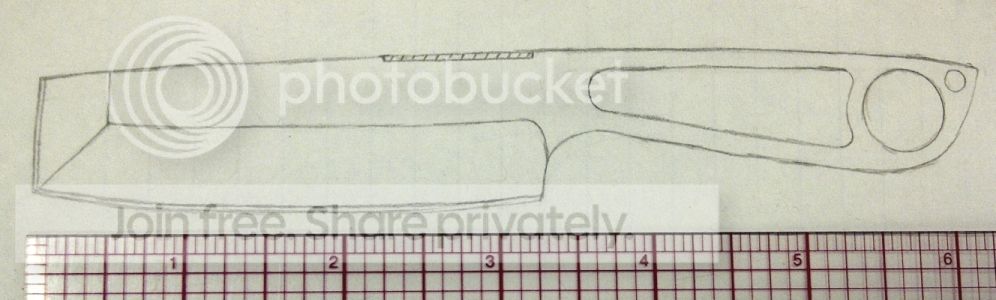
*Updated sketch on 2nd page*

Hi all,

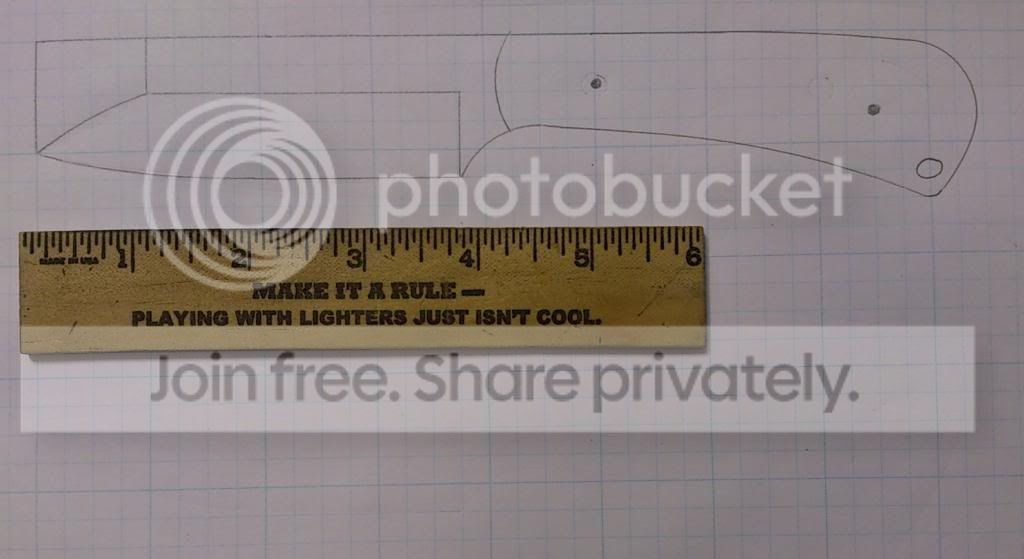
I have a hand sketch of of a knife that I potentially want to have made. However, I'd like to refine the design by getting some input from the experienced individuals here.
The goal of this design is to be as lightweight as possible while having at least a 3 inch blade, and to maximize its "utility" aspect.
The blade shape is influenced by Jon Graham's Razel, and the handle shape is influenced by the ESEE Izula. The proposed features are a 3.25" blade, a 3" handle (I have small hands), 1/8" spine thickness, and about an inch of jimping for the thumb. The pommel serves to be a glass breaker, but that feature is optional.

The plan is to cord-wrap the handle. However, given the current proportions, the design appears blade-heavy. If that is the case, would mounting handle scales balance it?

I will most likely have to obtain permission from Jon Graham and ESEE to incorporate their designs; does anyone have experience doing this? Do I just send them an email?

All comments, especially suggestions for form and function, are welcome.
design1_zps18492300.jpg


The sketch is 1:1 scale with a ruler for reference.
 
Last edited:
Handle scales are only going to balance it so much, depending on what they're made out of. I suspect this one will be balanced quite a bit forward. Maybe not have the handle skeletonized? Looks like a fun design though.

-edit- Another thought; maybe use thicker stock, and surface grind the blade portion down, so the thickness in the handle is broader than the blade? That should help with a more neutral balance. Sort of like an integral.
 
Thank you for your reply Crimson.

I would like to have some form of a cutout in the handle so that it can be more versatile when it comes to cord-wrap techniques; that's one of the reasons why I referenced the Izula design.
However, given your comment about balancing, the thing I'm trying to work out now is how much material I should remove (if any at all). Or maybe lighten the blade side somehow.

Also, I love your idea of an integral approach, but that just sounds like $$$ :D
 
Hmmm. You've asked for a critique, so I hope I don't heart your feelings. It looks like a mini, chisel- ground meat cleaver to me. I think a more traditional blade shape, with a high flat grind, would be more useful as a "utility" knife. Not my cup of tea at all, but to each his own.

Adam Buttry
 
Full flat grind might help with balance too. I don't think you need permission from Esee unless you plan to sell these. If you're just making it for your own use or to give to a friend I don't think you need to bother.
Will you be cutting this out with a water jet or similar or using hand tools? If hand tools, you can cut out the profile, maybe drill the large hole at the butt, and then do all your blade grinding. Once you're done you can see how the balance feels and and proceed from there. You could get away with a much narrower cut out in the middle and still be able to weave a paracord wrap.
 
Another thought, and more experienced guys might be able to comment on this, maybe try making a wood template complete with bevels and cut-outs. It would be fairly quick and easy and should give at least some idea. It seems logical. Metal will be heavier but the balance point should be the same or similar regardless of material. I would not simply go by the feel of the wood template in hand, since it is so much lighter. But you could balance it on a knife edge and find the centerline. If it's near the ricasso you should be fine, if it's way off then you know you need to change something.
 
Last edited:
You could make it more of a tanto as executed by Emerson in the CQC-7. No far from your design, but more of a knife look. Just an idea.
 
It's like you cut two knives in half and stuck them together.. Don't you want some a bit more original if "you" are having it made for.. you? I like the Graham design. I don't care for the ESEE design. I don't like "Strider wraps" or whatever they are :) That help? lol
 
I really like the Razel design and think that it would be quite utilitarian. I have several variations of that design drawn up as well. I like the blade to be around 3.75" long and about 1.25" wide. I like the tip to be square with the spine but stop about a 1/4" from the edge. Then I like about 2-2.5" of straight edge from the ricasso area toward the tip. Then the remainder with some slight belly up that 1/4" to the vertical chisel tip. I am not a fan of cord wrapped handles so mine are solid but in a similar shape. Unless your hands are really small and you never wear gloves then I would suggest a little more length to your handle. Unless you plan for your pinky to hang off or more along the line of a neck knife. What kind of steel are you thinking would be good? And at what thickness? If you are gonna have it made then I would say CPM 3V at about 3/16".
 
Thank you for your responses. I am new to the world of custom made knives, so I'd like to thank you all in advance for being patient with me.

Full flat grind might help with balance too. I don't think you need permission from Esee unless you plan to sell these. If you're just making it for your own use or to give to a friend I don't think you need to bother.
Will you be cutting this out with a water jet or similar or using hand tools? If hand tools, you can cut out the profile, maybe drill the large hole at the butt, and then do all your blade grinding. Once you're done you can see how the balance feels and and proceed from there. You could get away with a much narrower cut out in the middle and still be able to weave a paracord wrap.

I posted my design not as a knifemaker, but as a potential customer of one. My plan was to polish the design as much as possible and hand the project over to a knifemaker. The furthest I'll carry this design physically is a cardboard prototype.

Hmmm. You've asked for a critique, so I hope I don't heart your feelings. It looks like a mini, chisel- ground meat cleaver to me. I think a more traditional blade shape, with a high flat grind, would be more useful as a "utility" knife. Not my cup of tea at all, but to each his own.

Adam Buttry
You could make it more of a tanto as executed by Emerson in the CQC-7. No far from your design, but more of a knife look. Just an idea.

I am specifically going after the Razel design with a square-on chisel "tip". When it comes to the word "utility", the high grinds and tanto designs can perform just as well for scraping like a chisel, but Graham's Razel approach makes the knife look a little less "stabby" than traditional blade shapes. Thoughts?

Maybe there is a way to maintain the flat chisel tip while having a high grind on the long edge?
 
It's like you cut two knives in half and stuck them together.. Don't you want some a bit more original if "you" are having it made for.. you? I like the Graham design. I don't care for the ESEE design. I don't like "Strider wraps" or whatever they are :) That help? lol

Haha, yeah, I kind of did just weld two knives together. I guess it's because, in my engineering experience, I have tried to "reinvent the wheel" too many times, and I'm really trying to avoid doing that again. The ESEE handle is just one potential design; I chose it because it reduced weight, and it's wrap-able. It doesn't have to stick to ESEE's formula as long as it meets both those requirements.

I really like the Razel design and think that it would be quite utilitarian. I have several variations of that design drawn up as well. I like the blade to be around 3.75" long and about 1.25" wide. I like the tip to be square with the spine but stop about a 1/4" from the edge. Then I like about 2-2.5" of straight edge from the ricasso area toward the tip. Then the remainder with some slight belly up that 1/4" to the vertical chisel tip. I am not a fan of cord wrapped handles so mine are solid but in a similar shape. Unless your hands are really small and you never wear gloves then I would suggest a little more length to your handle. Unless you plan for your pinky to hang off or more along the line of a neck knife. What kind of steel are you thinking would be good? And at what thickness? If you are gonna have it made then I would say CPM 3V at about 3/16".

Yes, my goal is somewhere along the lines of a neck knife, and the size of my hands are small enough for that to work. As for material, I haven't really decided yet (154CM, 3V, or even Ti), but I hope to keep it around 1/8". That's about twice as thick as my Opinel, and my Opinel is one tough mother.
 
Here is a sketch of what I was trying to describe earlier.

DSC_0333_zps1b874758.jpg


For me this knife is all about the potential for abusive use. Chopping wire, scraping, prying (yep I said it) and whatever else one might reasonably throw at it. That is why I like 3/16" or maybe 5/32" thickness for such. All the Razels I have seen have a hollow grind for the main edge. (I tried to represent that in the sketch with the curve in the yokote.) I think that I will use a saber grind with a small secondary bevel at about 40° inclusive. Same grind for the tip edge but the secondary bevel for this would be closer to 20° inclusive. I think a "chisel grind" (one side of the blade only) would work well for this design except that the presentation side of a right handed knife would be rather dull to look at. Might be of small consequence when taking into account the less work involved with just one side beveled. I will be making my first one from 5160. I have it already in the appropriate thickness and it is a tough steel. Titanium doesn't get hard enough for a knife, IMO. The handle in this sketch is basically yours flipped upside down with the glass breaker point down so as not to dig into the hand. (Also since it was my drawing I drew full tang so as to attach scales of G-10 or rubber.) I am still experimenting with different handle shapes for myself.

Our purposes for such a knife are slightly different I believe. I read that you are thinking small, light, and minimalistic. Both seem pretty interesting to me.

One last thing, I am not an experienced maker, I'm learning though. I have very limited practical experience. I only chimed in because this is a design that I have thought about, drawn a million times and have made several foam board models of. Also I did stay at a Holiday Inn Express not too long ago...

Good luck. I hope you think about doing this yourself instead of commissioning the piece. It doesn't seem like too difficult of a build and could certainly be done with hand tools. (Not 3v steel but maybe CPM 154 if you want stainless or many of the carbon steels.) It was at the point where I was commissioning 3 knives to be built by a local maker I found on a fbook trading site. I wanted a kukri, a push dagger, and an ESEE 4 style of edc. He told me he could do those things. So in the ensuing emails back and forth it occurred to me that instead of trying to tell someone else how to make my knife I just needed to do it myself. So here I am at the University of Bladeforums.
 
If you want to get everything possible out of it as a tool, an impact feature on the handle butt would serve your balance issue and increase utility. I also think if you designed it carefully you could make it do double duty as a can opener. I'd suggest splitting the tip for nail prying, but the skeletonized handle doesn't serve well in that capacity, and it may make it a bit too much of a demolition bar, although if the notch was sharpened it could serve as a wire stripper/bone cracker if you like marrow...those are my thoughts.
 
1 that pointy bit on the pommel may be uncomfortable during hard use and probably not much help in breaking tempered/plasticized glass; if the glass isn't tempered or plasticized then any metal shape will work even rounded
2 if the skeletonized portion was wider than it is now (.25: instead of .125" for example) that would yeild more handle weight
3 or you could have a hollow gound into the backside of the blade making it concave to reduce weight
4 but if you give the design to a maker and specify where you want the balance point to be he can figure out the best option for you
 
I get a chuckle out of al the worry about "balance" in a knife. It isn't a tire spinning at 1000RPM. It is a stationary small piece of steel.

If it is a fighter or chopper, balance can be part of the design and function, but for a three ounce utility blade, balance plays almost no factor. In this case, the person deliberately wants a short handle ( too short in my opinion). That will alter the balance. Trying to add weight to "balance" a lightweight object would defeat the point of it being light weight.

Just for thought....a scalpel is totally handle heavy and horribly balanced...yet they seem to work pretty well for what they are made to do.

For a utility chisel grind, the side doesn't really matter. For food slicers, it doers. On a general use knife, the ura is on the left side for a right handed person ( as in nopyo's sketch).
 
Last edited:
Thanks for all the additional feedback.

If you want to get everything possible out of it as a tool, an impact feature on the handle butt would serve your balance issue and increase utility. I also think if you designed it carefully you could make it do double duty as a can opener. I'd suggest splitting the tip for nail prying, but the skeletonized handle doesn't serve well in that capacity, and it may make it a bit too much of a demolition bar, although if the notch was sharpened it could serve as a wire stripper/bone cracker if you like marrow...those are my thoughts.

I've thought about adding a bottle opener either HEST-style or BK11-style. Still toying with that idea.

1 that pointy bit on the pommel may be uncomfortable during hard use and probably not much help in breaking tempered/plasticized glass; if the glass isn't tempered or plasticized then any metal shape will work even rounded
2 if the skeletonized portion was wider than it is now (.25: instead of .125" for example) that would yeild more handle weight
3 or you could have a hollow gound into the backside of the blade making it concave to reduce weight
4 but if you give the design to a maker and specify where you want the balance point to be he can figure out the best option for you

I get a chuckle out of al the worry about "balance" in a knife. It isn't a tire spinning at 1000RPM. It is a stationary small piece of steel.

If it is a fighter or chopper, balance can be part of the design and function, but for a three ounce utility blade, balance plays almost no factor. In this case, the person deliberately wants a short handle ( too short in my opinion). That will alter the balance. Trying to add weight to "balance" a lightweight object would defeat the point of it being light weight.

Just for thought....a scalpel is totally handle heavy and horribly balanced...yet they seem to work pretty well for what they are made to do.

For a utility chisel grind, the side doesn't really matter. For food slicers, it doers. On a general use knife, the ura is on the left side for a right handed person ( as in nopyo's sketch).

If balance isn't much of a design factor, then that makes it easier. I'll try to get a better idea of handle size and pommel placement once I make a cardboard prototype.
 
I have made a lot of tanto knives in similar shapes. Try a 3" blade and a 3.5" handle and you will be quite pleased. The missing 1/2" of blade will never be noticed, but the added 1/2" of handle will make the knife much easier to use, as well as better looking.

In a line from an advertisement long before your time..."Try it, You'll like it!"
 
Back
Top