
Pretty Trash - Help!

Fiddleback

Knifemaker
Moderator
Knifemaker / Craftsman / Service Provider
Joined
Oct 19, 2005
Messages
20,015
Last night I was sharpening up the Nessies to ship and realized that every one of the 1095 blades was cracked right to the edge. Checked the rest of the 1095 blades (3 more) all cracked. Yep. Gonna go back to 01.

They're really pretty trash now. The solid Cocobolo one was 01 and is fine.

WTF?!?!
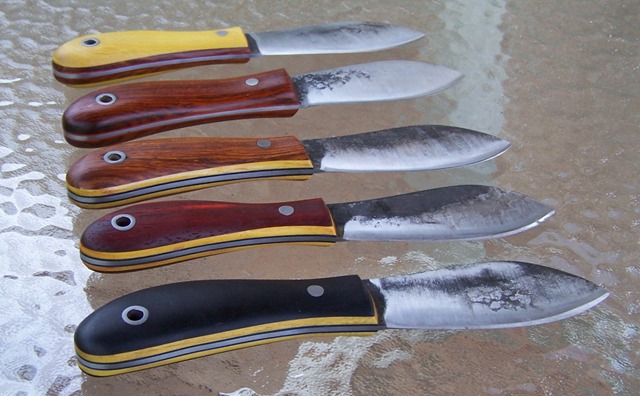
n1201-vi.jpg


These blades are 3/32 thick, and were fully annealed before grinding. After grinding I normalized 3 times, then heat treated using Parks 50 quenchant, then immediately into a 400 degree oven for an hour to temper. I did 7 blades. All have these cracks, all at almost the same spot (the belly of the Nessmuk).

I hated using parks 50. It flames up when I edge quench and scares the snot out of me. My inclination is to go back to 01 and pay the premium. Or just send out 1095 blades for heat treat.

What a kick in the stomach.
 
Looking at the scale pattern Andy, I'd say ya cooked 'em. 2nd from the top, 2nd from the bottom and the bottom one all look like they were over heated. bruce
 
Looking at the scale pattern Andy, I'd say ya cooked 'em. 2nd from the top, 2nd from the bottom and the bottom one all look like they were over heated. bruce

Thats kinda what I was thinking too. That or the too thin thing. I'm using a charcoal forge, and with thin steel like that its hard to know when they're over done. Plus, the stock being 3/32, its pretty thin already.
 
It's not the Parks #50 - that's what it's designed for, and what I use.
I use W1, and the ONLY time I have ever cracked one was when I knowingly got 'er just too hot.
And it was right down on the cutting edge at the ricasso.
 
Looks overheated to me, too.

Take one and fully snap it at the crack and see what the grain looks like.
 
BTW those handles are sweet and very unique! try to pull em off with a heat gun so you don't waste the materials.
 
Judging by the fact that you still have HT scale on your bevels I would guess that the edge was way too thin, I usually leave at least 1/16th inch edge thickness before HT if I can, If I can't maintain at least 1/32 of an inch I'll grind the edge back until I'm there,
One trick I've heard of for HT in a solid fuell forge is to use a 2 inch diameter black iron pipe (NOT GALVANIZED) running through the fire as a muffle to even out the heat and protect the blade from excessive oxidation from direct blast. I haven't tried it yet, but I will be getting my coal forge fired up soon so I will then

-Page
 
BTW those handles are sweet and very unique! try to pull em off with a heat gun so you don't waste the materials.

Thanks David.:thumbup: Unfortunately, that front pin is a corby bolt. THe handles are toast.

I'll snap one and check the grain size. If it sparkles its too big right?

I will add a pipe baffle. Thats easy to try at least.
 
Sparkles ? There is a proper method to rate fracture grain size but it has nothing to do with sparkles.It just relates texture , fine to coarse.You should do some experimenting .For example compare grain size after first, second, and third normalizing and after final hardening. ..I would have to agree with the too hot/too thin comments.
 
Thanks David.:thumbup: Unfortunately, that front pin is a corby bolt. THe handles are toast.

I'll snap one and check the grain size. If it sparkles its too big right?

I will add a pipe baffle. Thats easy to try at least.

Drill it out!
 
You guys help is greatly appreciated. Its time to refine my process.

Thanks!!!!!
 
Andy probably epoxied them, too. Andy, I also agree with the "too hot" consensus. 1095 is not as forgiving as your favorite steel is.:grumpy:
- Mitch

I know. I miss 01 badly right now. I'm going back to it, price bedamned. 1095 was so appealing with that low low price.
 
You may want to try to pick up some of Aldo's 1084...its about as cheap as 1095, takes hamons really well and seems to heat treat well and not be quite as sensitive as 1095, but that might be all in my head :)
 
I did the same thing with O1 recently. same thickness and had the same scale pattern. I was using PCB powder for the first time and I believe that it didn't let me see the color as I am used to. I have heat treated and broke some O1 and 1095 since then to see the grain. I wouldn't quit the 1095 yet. Since it doesn't need the soak time I find it a bit easer with my simple equipment. Just my opinion.

Mike
 
Back
Top