Primos gots pants!

Nothing better than putting something good together your own self. Awesome looking bowie too. ;)
 
Lorien,
That IS a nice looking sheath for sure. WAY better than others you have posted.

You mentioned you want to increase your "fit and finish" details: a couple of things would be to measure/mark the location of the holes, perhaps pre-drill them, bevel the edges and sand them for smoothness. I'm sure Mr. Long could provide some more precise information:D

The sheath looks excellent as is however, and looks great with that Primos "curly maple" handled bowie. NICE package!

Peter
 
The sheath looks great. :thumbup:

and I do remember that Primos, but can't remember why I didn't buy it. :rolleyes:
 
Peter, that's good advice. I appreciate that, you're right about beveling the edges, I haven't really considered that much. It would certainly make for a more comfortable sheath, taking of those sharp edges. Thank you.
I'm going to just give an outline of the process, if I may. Maybe it can help somebody out who doesn't know about making sheaths, and maybe if my method is faulty, someone could correct me.

-the knife is traced onto paper. I then think about how the knife will be carried. What is expected of the sheath?
-leather shapes, in the general size of the sheath are usually saturated with water and then dried a bit
-the knife is coated in wax, and then wrapped in plastic wrap
-the knife is sandwiched by the leather, and the leather is sandwiched by varying thicknesses of foam and the the foam is sandwiched by a countertop and a rigid plate, (in my case, it's a cutting board). Why am I getting hungry?
-the whole works are clamped for awhile, and then the leather is set on the window sill to dry out for however long it takes
-once the pattern is cut, glued and finished to its near net shape, I cut a trough for the thread to be countersunk into with a gouge
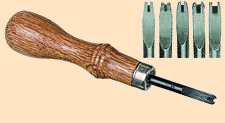
-I mark where the holes will be drilled with either a little stitching wheel or one of those fork things
-then, using my ancient dremel tool and a tiny drill bit, (I think it's 5/64") I drill from the front of the sheath to the back, with the sheath flat on a counter. The thicker the welt, the harder it is to line the holes up with the gouged groove on the back side
-once all the holes are drilled and cleaned up somewhat, I start stitching using waxed polyester thread from one end to the other, then I go back again
-a mixture of bee's wax and parafin are heated at about 220C until liquid, and then the sheath gets heated up for 10 mins or so at that temp
-the wax is applied with a toothbrush and everything goes back in the oven after each application
-it took about 6 applications for this leather to be completely saturated
-then I let the sheath cool down and dry off in the sun, if there is any:rolleyes:

One mistake that I've learned the hard way to avoid, is to NOT put the knife back in the sheath while the sheath is still warm! There is lots of condensation going on in there, and you'll like rust your blade in a matter of minutes.

I think I'd do a much better job if I had a drill press. Either that, or back to old skool with an awl and a stitching pony, just like that leather guy whose books I read.

Raymond- How to you like the sound of 'Bikes n Blades'?:D
 
Really nice sheath Lorien. I like a lot of the protection of guard. Very functional.
Congratulations,
Eduardo Berardo
 
Peter, that's good advice. I appreciate that, you're right about beveling the edges, I haven't really considered that much. It would certainly make for a more comfortable sheath, taking of those sharp edges. Thank you.

This is the tool. Size 2
8076.JPG


When we meet up, (finally) I'll bring you one.

As far as your process, all sounds good to me. I've never tried the clamping with foam thing before. Good idea.

This though:
-then, using my ancient dremel tool and a tiny drill bit, (I think it's 5/64") I drill from the front of the sheath to the back, with the sheath flat on a counter. The thicker the welt, the harder it is to line the holes up with the gouged groove on the back side..
...I think I'd do a much better job if I had a drill press. Either that, or back to old skool with an awl and a stitching pony, just like that leather guy whose books I read.

I've tried that and figured the drill press idea would be better but for tapered welts and such I've found that holding the sheath in your hand and drilling horizontally (slowly) you can watch the bit push on the back and you can line it up much better with the groove at the back. Once you get a feel for the angle then it goes quickly. It's invaluable to do it this way if your welts tend to get quite thick as the easy parts will have already established a kind of muscle memory to help you. Going blind from the top I found to be inaccurate and slow as you have to check the back after each hole...


Anyway, that's a couple things for what they're worth.

It's a nice looking sheath and with that beeswax finish, I'm sure you could go swimming with it and not worry about moisture.
Only other thing I would add past the beveling and sanding would be to give yourself a little more room between the stitching and the edge of the sheath. I did this after looking at Paul Long's sheaths and it really "frames" the stitching nicely and gives you a little room to clean up the edges if the compression from the stitching causes the welt to protrude a little.

I quite like that extended flap over the guard and I suspect that with your leather finish it acts as retention much like in kydex sheaths.

One last thing, are you tying knots with the thread at the end of the stitching line? (it looks like it near the mouth on the edge side) If so, you don't need to. Just back stitch a couple stitches. If the thread is waxed it won't go anywhere and considering how much wax you use as top coat/sealant you certainly wouldn't need a knot.

Keep up the good work. :thumbup:
 
One last thing, are you tying knots with the thread at the end of the stitching line? (it looks like it near the mouth on the edge side) If so, you don't need to. Just back stitch a couple stitches. If the thread is waxed it won't go anywhere and considering how much wax you use as top coat/sealant you certainly wouldn't need a knot.

Keep up the good work. :thumbup:

Great advice my man, all around:thumbup: As for the knot tying, that is one of the things which bothers me the most about this sheath. I am going to try and avoid tying knots in my thread from here on in. They look terrible.

As for drilling the holes and lining things up, I'm going to take your advice and drill while the sheath is held vertically, the other thing I have a real problem with on this sheath and others I've made is the stitches which wander around. That looks terrible too.

The ear which rests over the guard does help to lock the knife into the sheath. There's a lot of friction when the knife is fully inserted into the sheath, and I push against that ear to break the knife free of the sheath. I must say that the knife makes a very positive and satisfying click when it mates up to the sheath. Thanks to the wet molding I think.
 
Once I have a little more faith in my skill and knowledge, maybe I'll get some really nice leather.

Lorien, first that is an admirable job you did on the sheath. The design is just great and fits the knife really well.

Regarding the quote above, one my critical views is that a sheath that well designed and executed was made with less than the quality and cut of leather it deserved. I bet when you finished it and it looked so nice you thought, "if I had known it was going to turn out this great, I would have used better leather". (You never know when something is really going to go just right, so always start with the best materials you can find/afford.):D

If you are serious about your leather work, I'll be ready to help you whenever I can, and don't forget you've got Stuart right there next to you and he is getting to be as good as there is.

Paul
 
Lorien,
You have a very good process and are gaining experience. I haven't done much leatherwork in many years.

In your process of stitching all the way around then going back, perhaps you may want to consider "double needle stitching"? I watched video of it being done and it looked pretty cool, but I haven't tried it myself.

What do the pros think? Paul, Stuart?

Peter
 
Lorien, first that is an admirable job you did on the sheath. The design is just great and fits the knife really well.

thank you very much, Paul! That means a lot to me, especially coming from you. You are one of my knife making 'idols', (sorry, can't think of a better word) but hopefully you know what I mean. Even though you don't make knives. A knife is worse than useless without some way to carry it- it's downright dangerous- and your sheaths epitomize to me the top tier of quality and design.

I'm going to go in on an order with Stuart for some Wickett and Craig leather. The stuff I'm using now is better than anything I've used before, but it's still basic veg tan sides, but at least it's fairly consistent. I think I'll use it up before I buy some of that fancy stuff. Unfortunately, I've run out of knives to make sheaths for, so I guess I'll have to make another knife so I can make a sheath.

Or perhaps I will use the remaining leather to fabricate some armour for mountain biking...

Thank you especially for your offer of help. That really says a lot about this community we're a part of and I really noticed how much your expertise has helped Stuart along with his efforts:). I have a lot of admiration for what you do with leather, but even more for what you seem capable of doing for the positive vibe in this community.
 
In your process of stitching all the way around then going back, perhaps you may want to consider "double needle stitching"? I watched video of it being done and it looked pretty cool, but I haven't tried it myself.

Thanks again Peter:)
I've read Al Stohlman's books on leathercraft, and he's a big proponent of double needle stitching, using an awl to perforate the stitch holes. It does seem to me to be the 'best' way, however, I've used my 'double back' technique, with drilled stitch holes, because it is easy to do and doesn't require a stitching pony.
Ideally, I will get set up to do it the 'right' way, which I feel is the Stohlman way. All I really need I guess is a good awl, and a stitching pony.
 
Looks good Lorien! If you follow the great advice you've gotten here your next one will be just that much better. Can't wait to see it.
 
If you follow the great advice you've gotten here your next one will be just that much better. Can't wait to see it.

Thank you very much Harry. This is why I post this stuff, in order to get information which can help me become better. This forum has done SO much for me in so many ways with regards to that.

Mr. Farias, thank you:D
 
Lorien, good looking sheath I would say you should be proud of that work. Any chance that is curly Walnut? Hard to tell from the pics but the general color of the wood and darkness in the curly strips looks like it could be Walnut.
 
Back
Top
