Problems with 1095

SAR

Joined
Aug 15, 2005
Messages
710
Thought I would throw this out here, every time I play with 1095 it warps on me in HT.

I have ground out three fixed blade wharncliff's, I ground the bevels to 600 grt the flats are 400. The bevels are even, holes are counter sunk a little to relieve any stress that can occur there.

I have applied a wash of satinite, and about a half inch of satinite along the top portion of the blade to get some hamon activity.

I will use my evenheat with the blades in I will ramp up to 1400 degrees for normalizing for 10 to 15 minutes then ramp to 1550 and hold for 10 mintues.

I start to grab blades at about 8 mintues and straight into parks 50 fast quench that has been heated to about 110 to 120 degrees.

I have it set up to ensure no time is wasted getting it into the oil.

So whats my problem why do my blades always warp?, they are a pain in the ass to straighten stock thickness is .170

I never have this much trouble with air harding even if I do not plate quench?

Is there anything I should or should not be doing, I really like working with the stuff, I have no problems getting a good hamon.

Yes I have searched and read plenty on this subject, is it just the way things are, or am i that screwed up:D ( i am sure someone will answer that one):D

For any help thanks in advance
Spencer
 
It seems like you are doing everything you can... I assume that the clay was applied even, so... no idea :confused:
 
From reading your post. You need to heat treat it at 1500 and put in oil. Now you need to temper the blade as well at 350 for 2 hours. See how that works. I use the 1095 all the time. With no problems at all. Let me know how it goes. And Happy New Year to you SAR: :)
 
OKAY BUT THAT WAS NOT MY QUESTION so do you normalize or not?


no need to yell, but thanks got it..... oh yea happy new year to you as well

Spencer
 
when you plunge, plunge straight in belly on the bottom tip first you may be warping. if your puttin it in on its side. the side that cools first will pull the other side. So make sure she's at 90 degrees on the yaw(vertical axis) and about 30 degrees negative forward on the pitch with no roll. she should be nice and straight for ya
 
Spencer,

Yes, you need to normalize. Personally, I would bring the blade up to critical and then let it cool to black. I would do this at least 2 or 3 times. When it cools to black, check it for being straight. It should be. There is all kinds of info floating around here as to why you should normalize. Much of the info is geared toward stress relief and grain refinement.

1550 sounds a little high to me, especially if you are trying to get some activity with your clay. You might try 1430 - 1450, and reduce the soak time. I am assuming that your soak time is "at temperature", and not including getting up to temperature.

If it is "at" temperature, I don't think you are gaining much by such a long soak with 1095.

J.S. Carter is dead on about plunging into oil. No side-to-side movement. Only move parallel to the blade.

Maybe someone will show up and shoot holes in my advice, but you can't beat the price. :D

Hope this helps............. Robert
 
With 1095 there is no need to soak for longer than enough time to get a complete and even heating.
Normalize by heating to critical and cooling two or three times.
Heat to quench temp, 1475F, and quench straight in ,point first, in fast oil.Once in the oil move around in a circular motion (like stirring the tank) rapidly. Pull the blade out after about 8-10 seconds and if there is any warp, correct it immediately. Use the anvil and a hammer, bend it in a vise,use pliers - whatever. Just do it before the blade cools below 500F.The metal is very plastic at this point and can be manipulated greatly. Once straight ( or if it doesn't need straightening), stick back in the oil and let cool .Temper immediately ,at 400F twice.

Other advise would be to not make the edges too thin. Leave some extra to grind away after HT (no need for the 600 grit pre-quench finish).About .040" is a good quench edge for 1095.
Stacy
 
A couple years ago we discussed the metallurgy of 1095 at great length... I was under the impression that the consensus (and science) said to soak 1095 for a while. Am I wrong?
 
Happy New Year Spencer :) ,
Are you doing stock removal or are you forging the 1095 in this case ? The reason I ask is that if you're doing stock removal the material probably does not need to be normalized prior to HT. Normalizing as I'm sure you already know :rolleyes: ;), is usually done for the purpose of grain refinement and to get uniformity of structure and the steels properties after forging.
A stress relief cycle may definately be in order though, especially if there is some odd shaped geometry. Heating the steel to below critical, equalizing then cooling slowly may help relieve some of the internal stress that is causing some of your problems.
If it makes you feel any better I have experienced the same problem with 1095. Stress relief cycle has improved my end results dramatically on many steels that were warp prone during hardening. Oh, btw, I let my 1095 soak in the evenheat for ~ 5 min after equalizing too, but at 1525*.
 
Oh thats thats the problem with these advice threads is what to go with, I thank everyone for the great advice.

Time to crank it up
Spencer
 
I'm sorry Spencer, I just read your post again and noticed that what you're calling your normalizing cycle is actually at stress relief heat (just below critical) minus the cooling cycle. Normalizing should be done at temps above critical and cooled in still air. Try the stress relief cycle I mentioned in my first post and after cooling make any adjustments needed then move to your hardening. I'll think it may make a difference for you. At least I hope it does :), I know problems like this can sometimes be quite frustrating.
 
Spencer im curious how thin are you grinding the edge ? I leave the edge of my blades even more then Stacy suggested , about .080 . I have had no problems with blades warping. I go point in on the quench , also going to try the .040 edge . Everything else is pretty much done like Stacy suggested.
 
I agree with David; you're not normalizing properly. Let the blade cool at least to black for a normalizing cycle.
- Mitch
 
I wear big heavy firemans gloves during heat treating and straighten by hand.I sight down the blade (after the 8-10 seconds in oil) with a flourescent light in the backround and a fan blowing away the smoke.Those gloves are getting a little crispy but the method is good for me.
 
If you quench in oil, there is a window of opportunity to straighten minor warps immediately following the quench while the blade is still warm, 200-300 degrees or so. It takes a few minutes before it sets up and becomes springy. Just use gloves and hand pressure on thin blades, but be careful not to overstress the blade.
 
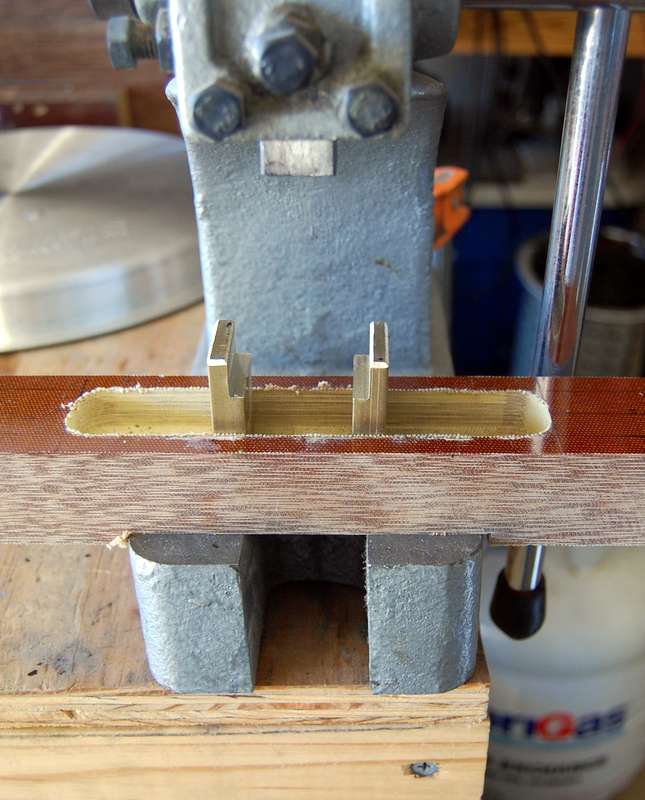
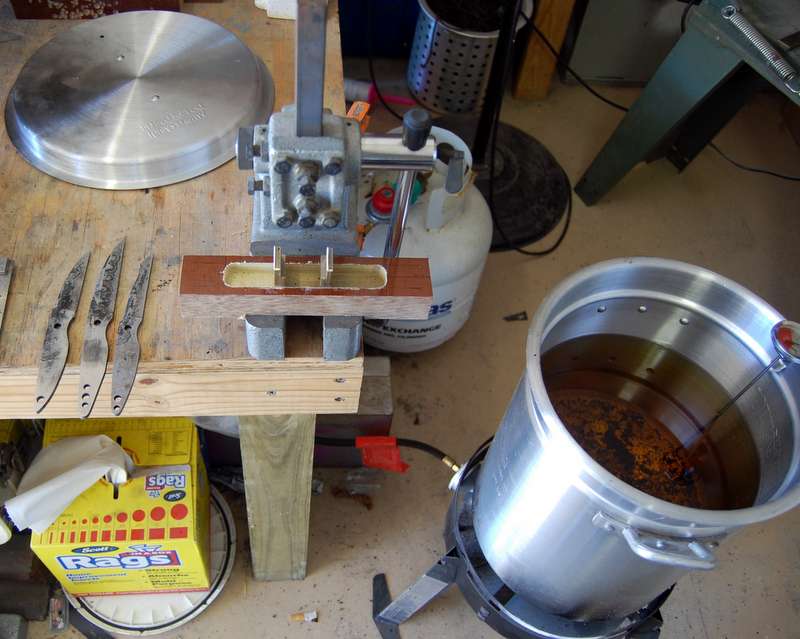
Hey Guys I really appretiate the feed back, I HT'ed all three blades, first thing this morning I took them to 1500 degrees then shut down the oven and crack the door slightly. I then went and did some thing else productive like building a jig to help me straighten my blades.

I then HT'ed one blade at a time bringing it to 1500 and holding until non mag, then vey quickly straight in the 120 degree oil.

I very quickly got to straighting some minor warping, funny how your eyes play tricks on you but the surface plate never lies.

Success is great if you take the time to pursue it!;)

Thanks Again

Simple jig from micarta and brass

dsc0905ba4.jpg


dsc0904us6.jpg
 
I like the turkey fryer idea. I use the same thing for my bowies. ;)

When you quench, try an interrupted quench -and quench the blade vertically. In for 3 seconds, out for a split second, then back in (before the vapors burst into flames) and continuously do this until it's cool enough so that it won't ignite the vapors and then into the oil until you can touch it. I use automatic transmission fluid and it works very well.

I also currently use a forge and a pair of tongs. I used to have an evenheat and made a basket out of chicken wire in the quench tank, I would snip the heat treating foil and let the blade fall into the basket then I would raise and lower the basket vertically until the blade was cool.

Another thing, quenching in fluids is much more aggressive than air-hardening stainlesses (I noticed on your site that you do a lot of work in stainless). You have to leave the bevels thicker (0.040"+) and finish grind them. Whereas, in stainless you can grind to finish thickness and someone (like Paul Bos) can do a spectacular job of heat treating it without warpage.

However, 1095 does like to warp. :mad: I've made lots of knives from 01 and 5160 and they seem less prone to warpage. I get my 1095 from Admiral, where did you get yours from?
 
Great to hear SAR: I know 1500 would do it. Great looking setup. I can not let me wife see that setup, she may want you to put on a turkey to fryer. Have a good one. Thanks for showing it to all of us. :):thumbup::D
 
Back
Top