
-
The BladeForums.com 2024 Traditional Knife is available! Price is $250 ea (shipped within CONUS).
Order here: https://www.bladeforums.com/help/2024-traditional/
You are using an out of date browser. It may not display this or other websites correctly.
You should upgrade or use an alternative browser.
You should upgrade or use an alternative browser.
Professor Apelt's Homework Assignent WIP
- Thread starter Folsoml
- Start date

Stacy E. Apelt - Bladesmith
ilmarinen - MODERATOR
Moderator
Knifemaker / Craftsman / Service Provider
- Joined
- Aug 20, 2004
- Messages
- 38,572
Clean it up and try to close the weld. When the bar is fully welded, you should not see dark lines.
The main cause of these problems is not getting the billet hot enough and not soaking long enough to assure it is heated all the way through.
Hopefully, the unwedded place will weld up closed. Sadly, once the billet has been taken this far, it may not weld shut fully. Give it a try and see what happens.
When doing the starter billet, weld from end to end several times. Don't quit the process until the bar appears to be a solid bar of mono-steel. Dark lines mean unwelded layers. Remember to brush off the billet with a wire brush and re-flux the sides after every forging heat.
The main cause of these problems is not getting the billet hot enough and not soaking long enough to assure it is heated all the way through.
Hopefully, the unwedded place will weld up closed. Sadly, once the billet has been taken this far, it may not weld shut fully. Give it a try and see what happens.
When doing the starter billet, weld from end to end several times. Don't quit the process until the bar appears to be a solid bar of mono-steel. Dark lines mean unwelded layers. Remember to brush off the billet with a wire brush and re-flux the sides after every forging heat.
I cleaned it up on the grinder and then made sure it was fluxed and good and hot before I (hopefully) fixed the welds. I saw no bad spots when I was done. I then brushed it, fluxed it, heated it, and twisted it three times until we got to this point:
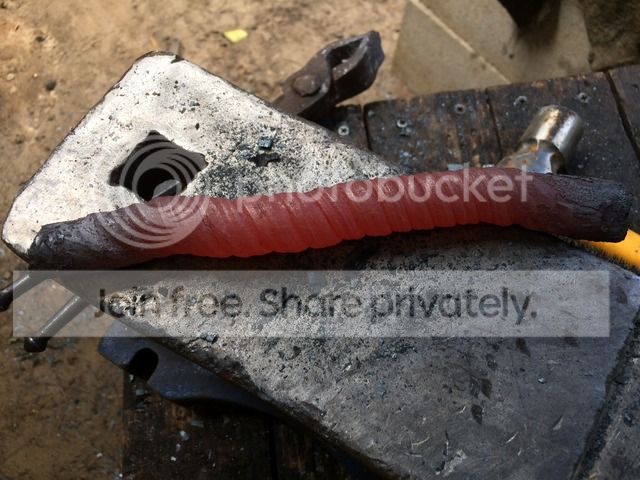
Here's where we ran into a problem. It was too long and thin after a cleaned it up on the grinder. I then hammered it flat and folded it one time. I've got that forge welded solid (I hope) but now there is not enough steel left to make the assigned knife. I'll post another picture when I clean up what I have left.

Here's where we ran into a problem. It was too long and thin after a cleaned it up on the grinder. I then hammered it flat and folded it one time. I've got that forge welded solid (I hope) but now there is not enough steel left to make the assigned knife. I'll post another picture when I clean up what I have left.
Stacy E. Apelt - Bladesmith
ilmarinen - MODERATOR
Moderator
Knifemaker / Craftsman / Service Provider
- Joined
- Aug 20, 2004
- Messages
- 38,572
You have some sacrificial metal on any billet. You have to be a mench and cut it off. Twist has a good inch or more waste on each end.
The trick to getting the ends ( or any resistant area) to twist evenly/fully is having a friend hold a torch with a large flame on the trouble spot to keep it slightly hotter than the rest. As the main part cools to red and resists twisting, work the trouble spots with the torch and twist them tight. You can get within an inch of the end that way.
When making damascus, remember that the final yield will be much less than you started with. In some cases, only 25-30% of the initial billet. Accept this and cut off or grind away the bad welded ends, twist ridges, side welds, etc. Trying to keep them and forge them down in the next step or fold is a foolish attempt at economy.
There are many things that can extend a damascus billet to make it work for a large knife. One is to weld on a mono-steel tang. Another is to make san-mai. It might be camera angle, but from what I see in the photos, you should be able to make a full size kufe from the final billet.
The best way to get enough to make a project from is to start with more than you think you will need. Figure 50% yield on a twist billet, so start with more than 200% of what you want in the end. If the final bar is going to be 12X1.5X.25", that is 4.5 cu.in. - call it 5cu.in. . Start with a billet 6X1.5X1.5" and you start with 13.5 cu.in.. This should supply more than enough steel for the final knife. If everything comes out right, you get another smaller knife or a guard from the extra.
The trick to getting the ends ( or any resistant area) to twist evenly/fully is having a friend hold a torch with a large flame on the trouble spot to keep it slightly hotter than the rest. As the main part cools to red and resists twisting, work the trouble spots with the torch and twist them tight. You can get within an inch of the end that way.
When making damascus, remember that the final yield will be much less than you started with. In some cases, only 25-30% of the initial billet. Accept this and cut off or grind away the bad welded ends, twist ridges, side welds, etc. Trying to keep them and forge them down in the next step or fold is a foolish attempt at economy.
There are many things that can extend a damascus billet to make it work for a large knife. One is to weld on a mono-steel tang. Another is to make san-mai. It might be camera angle, but from what I see in the photos, you should be able to make a full size kufe from the final billet.
The best way to get enough to make a project from is to start with more than you think you will need. Figure 50% yield on a twist billet, so start with more than 200% of what you want in the end. If the final bar is going to be 12X1.5X.25", that is 4.5 cu.in. - call it 5cu.in. . Start with a billet 6X1.5X1.5" and you start with 13.5 cu.in.. This should supply more than enough steel for the final knife. If everything comes out right, you get another smaller knife or a guard from the extra.
It might be camera angle, but from what I see in the photos, you should be able to make a full size kufe from the final billet.
Once I smoothed this out on the grinder, it ended up quite a bit smaller than in this picture. Since I used the last bits of 1095 and 15N20 that I had on this, I will most likely not attempt another layer damascus hammering it by hand.


bodog
BANNED
- Joined
- Dec 15, 2013
- Messages
- 3,097
Looking good. I want to offer a suggestion, and please only take it as a suggestion as this is a matter of opinion or preference. I struggled a bit when I first started, shaping handles in an ergonomic way. I think in straight lines, and a lot of my early handles had similar profile as yours. What I found was that a large swell in the center, depth wise, really wasn't conductive to a good normal grip, again, in my opinion. I just sketched this as an example. The top being similar to your design, the middle replacing the swell with a choil, and the bottom moving that choil to the index finger.

Something like a combination of the second and third one.
Something like a combination of the second and third one.
I did a mock-up of the handle in wood to see what it would feel like in the designs you suggested. As I suspected, it made the handle feel like nothing in my hand. I decided to go ahead and drill holes for a handle and then heat treat it. This is what I ended up with:
This is after heat treat and after sanding:

Not only is the blade very very thin, but it has a built in right turn:


Stacy E. Apelt - Bladesmith
ilmarinen - MODERATOR
Moderator
Knifemaker / Craftsman / Service Provider
- Joined
- Aug 20, 2004
- Messages
- 38,572
Not bad.
What the handle needs is some rounding. The basic cross section is very squared off. The corners should be rounded into slightly curved sides, and the bottom should be slightly narrower than the top. The overall cross section should be somewhat egg shaped.
What the handle needs is some rounding. The basic cross section is very squared off. The corners should be rounded into slightly curved sides, and the bottom should be slightly narrower than the top. The overall cross section should be somewhat egg shaped.
Last edited: