Project #5: Leaf Knife

I've been using it to spot imperfections in my sanding. It makes an easy job much more difficult. ;)

Anyway, I'm up to 400 grit now on most of it, but I had to go all the way back to the file to fix a problem I noticed on one area. I'll post pictures once I'm done sanding and it's ready for HT.
 
if you still have deep file marks you can use layout dye to fill the scratches so you can see em better, and you know for sure when they are gone when the blue or red is gone. Or you can even just use a sharpie marker.
 
I started giving some serious thought to the handle, and I've come up with an idea that I can't seem to shake, so it is probably the way I'll go.

Given the sharp points along the blade, it would be awfully difficult to get this blade in and out of a sheath. As noted by Stacey, the weld is probably not sufficient to make this a particularly strong knife anyway. I toyed with drilling a large hold in the ricasso to allow mounting a solid handle with a large mosaic pin... but that didn't really do it for me... there would still be structural strength problems.

Then I started thinking about butterfly knives, and it occurred to me that solves both the handle and the sheath problems. Done properly the handle halves would cover the blade and protect the points. Moreover, I could do some stylized design on the handle that would work with the leaf pattern (assuming my skills are up to it).

So that's where I've decided to head next. I bought and received a kit knife so I can figure out what's important about balisongs and how they are constructed and assembled. The kit is not useful for this particular blade, but I might use some of the parts... if I can wrap my brain around making the handle parts with no milling equipment.

- Greg
 
Just a quick update. As someone opined some time ago, this blade is a challenge to properly sand and finish. I found another area of the blade that essentially was too thick, so I had to revert back to filing that section and start the sanding all over again.

I'm pretty near conclusion on that, but as close as I get on the edges, I continue to be dissatisfied with the center line. One problem is that sanding the plung areas causes a little crossover at the center line, which results in light 'scarring' of the other side. Addressing that 'scarring' just moves it back to the first side or leaves light cross hatch marks on the center line.

I'm thinking the only way past this is to buff the blade once I get to 1000 grit. I made a preliminary attempt to see if that would work while at 500 grit. The results were inconclusive because I couldn't find the right rouge.

I also bought some cheap steel to use for the balisong style handles. Since mounting those will require drilling holes in what is now the ricasso (something I won't be able to do after HT), I'm putting off sending the blade out until I have the handle pieces made, so I can be sure I won't need to drill any holes post-HT.

Right now I'm trying to process making balisong handles that hold the blade stable during usage, ideally without having to mount unattractive posts in the ricasso. This will probably involve working on preliminary trial handles on a different blade to make sure my design is functional. For that I'll modify the blade that came with the kit (which already has those unattractive posts), since I have no interest in assembling or using that kit knife as it came anyway.

-Greg

 
Latest pictures

LeafWIP8.JPG


LeafWIP9.JPG
 
I've sanded the blade down to 2000 grit, and even lightly polished it. That was mostly because I didn't have anything else to do until I figured out the details of how to make and attach a balisong style handle.

At this stage, my brain is moving slowly on the handle. I've cut the blank pieces that will be the main part of the handle. They still need to be reduced and shaped. I have not yet drilled the holes in the ricasso. I have not yet figured out the small (generally invisible) bits of the handle, nor the posts and cut-outs needed for the handle to operate properly. I also haven't figured out what sort of washers or bolts to use. In short, I'm moving about as quickly as molasses in December.

But I am moving. Tonight and tomorrow I plan to shape the handle pieces and begin working out the geometry of the moving parts. I also plan to reshape the ricasso a bit in order to accomodate the moving handle parts. If all goes as planned I may even get some holes drilled and the posts put into position. For me that's a pretty aggressive plan for the weekend. We'll see how it goes.

- Greg
 
Greg,
I'm really enjoying this WIP. It's the first thing I click when it comes to the top.

I can totally relate to the "moving slowly" part. When an art piece hits a technical roadblock or I rethink it and suddenly need to learn a new technique, I tend to slow down and cogitate for a while. I don't know whether it's nerves or my head wrapping itself around a new concept, but I've learned not to try to hurry it.
 
Nice going.
if you've sanded up to 2000 I don't see the need to polish.
Just finish off by moving the paper from the spine to the edge, lift it up, replace, and move in one swift move to the edge again.
(making sure all the minute scratches will be one direction)
Polishing it won't make much difference.
2500 is the max I've used.

You might want to concider making the handles out of a plastic or aluminium, until you've tweaked them to the exact form you want and only then make them out of steel, using the template.

It doesn't need to be solid steel, you could use liners covered with any handle material of your choice.
Straight grained wood might suit the leaf shape well.

Good goin'!
 
You might want to concider making the handles out of a plastic or aluminium, until you've tweaked them to the exact form you want and only then make them out of steel, using the template.

It doesn't need to be solid steel, you could use liners covered with any handle material of your choice.
Straight grained wood might suit the leaf shape well.

Excellent suggestions. I do have some stock aluminum to use, so I'll probably start there. As for having the handle covered, I have considered that. My first thought was to use some of the ivory I just bought and scrimshaw a twisting vine pattern. Frankly, I think that would be a bit too much, so I'm waiting for an idea to become compelling. It would certainly be easy enough to make straight grained wood pieces and try that look out. I certainly have enough wood on hand.

Thanks for the suggestions.
 
Thank you. I'm having to bite back the desire to see this blade etched. First things first, though...
 
Greg,
I know you are just having fun with it, but sanding to 2000 on a pre-HT blade is a waste of time, and may remove too much metal. Remember, you will have to go back and start again after HT. Sand to 400 before HT, leaving the edges about .030" thick.
You are correct about waiting until all the handle fitting issues are resolved before you sent the blade for HT.
 
Thank you for the information, Stacy. I have a micrometer... I suppose this is the right time to learn how to use it for edge measurement. One of the reasons I kept sanding to higher grits was because each time I did so some flaws that were invisible at prior grits became obvious, especially in the grooves between the sections. I didn't want those flaws to create irresolvable problems post-HT, so I figured I'd go all the way to 2000. I knew I'd be doing it all over again to remove the HT scale, but I never thought much about how much material I was removing, since I was sanding by hand.

For those who are curious about the damascus pattern that will emerge (as I am), here's a picture of the remainder of the bar. The pattern, called "Egyptian", was made by Matt Whitmus.

Egyptian.jpg


Likewise, if anyone is curious about the piece of ivory I picked up, here's a picture sitting next to the blade and the billet.

DSCN5433.JPG
 
I have to admit, that is a very interesting and unique idea. Not my cup of tea, but outside the box for sure. You're making a real go of it too. I applaud your efforts and it's looking really nice.

I think getting rid of the tang and making it a folder is a good move.

Is the blade shaped the same on both sides or is the back side flat?

Keep the pics coming. :thumbup:
 
The blade is shaped the same on both sides.

It's actually pretty thin, too... especially compared to my first attempt at a hand ground blade. It's about 0.150 inch at the center line, whereas the ricasso comes in at 0.176 and the original billet measures in at 0.188 inch. I have a feeling it will be a very sharp knife when completed... though I wouldn't try shaving with it (for obvious reasons).
 
On Hengelo's suggestion, I decided to mock up the handles in order to work out the geometry and the mounting issues. I'm very glad I did... it's helping me see where the problems will arise before I have to make permanent changes to the blade.

Right now the chief problem is that the handles are unable to cover the widest part of the blade. Here's the mock-up, so you can see the problem. You'll notice I made a mock-up of the blade too.

Balisong1.JPG


Balisong2.JPG


Any thoughts on how I can make this solution work? Bear in mind that simply widening the handle parts will prevent them from coming together as a handle. The only idea I have is to trim off the part of the blade that pokes through... something I'm loathe to do... but I really see no other option.

- Greg
 
Since the pivot holes are already drilled I see only one solution: leave the parts sticking out unsharpened.
Not the most fancy solution, but I can't think of anything better
 
Second thought:
You could make only one of the handles a bit wider, and thus make the opposite the 'negative shape' so the handle can close.
That way you get away with leaving only one side of the blade partially unsharpened.
The downside is having a handle that is not simmetrycal.
 
The pivot holes are not drilled on the real blade... only on the mock-up... but I couldn't drill them much farther apart than the ones on the mock-up blade are drilled... if that helps.
 
Moving the pivots more forewards toward the point, would that work?
It's a matter of choosing the lesser of the worst, I think.

I also like to step outside of the boxes ;)
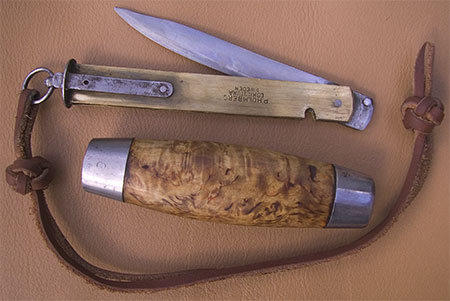
How about making a barrel knive out of your blade?
They are an old Scandinavian (Swedish?) design.
I think it would fit the shape of the blade very well.
Barrel-knife-2.jpg
 
Back
Top