
-
The BladeForums.com 2024 Traditional Knife is available! Price is $250 ea (shipped within CONUS).
Order here: https://www.bladeforums.com/help/2024-traditional/
You are using an out of date browser. It may not display this or other websites correctly.
You should upgrade or use an alternative browser.
You should upgrade or use an alternative browser.
Project #5: Leaf Knife
- Thread starter tryppyr
- Start date


- Joined
- Feb 5, 2010
- Messages
- 3,911
Hmmm... that is interesting. I'll try mocking it up (probably this weekend) and see how it works.
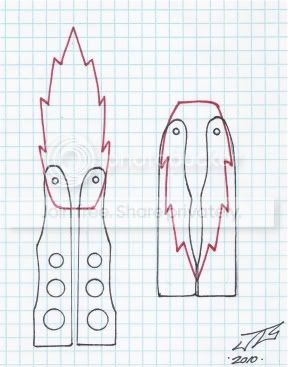
At the moment I'm working on another idea I had. I went back to nature for the idea, and one came... so I spent a little time yesterday cutting out the parts I need for it. If it works out, the project would go back to being a fixed blade, but the all-thread tang would be gone. Basically, the idea is to have two small smooth-edged "leaves" become the guard, and integrating them into a tapered tang that is sculpturally integrated with the blade. I'll draw out what I'm thinking and post a picture if I get the time. I've been awfully busy at work this week.
- Greg
At the moment I'm working on another idea I had. I went back to nature for the idea, and one came... so I spent a little time yesterday cutting out the parts I need for it. If it works out, the project would go back to being a fixed blade, but the all-thread tang would be gone. Basically, the idea is to have two small smooth-edged "leaves" become the guard, and integrating them into a tapered tang that is sculpturally integrated with the blade. I'll draw out what I'm thinking and post a picture if I get the time. I've been awfully busy at work this week.
- Greg
- Joined
- Feb 5, 2010
- Messages
- 3,911
I've made a little progress on the guard segments, so I thought I'd post a WIP picture. I'm following the same basic filing method used on the blade, but without the sharp edges and points. The intent is to have the guard look like two baby leaves at the sides of the bigger leaf. They are VERY rough right now, but I like where it's going.

As for assembly methods, I have a plan, but I'm not sure how closely I'll adhere to it. It will make more sense once I have the other two pieces roughted out and these guard pieces attached. For now I'll just focus on getting these ready.
In any event, I'm pretty close to being decided that there need to be three holes in the ricasso of the blade, which would be adequate for a balisong implementation or the fixed blade direction I'm going now. Moreover, the placement of the holes could be identical for either approach, so I'll probably get them drilled in this week and get the blade sent off for HT while I work on these other pieces.
- Greg
As for assembly methods, I have a plan, but I'm not sure how closely I'll adhere to it. It will make more sense once I have the other two pieces roughted out and these guard pieces attached. For now I'll just focus on getting these ready.
In any event, I'm pretty close to being decided that there need to be three holes in the ricasso of the blade, which would be adequate for a balisong implementation or the fixed blade direction I'm going now. Moreover, the placement of the holes could be identical for either approach, so I'll probably get them drilled in this week and get the blade sent off for HT while I work on these other pieces.
- Greg
- Joined
- Feb 5, 2010
- Messages
- 3,911
If anyone is curious, much of the last week has been spent working on those guard leaves. It's amazing how long the smallest details take if you let them. These are still not done, by the way... but at least they are the right shape and size now. Here's the current state:

- Joined
- Feb 5, 2010
- Messages
- 3,911
Quick update.
I have removed the All-thread tang, flattened the ricasso and drilled the holes that will be used to mount the blade to the handle, all in preparation of sending the blade out for HT.
While the knife is off getting HT, I'll be working on the handle pieces. I'll show more photos when there's something worth seeing.
Last night I performed some etching tests on pieces of the damascus I cut off when making the blade. One piece was etched for 1 hour (on the right), another piece was etched for 4 hours (on the left). The color resulting from both etches was similar, the texture was very different. I'll do some more testing to see how well these two etches finish out, in order to determine how far I want to push the real blade.

- Greg
I have removed the All-thread tang, flattened the ricasso and drilled the holes that will be used to mount the blade to the handle, all in preparation of sending the blade out for HT.
While the knife is off getting HT, I'll be working on the handle pieces. I'll show more photos when there's something worth seeing.
Last night I performed some etching tests on pieces of the damascus I cut off when making the blade. One piece was etched for 1 hour (on the right), another piece was etched for 4 hours (on the left). The color resulting from both etches was similar, the texture was very different. I'll do some more testing to see how well these two etches finish out, in order to determine how far I want to push the real blade.
- Greg
- Joined
- Feb 5, 2010
- Messages
- 3,911
Got word that the blade was sent Priority Mail from PA on Saturday following HT and tempering, so I should get it today or tomorrow. I'm really looking forward to getting this one finished, but do anticipate this will take a bit of time. Next two steps are to descale and etch.
- Greg
- Greg
- Joined
- Feb 5, 2010
- Messages
- 3,911
The blade came back from HT yesterday. Interestingly, the heat treatment resulted in carbeurization that raised the damascus pattern to make it totally visible. I didn't know what to make of it.
Anyway, I sanded it back down with 220, then worked my way back up to 2000 grit. After that, I gave it a 40 minute bath in FC, and hit it with the 2000 grit again. Here's the result.

Anyway, I sanded it back down with 220, then worked my way back up to 2000 grit. After that, I gave it a 40 minute bath in FC, and hit it with the 2000 grit again. Here's the result.
- Joined
- Mar 5, 2010
- Messages
- 525
cool, looks interesting, I think you should mount it on a 2ft pole

- Joined
- Feb 5, 2010
- Messages
- 3,911
I spent much of this weekend trying to wrap up this project. Based on the advice of a few, I was trying to fashion a simple wood handle.I selected a piece of stabilized maple burl and started working on it. I drilled out the center holes just so. I spent a few hours filing the center cavity to hold the blade perfectly. This morning I started serious shaping on it and had it pretty much as I imagined. I switched to hand sand paper, starting at 150 grit... then 220...320 and then 400. While doing the 400 grit pass a hole developed.  I had cut the thin part of the handle too close to the center hole.
Alas, all that work down the tubes.
Just as well, actually... when I had the whole thing together it looked too large for the blade anyway. I might have settled for it for a while, but I would not have been satisfied. At some point I would have done a redux to get the handle more to my liking. Now I get to do that sooner rather than later.
But it was a particularly striking piece of maple burl. (sigh)
Back to the drawing board.
- Greg
I had cut the thin part of the handle too close to the center hole.Alas, all that work down the tubes.
Just as well, actually... when I had the whole thing together it looked too large for the blade anyway. I might have settled for it for a while, but I would not have been satisfied. At some point I would have done a redux to get the handle more to my liking. Now I get to do that sooner rather than later.
But it was a particularly striking piece of maple burl. (sigh)
Back to the drawing board.
- Greg

Hengelo_77
Basic Member
- Joined
- Mar 2, 2006
- Messages
- 6,331
been there done that... auch
How about a black handle?
I mean the blade shape is quite busy as is the damascus pattern. A more sober, plain but beautifull blackwood handle might look good on it. IMHO
Blackwood takes a beautifull polish and shows it's grain pattern if inspected closer.
How about a black handle?
I mean the blade shape is quite busy as is the damascus pattern. A more sober, plain but beautifull blackwood handle might look good on it. IMHO
Blackwood takes a beautifull polish and shows it's grain pattern if inspected closer.
- Joined
- Feb 5, 2010
- Messages
- 3,911
After last week's abyssmal failure, I spent some time thinking about alternatives. Hengelo's advice aligned with advice I'd gotten from my wife, so I checked my blackwood supply and found it inadequate. I have three pieces, all different, all too small.
I think to understand the problem I need to show pictures.
As you may recall, my original idea was to use a welded on piece of all-thread as the tang. When I was advised that the way I'd done it would yield a very weak knife, I decided I had to change course. I considered the balisong approach, but hit s snag there too. Someone offered up a balisong handle design that solved the problem, but was too clunky and awkwar feeling in the hand.
I decided to attach an extension to the ricasso. It took three attempts, but I finally came up with one that seemed to work.

As you know I've also been working on leaf shaped finger guards, and getting them fitted was also one of the big time sinks. Here's what it looks like with them attached. Since taking this picture I've polished them to 200 grit (top and bottom) so now they have a mirror shine.

When I came up with the concept for the finger guards, the idea took a shape that sort of resembled a small olympic torch. I still have the drawing, but I haven't scanned it yet. That's what the first wood handle was going to try to recreate. Needless to say that didn't work out.
Since then I've been looking at antler, and I think this is what will ultimately work. Bear in mind that one of the things the handle must do is cover most of the plates that form the tang extension, as much for structural rigidity as for aesthetics. By the way, it is VERY structurally sound when assembled, and actually feels good in the hand, except for the rough area near the butt.
So I now have a rough cut and drilled piece of antler that (unless I screw it up) will be the foundation for the handle. Here's where it's at today.

Obviously, I'll do some shaping and add a couple of discrete elements (e.g. a butt cap to smooth out the bottom).
For me, however, the next step is to completely disassemble it one more time and re-etch the blade, because it has somehow developed some wear lines near the ricasso, probably as a result of all the fitting and fiddling I've been doing. While disassembled, I'll do the shaping and finishing of the handle, polishing of the visible portion of the tang extension, and final dressing of the guard pieces. Then I'll do the final assembly and call it quits.
For those that have been following the thread, I appreciate your comments. They have really been helpful, if not always what I wanted to hear.
- Greg
I think to understand the problem I need to show pictures.
As you may recall, my original idea was to use a welded on piece of all-thread as the tang. When I was advised that the way I'd done it would yield a very weak knife, I decided I had to change course. I considered the balisong approach, but hit s snag there too. Someone offered up a balisong handle design that solved the problem, but was too clunky and awkwar feeling in the hand.
I decided to attach an extension to the ricasso. It took three attempts, but I finally came up with one that seemed to work.
As you know I've also been working on leaf shaped finger guards, and getting them fitted was also one of the big time sinks. Here's what it looks like with them attached. Since taking this picture I've polished them to 200 grit (top and bottom) so now they have a mirror shine.
When I came up with the concept for the finger guards, the idea took a shape that sort of resembled a small olympic torch. I still have the drawing, but I haven't scanned it yet. That's what the first wood handle was going to try to recreate. Needless to say that didn't work out.
Since then I've been looking at antler, and I think this is what will ultimately work. Bear in mind that one of the things the handle must do is cover most of the plates that form the tang extension, as much for structural rigidity as for aesthetics. By the way, it is VERY structurally sound when assembled, and actually feels good in the hand, except for the rough area near the butt.
So I now have a rough cut and drilled piece of antler that (unless I screw it up) will be the foundation for the handle. Here's where it's at today.
Obviously, I'll do some shaping and add a couple of discrete elements (e.g. a butt cap to smooth out the bottom).
For me, however, the next step is to completely disassemble it one more time and re-etch the blade, because it has somehow developed some wear lines near the ricasso, probably as a result of all the fitting and fiddling I've been doing. While disassembled, I'll do the shaping and finishing of the handle, polishing of the visible portion of the tang extension, and final dressing of the guard pieces. Then I'll do the final assembly and call it quits.
For those that have been following the thread, I appreciate your comments. They have really been helpful, if not always what I wanted to hear.
- Greg
- Joined
- Mar 7, 2009
- Messages
- 254
I think that's going to look VERY good.
Hengelo_77
Basic Member
- Joined
- Mar 2, 2006
- Messages
- 6,331
Your threat is like an interesting movie, it keeps your attention by taking completely unexpected turns.
If you have a test piece of the antler you are using, you can see how it will look if you sand the most outer skin off and give it a good polish.
I've seen an antler handle as white as if it were ivory.
Looking at your photo it looks a bit brown, but personally I think smooth polished light brown will look good as a handle.
If you have a test piece of the antler you are using, you can see how it will look if you sand the most outer skin off and give it a good polish.
I've seen an antler handle as white as if it were ivory.
Looking at your photo it looks a bit brown, but personally I think smooth polished light brown will look good as a handle.

That's an awful skinny looking tang. Look forward to seeing it develop :thumbup:
Yeah but it's a full tang
- Joined
- Feb 5, 2010
- Messages
- 3,911
Yesterday I did final assembly using Acraglass epoxy to hold it all together. I decided to try this one without an accompanying pin, so we're using suspenders but no belt.
Just to follow up with Hengelo, I took your suggestion and removed the bark from the antler, getting down to the pale bone section. The color is not 100% gone, but very nearly so. I capped the top and bottom with pieces of fossil walrus ivory that pretty closely match the antler in color. Essentially, the handle is off-white with some of the ridges and valleys that give the handle texture, but not the color.
I really like the feel of the handle... the way the curve of the handle lines up the blade when gripped.
All that remains now are the finishing details. I should be able to post final pictures this weekend.
- Greg
Just to follow up with Hengelo, I took your suggestion and removed the bark from the antler, getting down to the pale bone section. The color is not 100% gone, but very nearly so. I capped the top and bottom with pieces of fossil walrus ivory that pretty closely match the antler in color. Essentially, the handle is off-white with some of the ridges and valleys that give the handle texture, but not the color.
I really like the feel of the handle... the way the curve of the handle lines up the blade when gripped.
All that remains now are the finishing details. I should be able to post final pictures this weekend.
- Greg