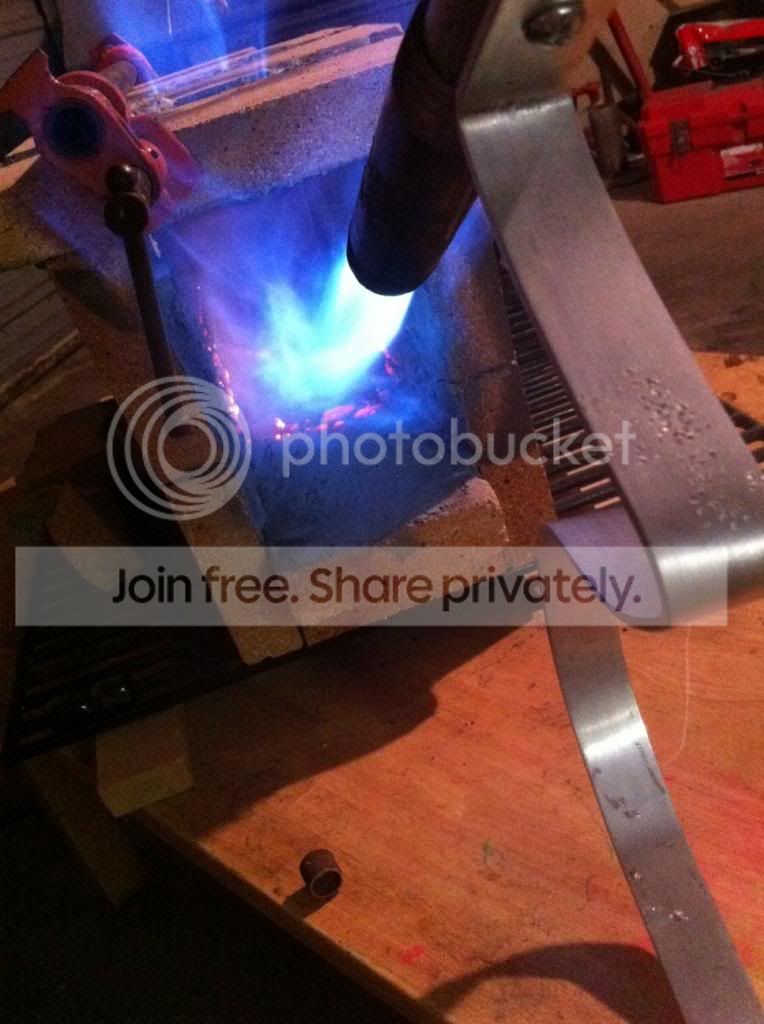
I built a propane forge that works pretty well on 3/16" thick 1095 steel, but its having a hard time heating up a long (takes up the full 19" length of my furnace) 1/4" thick 5160 blade. I decided to take a small mapp gas burner and throw some extra heat in, and it actually worked great. Gave it that little extra boost it needed to get it to non magnetic. Heres my problems.... First, how do I get it hotter as is? I have it vented in several places, should I close up the venting a little more? I played around some, but it didn't seem to make a difference. Secondly, when I used the mapp gas, it seemed to heat up one area of the blade a little more, causing some warpage. Its VERY slight, but I can see it. I had it in the oven tempering, and while still hot I tried bending it back. No way this stuff is budging! I am a fairly big guy, and I put a lot into trying to get it to bend back a little. It flexed quite a bit, but went right back to where it was. Do I need to get it hotter? I don't want to go too hot, as I am trying to keep the steel in the RC 58 to 60 range. Any suggestions? Thanks for reading.

-
The BladeForums.com 2024 Traditional Knife is available! Price is $250 ea (shipped within CONUS).
Order here: https://www.bladeforums.com/help/2024-traditional/
You are using an out of date browser. It may not display this or other websites correctly.
You should upgrade or use an alternative browser.
You should upgrade or use an alternative browser.
Propane forge and 5160 warpage questions
- Thread starter rjfm1972
- Start date

- Joined
- Feb 4, 2011
- Messages
- 1,429
Hello,
First, despite the "knifemaker" status I'm a newb. But....
There are many problems in your methods. I believe they come from a lack of knowledge. You are getting great experiential knowledge in your process though!
First. 3/16", 1/4", or 1" your forge should be able to heat the steel all the way through. Sounds like your forge and burner design need examined? Want to share your set up and we can help you get up to forging temps? Or just an even heat treat temp?
Warpage is a common occurence for blades coming out of the quench. Rick Marchand has a great tread he started on straightening warped blades with a piece of angle iron and small c-clamps in the oven during the tempering cycle.
Sometimes warpage is cause by uneven grinds. Uneven heating(possible with your heat issues), wavingthe blade sideways in the quench tank will cause warping too.
Please!! Don't try to straighten a blade with your bare hands after it's been hardened. Besides
straightening during the temper you can also straighten out of the quench tank for a few seconds while wearing leather gloves. Commonly a post vise(saw it done 3x today) is used, or a wooden 2"x4" with a slot cut in it to straighten the warp.
I personally have only straightened 4 blades out of the quench tank.(mine never warp...)

Another method to straighten a warp after temper is using a three point jig and a vise.
There's a couple other things to add if this helps.
First, despite the "knifemaker" status I'm a newb. But....
There are many problems in your methods. I believe they come from a lack of knowledge. You are getting great experiential knowledge in your process though!
First. 3/16", 1/4", or 1" your forge should be able to heat the steel all the way through. Sounds like your forge and burner design need examined? Want to share your set up and we can help you get up to forging temps? Or just an even heat treat temp?
Warpage is a common occurence for blades coming out of the quench. Rick Marchand has a great tread he started on straightening warped blades with a piece of angle iron and small c-clamps in the oven during the tempering cycle.
Sometimes warpage is cause by uneven grinds. Uneven heating(possible with your heat issues), wavingthe blade sideways in the quench tank will cause warping too.
Please!! Don't try to straighten a blade with your bare hands after it's been hardened. Besides
straightening during the temper you can also straighten out of the quench tank for a few seconds while wearing leather gloves. Commonly a post vise(saw it done 3x today) is used, or a wooden 2"x4" with a slot cut in it to straighten the warp.
I personally have only straightened 4 blades out of the quench tank.(mine never warp...)
Another method to straighten a warp after temper is using a three point jig and a vise.
There's a couple other things to add if this helps.
Thanks. I did finally get it to straighten out. I bumped up my temp a little more then I would have liked, and with oven mitts on (smoking hot) I was barely able to apply enough force to get it to straighten. Boy, this 5160 stuff is tough. I am 100% sure the warp happened because of how I brought the temp up with the additional torch. I could see a 3" long area that was definitely hotter then the rest of the blade. I didn't know it would cause it to warp, but I think the heat was hitting one side of the blade and being as thick as it is, wasn't heated all the way through equally. So when I quenched it....well, long story short I screwed up. Lesson learned.

- Joined
- Feb 17, 2007
- Messages
- 3,375
If you want to harden using a forge type setup you must do something about your forge. First it should be able to reach temps far above non magnetic. Then you need to have the temps uniform. Like Brian said lets see what you have. Either your burner isn't cutting it or your forge body isn't right. Does the forge flame swirl thru the chamber? Two ways to keep the heat even that I know guys use. Keep the blade moving back and forth thru the forge as it heats, the other is placing a piece of pipe in the forge and the bade in it. This acts as a muffle and helps keep the heat even
Next. on 5160 or 1095 non-magnetic is not hot enough to get the best from your steel//
Next. on 5160 or 1095 non-magnetic is not hot enough to get the best from your steel//
When you put a piece of pipe in it, should the flame go into the pipe as well, or do you just let the heat build up around it? Otherwise, wouldn't the pipe insulate the blade from the flame and make it take longer to heat? As far as the burner, when I try to put it right up to the forge (I mean so the tip is literally right up to but not into it) it seems like the flame wants to sputter like its not getting enough oxygen. Does this mean I need more air (bigger holes) up by the nozzle? I think this may be why its not getting hot enough. The holes I made are (8) 1/4" holes in a piece of 3/4" sch 40 pipe. Should I make them bigger? I just don't want to screw it up and have to start over again. Also, I am using a .030" mig tip for the nozzle. Should I go bigger if I open up the air vent holes? Sorry for so many questions. Still learning.
- Joined
- Feb 4, 2011
- Messages
- 1,429
Questions are good! You can't have too many. Let's see a picture of your burner design.
Sounds like a venturi type burner. If you aren't getting enough air then your design is suspect. Ideally you should HAVE to choke back the burner some or adjust the regulator lower.
Here's a link to Zoeller's how to on building a sidearm burner.
The stainless flare at the end doesn't HAVE to be stainless, but it will extend the life of the flare some. Without getting too technical, you can also "flare" where the burner enters the forge chamber to act as the flare...
What PSI regulator are you using? And what is it set at?
http://en.m.wikipedia.org/wiki/Venturi_effect
http://zoellerforge.com/sidearm.html
Sounds like a venturi type burner. If you aren't getting enough air then your design is suspect. Ideally you should HAVE to choke back the burner some or adjust the regulator lower.
Here's a link to Zoeller's how to on building a sidearm burner.
The stainless flare at the end doesn't HAVE to be stainless, but it will extend the life of the flare some. Without getting too technical, you can also "flare" where the burner enters the forge chamber to act as the flare...
What PSI regulator are you using? And what is it set at?
http://en.m.wikipedia.org/wiki/Venturi_effect
http://zoellerforge.com/sidearm.html
- Joined
- Feb 17, 2007
- Messages
- 3,375
Here is another simple burner design.
http://www.instructables.com/id/how-to-build-a-gas-forge-burner/
I made an all stainless improved copy of that burner and it will turn steel yellow in my small portable forge.
I don't think your burner is cutting it. A 1/4" hole has an area of .05 sq inches 8 of em is .4. The id of a 1" bell reducer is 1.5" for 1.75sq inches. Plus sucking through a funnel at the far end gives it some velocity. It takes a LOT of air to really cook. Sounds like you tried to copy a small propane burner. Won't work in a bigger forge (19") Your sputtering is O2 starvation. I highly doubt that more holes will work.
http://www.instructables.com/id/how-to-build-a-gas-forge-burner/
I made an all stainless improved copy of that burner and it will turn steel yellow in my small portable forge.
I don't think your burner is cutting it. A 1/4" hole has an area of .05 sq inches 8 of em is .4. The id of a 1" bell reducer is 1.5" for 1.75sq inches. Plus sucking through a funnel at the far end gives it some velocity. It takes a LOT of air to really cook. Sounds like you tried to copy a small propane burner. Won't work in a bigger forge (19") Your sputtering is O2 starvation. I highly doubt that more holes will work.
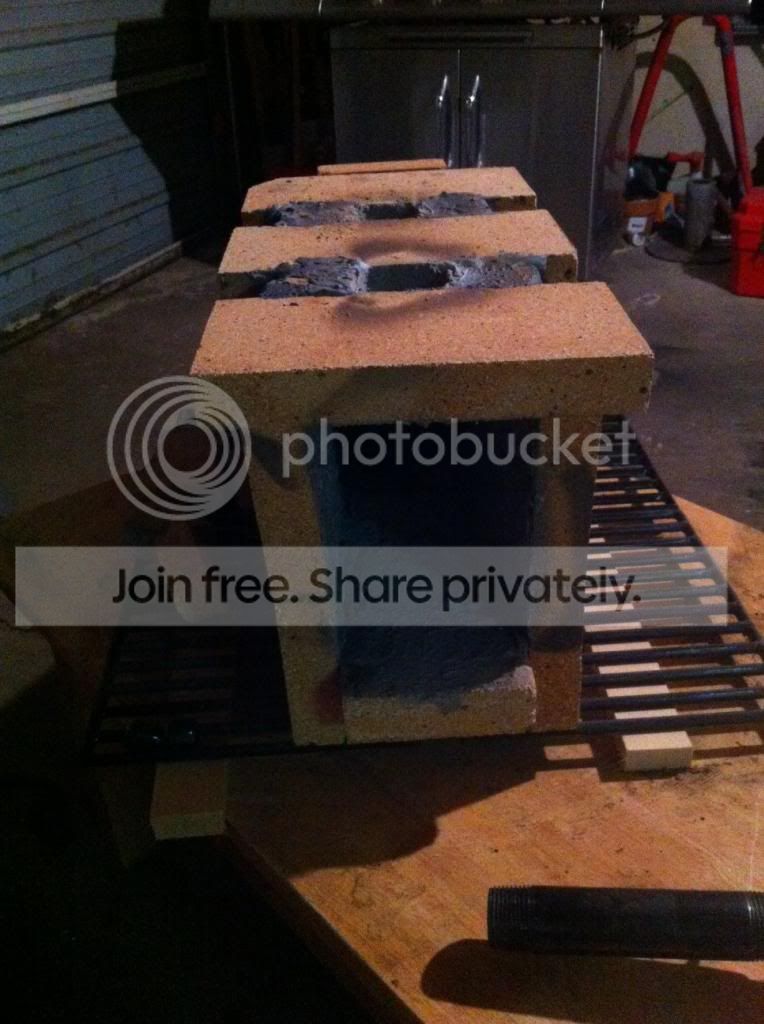
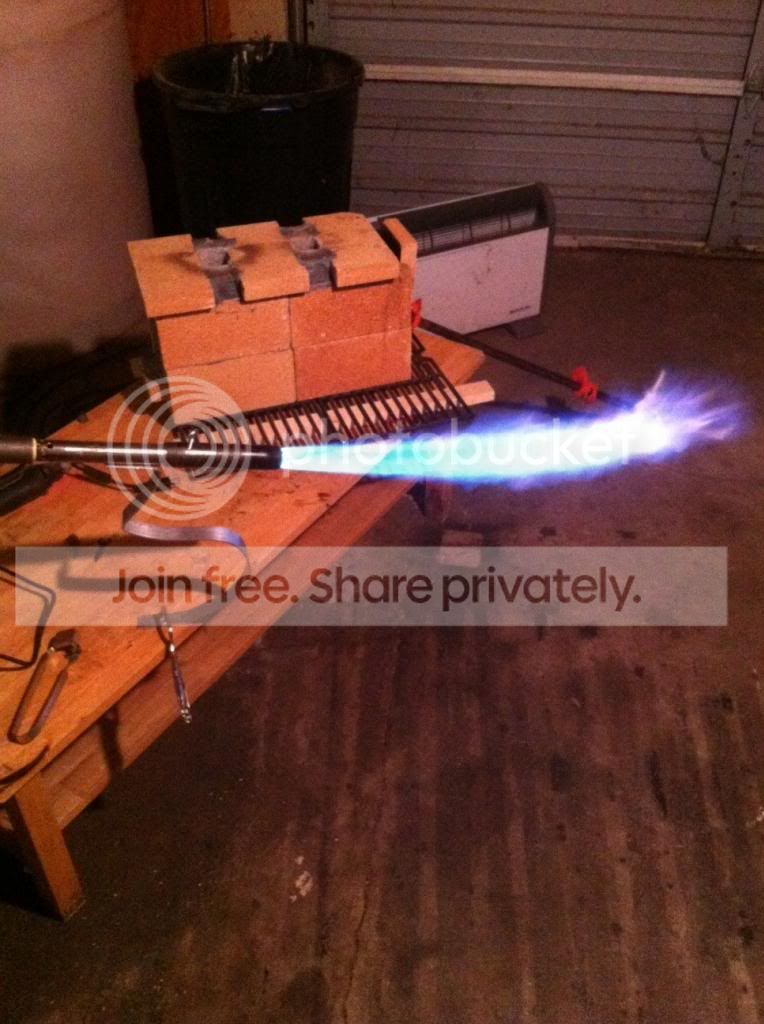
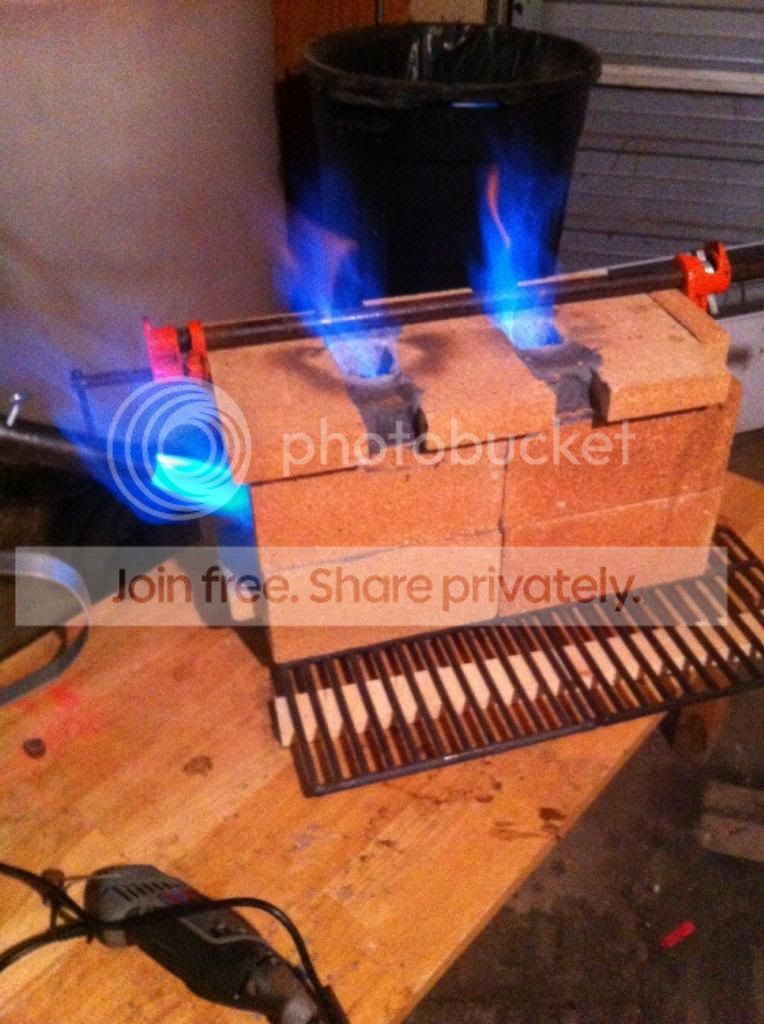
That burner you gave the link for is almost identical to mine. I have a 1" pipe slipped over 3/4" for the nozzle. Same length. Only difference is he uses a #57 drill, which is 50% larger then my .030" mig tip. Also, his design draws air in from behind the propane comes in, and mine has the holes drilled immediately after the propane. Maybe this is the problem. Heres a pic of my burner turned all the way up. Also a couple of pics of my forge. It shoots out a nice blue flame a good 30". Is this sub-par? And as far as where I position it in the forge, if I put it any closer, thats when it starts to sputter, like its going to blow out. Where its positioned now, it runs a very consistent flame, with no change in performance. OK Guys, now you have some pics. Tell me whats wrong. Please be kind!
 [/IMG]
- Joined
- Feb 4, 2011
- Messages
- 1,429
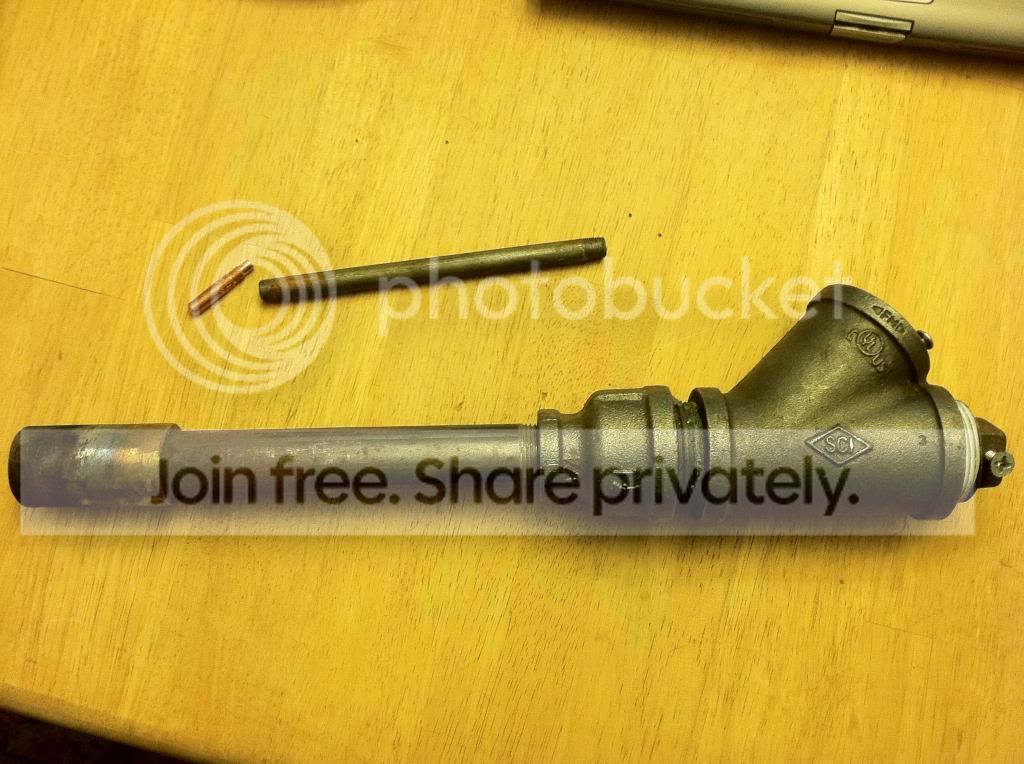
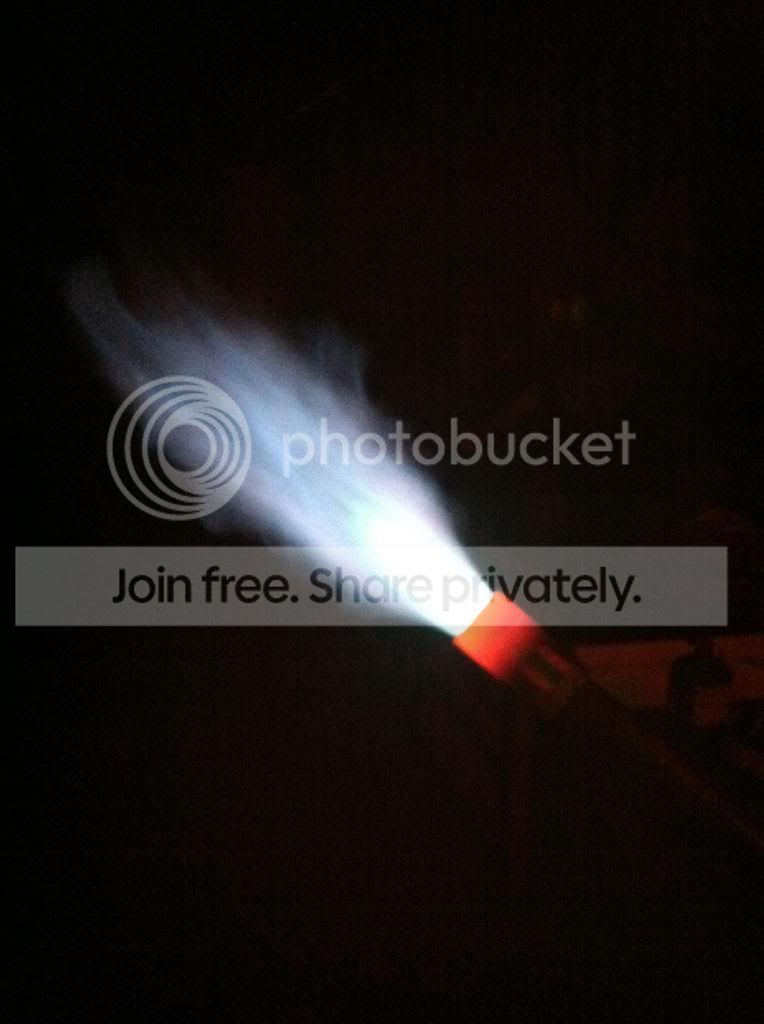
Here's this burner running. No extra air and the little forge could likely melt if we wanted it to......
It's an 1-1/4" fitting, I used a reducing coupling and a 6" 1/8" nipple so I could get the venturi to draw air in properly.
A couple things on your forge. Solid fire bricks soak up heat. The take awhile to come up to temp. So you would have to run your forge for fifteen, twenty, forty minutes to get it heated inside evenly.....
Then, the way you have it open with the burner in front, will basically never work right.

Your burner isn't getting enough air. When you say yours is like a Reil burner, it really isn't.
 No worries, easy to fix. :thumbup::thumbup:
http://ronreil.abana.org/design1.shtml
!-1/4" fitting, bushed to 3/4", add an 8" nipple and a 1" flare tube. I use 1" stainless that I ream on the pipe threader at work to a zeroish bevel.
If you have a regulator that runs up to 15PSI you should be fine. This one is a .030 tip running around 7PSI if I recall.
Thanks for the link Brian. Gives me a lot of ideas. Going to try some of them out in the next couple days. I work in a machine shop and have access to a nice lathe and all the stainless steel I can ever want, so I think I am going to make a new burner that will have a huge range of adjustments in just about every way. I will be sure to share some pics when its done.
- Joined
- Feb 4, 2011
- Messages
- 1,429
Thanks for the link Brian. Gives me a lot of ideas. Going to try some of them out in the next couple days. I work in a machine shop and have access to a nice lathe and all the stainless steel I can ever want, so I think I am going to make a new burner that will have a huge range of adjustments in just about every way. I will be sure to share some pics when its done.
Sweet! I making odds n ends is my ADD sideline to knifemaking. I'm making a copper bodied burner now. It'll have a stainless flare tube but mostly copper and brass otherwise. I'm honestly only making it so I can practice some Japanese Tagane chisel work on it and make it more of a piece of functional art.
There's more than one way to build a forge and burner. I always have to ask myself when I'm making a tool(Okay, Greg Haile asks me...) do you want to make knives or tools? Lol. I really enjoy both.
Btw. If
You flip your forge on it's side. Put the burner in the back "vent" hole that was on top, plug the second, line it with 1" Inswool and a light coat if refractory with an IR reflective coating you'd be ok. Honestly, get a freon tank from an HVAC company and line it with Inswool etc and you'd be set to start and then after using it you'll have a better idea of what you want.
- Joined
- Feb 17, 2007
- Messages
- 3,375
Ya, you need the bell reducer on the end and the big opening to get enough air in there. He is also right on the hard bricks, they last for ever, but, take a long time to heat up, do not insulate as well as soft brick or Kaowool Another source for forge bodies is propane companies. They often have old propane bottles that can't be filled. I just got one for free from the place I get my propane. If the valve isn't out remove it, fill it with water and cut the top off with a grinder. I am going to use the one I have for a vertical forge.
Honestly, this forge was kind of just a small inexpensive practice piece for me. I have access to pretty much any size or kind of pipe that I want, and can weld and pretty much fabricate anything I need to. I just didn't want to build something extravagant and find out my design was bad. Once I get it all figured out, I am going to make myself a nice forge. I like playing with fire! I started on the stainless burner today. I am using the same size (3/4") for the main tube, and have a 4" long piece of 1" sch 40 w/ a 1" X 1 1/2" concentric reducer welded on the end that will slide on the 3/4" pipe to give me the adjustable flared nozzle. On the other end, I have a piece of 1" sch 40 pipe welded to the 3/4" pipe, and then another concentric reducer on that side for the intake. I will have a plate that can swivel on that end to adjust air intake. I am also going to make a small piece to put through one of the vent holes on top for the burner to go into. BTW Brian, the entire inside of my forge is coated with a heavy layer of 2300 degree refractory cement already. Its about a 1/4" thick layer. I was thinking about going in there and adding a second layer. Matter of fact, I'm going to go do that now! I should have the burner done tomorrow. I will post pics.
Major fail! That was a bad idea. I went to bring the forge in out from the frigid garage, and the top half of my forge came right off! So much for the high temp mortar they sell at menards. Then when I got the bottom half inside, the sides came off and I almost lost a toe. This has inspired me! After I finish my stainless burner, I am making a stainless forge! Better yet, maybe a vertical forge! Nah, forget the vertical.... I'd have to make it huge to do longer blades. Maybe Ill make it a two burner horizontal. Oh, the possibilities!

- Joined
- Nov 29, 2011
- Messages
- 1,396
I just got the stuff in and went from a small propane tank single burner forge to a dual burner slightly longer propane tank forge. Unfortunetly my time has run out as far as making stuff goes for a little while so all I got to do is heat it up to set the liner. Cant wait to get it going for real though.
My first one worked very well. Lined with 2" kaowool, coated with satanite and a thin layer of ITC100. It would get up to about 2000F in about 20min. It was just limited due to being too short. This second one although about 6" longer has a hole in the back end to allow longer blades to be passed thru for forging or HT of simple steels.
My first one worked very well. Lined with 2" kaowool, coated with satanite and a thin layer of ITC100. It would get up to about 2000F in about 20min. It was just limited due to being too short. This second one although about 6" longer has a hole in the back end to allow longer blades to be passed thru for forging or HT of simple steels.

- Joined
- Sep 14, 2010
- Messages
- 288
No need for a huge vertical for longer blades as the blades pass through the other side effectively heating on the portion you are working on or you can pass the blade back and forth to evenly heat the entire blade.

Stacy E. Apelt - Bladesmith
ilmarinen - MODERATOR
Moderator
Knifemaker / Craftsman / Service Provider
- Joined
- Aug 20, 2004
- Messages
- 38,508
A vertical forge is just a forge with opposing ports on each side near the top. The burner is at the base, and swirls around the chamber with the heat and flames rising. The bar of steel/blade is put in the port, and passed through the other side if it is long. This means that the forge is vertical, but the blade being worked is horizontal. Two burners would not work well, or be needed, for most vertical setups. Vertical forges are more compact and are primarily as smaller forging forges. Large ones are very useful for welding damascus.
A good size for the shell for a countertop forge is a 12" section of 8" to 10" round pipe. This would give a 4" to 6" round chamber for the blade to pass through.
Large vertical forges for doing damascus have been made from 55 gallon drums.
In use, the vertical forge is brought up to heat and the steel is stuck in the port. The chamber heats a section of the bar and you work that section. As you move down the bar ( for longer blades) you just heat the part you want to work. Vertical forges are not quite as easy to do HT in as horizontal forges, but it can work with some practice on a smaller blade.
Many folks notice that the vertical forges run with less heat being put into the shop than a horizontal forge. That is because you are heating a much smaller chamber area...thus less heat is created. They are very efficient on propane consumption.
Sam currently has a thread going on his small vertical forge build.
http://www.bladeforums.com/forums/showthread.php/1030203-Vertical-Forge-build
A vertical gas HT oven is a very different thing from a vertical forge. In these, they are built like a long multi-burner horizontal forge, but set on end vertically. The blades are suspended down the center of the chamber for HT. These are complex to build and require a lot of tweaking to get the heat right. A center muffle is almost a requirement.
A good size for the shell for a countertop forge is a 12" section of 8" to 10" round pipe. This would give a 4" to 6" round chamber for the blade to pass through.
Large vertical forges for doing damascus have been made from 55 gallon drums.
In use, the vertical forge is brought up to heat and the steel is stuck in the port. The chamber heats a section of the bar and you work that section. As you move down the bar ( for longer blades) you just heat the part you want to work. Vertical forges are not quite as easy to do HT in as horizontal forges, but it can work with some practice on a smaller blade.
Many folks notice that the vertical forges run with less heat being put into the shop than a horizontal forge. That is because you are heating a much smaller chamber area...thus less heat is created. They are very efficient on propane consumption.
Sam currently has a thread going on his small vertical forge build.
http://www.bladeforums.com/forums/showthread.php/1030203-Vertical-Forge-build
A vertical gas HT oven is a very different thing from a vertical forge. In these, they are built like a long multi-burner horizontal forge, but set on end vertically. The blades are suspended down the center of the chamber for HT. These are complex to build and require a lot of tweaking to get the heat right. A center muffle is almost a requirement.
So I should go with a horizontal forge if I am using it mostly for heat treating? I have a piece of steel pipe at work that the owners are letting me have. Its a 14" OD, 1/4" wall 304 stainless steel 20" long. Should I look for something smaller? I plan on doing mostly blades that are 10"-12" long, and sometimes maybe a short sword up to 24" long. I plan on forging blades as well as just doing heat treating. Is this too big for a vertical forge?