Q and A for an Industry Icon

Nope, no Medfords for surgery. Surgical tools would be disassembled and cleaned after use. This would void the Medford warranty and put you on blast in a subsequent Youtube video for doing so. [emoji2]

Sent from my LGMS428 using Tapatalk

Haha you are correct sir. Can't take your ultra tough 2 inch thick steel medford apart because all the toughness will leak out - Warranty void.
 
Haha you are correct sir. Can't take your ultra tough 2 inch thick steel medford apart because all the toughness will leak out - Warranty void.

Warranties are for wimps. :D

When my Spyderco Titanium Military lock-bar went to the non-locking side, I took it apart, and used my anvil along with a center punch and hammer to peen it, bringing it back to the lock-up I wanted. :thumbup:

Sure, I could have paid to ship it there and let warranty take care of it, but where's the fun in that?

There is little in life that cannot be fixed with a hammer...or a bigger hammer. :thumbup:
 
Warranties are for wimps. :D

When my Spyderco Titanium Military lock-bar went to the non-locking side, I took it apart, and used my anvil along with a center punch and hammer to peen it, bringing it back to the lock-up I wanted. :thumbup:

Sure, I could have paid to ship it there and let warranty take care of it, but where's the fun in that?

There is little in life that cannot be fixed with a hammer...or a bigger hammer. :thumbup:

I like your approach :thumbup:

So if your Medford is borked you just hit it with another, larger Medford until it's fixed?

Lol, post of the day.
 
Upset? Because the people with the least to say are saying the most? Because sarcastic, dismissive derision has replaced knife discussion on a knife discussion board? What's upsetting about that?


Not in this interview. But he's discussed Hartsfield's influence on the initial CQC designs in other interviews in the past.


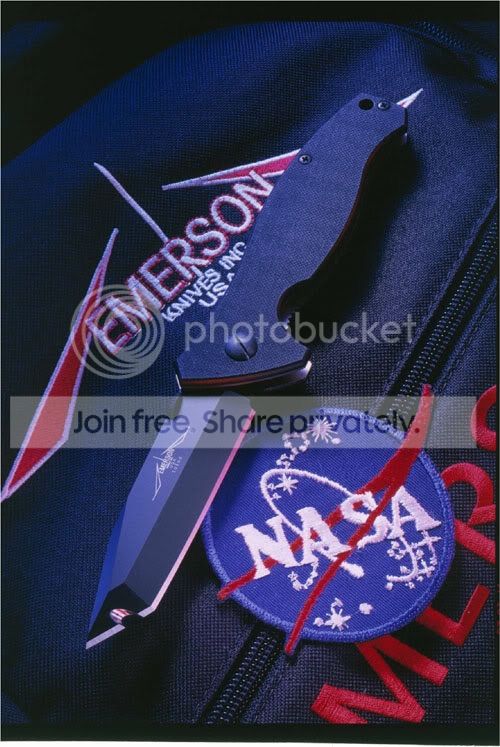
No. I'm saying that an Emerson knife is one of only a half-dozen knives selected for use in over fifty years of U.S. space exploration. It's an honor very few can claim.

It wasn't an off-the-shelf Emerson, either.

image_zpsfckqpuuu.jpg


image_zps36te9i3a.jpg


How often do we, as knife aficionados here on Blade Forums, complain when we see professionals using plain-Jane knives in their everyday activities and then devote entire threads to what brands/models they should've used instead? Here we have an example of an EKI knife (arguably not a brand your average hardware store knife buyer is even going to know exists) being selected for and used in space missions. And you're dismissing the significance of it by suggesting that NASA could've just gone with a box cutter?

-Steve

I'd be willing to bet that they went with Emerson, not because it was the best product available, but because he was the one who would fill their odd, small order for the best price. Kershaw's not going to bother with adding what I'm guessing is a wire stripper or clam shell plastic opener to a whopping 30 knives.
 
I'd be willing to bet that they went with Emerson, not because it was the best product available, but because he was the one who would fill their odd, small order for the best price. Kershaw's not going to bother with adding what I'm guessing is a wire stripper or clam shell plastic opener to a whopping 30 knives.

I left this when the thread petered out, but since the thread has arisen again, I can't allow it to remain unchallenged. Not only is it baseless speculation, but it's contrary to facts as supplied by Emerson Knives.

This is the description of the NASA SPECWAR from a 2002 archived copy of the Emerson Knives Web site:

NASA KNIFE

Disclaimer-Being a government agency, NASA cannot and will not endorse any product used by their agency in any of their operations.


Emerson Knives has been awarded a contract to produce knives for NASA and the Space Station program.

We were contacted sometime in the winter of 1999 by NASA to develop and test a knife that could be issued to the astronauts in the Space Station program. Working to a set of parameters and duties as defined by both the astronauts and engineers at NASA, several designs were considered and built. However, after a lengthy debate, a unanimous decision was reached, that the already existing design - The SPECWAR - fit all the requirements for size, weight, materials, strength, and ergonomics. The only change was to the front of the tanto style blade. The addition of a reverse hook was needed to facilitate opening food kits and other sealed items as well as any emergency situation that might require slitting open clothing or gear. The knives have been fully flight certified and tested at the White Sands, New Mexico government facility. Following are photographs of the "NASA SPECWAR."

The NASA SPECWAR knife is not currently available for civilian purchase.


-Steve
 
I left this when the thread petered out, but since the thread has arisen again, I can't allow it to remain unchallenged. Not only is it baseless speculation, but it's contrary to facts as supplied by Emerson Knives.

This is the description of the NASA SPECWAR from a 2002 archived copy of the Emerson Knives Web site:

NASA KNIFE

Disclaimer-Being a government agency, NASA cannot and will not endorse any product used by their agency in any of their operations.


Emerson Knives has been awarded a contract to produce knives for NASA and the Space Station program.

We were contacted sometime in the winter of 1999 by NASA to develop and test a knife that could be issued to the astronauts in the Space Station program. Working to a set of parameters and duties as defined by both the astronauts and engineers at NASA, several designs were considered and built. However, after a lengthy debate, a unanimous decision was reached, that the already existing design - The SPECWAR - fit all the requirements for size, weight, materials, strength, and ergonomics. The only change was to the front of the tanto style blade. The addition of a reverse hook was needed to facilitate opening food kits and other sealed items as well as any emergency situation that might require slitting open clothing or gear. The knives have been fully flight certified and tested at the White Sands, New Mexico government facility. Following are photographs of the "NASA SPECWAR."

The NASA SPECWAR knife is not currently available for civilian purchase.


-Steve
You're right in that my statement was pure speculation, but I fail to see how what you posted in any way contradicts it.

It states that NASA contacted Emerson for a knife design and they settled on the Specwar with the addition of a hook.

Nowhere in there does it say how they came to contact Emerson, whether or not they contacted other makers, etc.

I could be completely wrong, but your post doesnt do anything to prove it.

I really doubt this was any sort of priority. Can you imagine? The best of the best our country's space program has to offer looking for a knife and they go for an Emerson? It was a different time I suppose, 1999 vs. Today in the knife world.

Reading between the lines it could have been that they wanted a knife that fit certain parameters, one of which was most certainly a price point. Emerson has a bunch of Specwars as new old stock. It works fine for what they need and Emerson agrees to add the hook at no additional charge, maybe even at a discount in return for getting to make the NASA knife. We'll never know.
 
Can't attest to how NASA chose the Emerson, but I do have experience working with NASA on spacecraft suitable materials. The company I was working for at that time provided carbonized rayon for the lining of the solid rocket booster nozzle for the shuttle, 40,000 pounds of it at each launch. Every inch of rayon had to be checked, re-checked and visually hand inspected before sending to Carbone to be processed for the booster. It could not have one defect of any kind. We also manufactured kevlar and nomex for flight suits, fuel cells for most US fighter aircraft, and multiple high technology fabrics for the DoD. When NASA needed new fabrics for certain tasks, they approached us, since we were well known in the DoD as reliable 100% traceable suppliers.
 
You're right in that my statement was pure speculation, but I fail to see how what you posted in any way contradicts it.

The Emerson Web site didn't say that EKI responded to a Request for Proposal, the usual mechanism for letting government contracts. It also didn't indicate that EKI was submitting knives for competition with other vendors (a fact that would have given the company crowing rights, since it won the contract). Combine that with the fact that NASA went to Emerson, not the other way around, and that leaves only one option that I'm aware of: Emerson Knives Incorporated was a sole-source provider, which means that, for one reason or many, NASA wanted what EKI was offering, to the exclusion of every other manufacturer.

The SPECWAR was not new old stock in 1999. It was a recently introduced knife. And as you pointed out, the knife industry was quite different then. The use of aerospace-grade G-10 and titanium was not common, and among commercial knife manufacturers it was downright rare. 154CM, while scoffed at now, was a premium steel at that time. If NASA did have strict requirements for size, weight, materials, strength, and ergonomics (and JB's example of carbonized rayon procurement is only one of hundreds that show that the organization has extremely stringent standards for absolutely everything that goes up), then Emerson was a great choice in 1999.


I don't care if you have an unfavorable opinion of Emerson Knives, as I have no vested interest in EKI or any other company. But no matter what you or anyone else here says to minimize its significance, it's a big deal to have a knife selected for use aboard NASA's manned space flights and the International Space Station. Is it enough to declare the company's owner an icon? By itself, maybe not. But in conjunction with everything else Emerson has accomplished, it helps to make a pretty compelling argument.

-Steve

 
The Emerson Web site didn't say that EKI responded to a Request for Proposal, the usual mechanism for letting government contracts. It also didn't indicate that EKI was submitting knives for competition with other vendors (a fact that would have given the company crowing rights, since it won the contract). Combine that with the fact that NASA went to Emerson, not the other way around, and that leaves only one option that I'm aware of: Emerson Knives Incorporated was a sole-source provider, which means that, for one reason or many, NASA wanted what EKI was offering, to the exclusion of every other manufacturer.

The SPECWAR was not new old stock in 1999. It was a recently introduced knife. And as you pointed out, the knife industry was quite different then. The use of aerospace-grade G-10 and titanium was not common, and among commercial knife manufacturers it was downright rare. 154CM, while scoffed at now, was a premium steel at that time. If NASA did have strict requirements for size, weight, materials, strength, and ergonomics (and JB's example of carbonized rayon procurement is only one of hundreds that show that the organization has extremely stringent standards for absolutely everything that goes up), then Emerson was a great choice in 1999.


I don't care if you have an unfavorable opinion of Emerson Knives, as I have no vested interest in EKI or any other company. But no matter what you or anyone else here says to minimize its significance, it's a big deal to have a knife selected for use aboard NASA's manned space flights and the International Space Station. Is it enough to declare the company's owner an icon? By itself, maybe not. But in conjunction with everything else Emerson has accomplished, it helps to make a pretty compelling argument.

-Steve
You're probably closer to correct than I am. It's a cool bragging right if nothing else, regardless of how they came about the contract.
 
I think it's the tooting his own horn here, like he has a head the size of a blimp, that puts people off. Regardless of the NASA knife.
 
Back
Top