
Question about a surface grinder

Joined
Nov 26, 2005
Messages
76
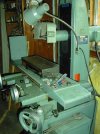
I just bought a Acra 6 x 18" surface grinder with a three phase, 220/440, 1hp motor. I have been looking at phase converters and I found a static converter for around 100 or I can purchase a rotory converter for 3 times that.
Can I use a static converter or do I have to buy a rotory to run the machine ?
Here is a picture of the machine if anyone can help.
Thanks !
 

Attachments

  • Bryan 022.jpg
    Bryan 022.jpg
    49.9 KB · Views: 122
First of all, be careful with three phase. Make sure the machine is grounded properly, all wires are in good condition etc.

A static converter takes your single phase power and converts it to three phase only for a short time - enough for the machine to start. After it starts, you're no longer converting your single phase to three phase. The machine will keep running on single phase, but not at maximum power. Essentially the static converter only converts long enough for the machine to start, then feeds it single phase to keep it going. It will work, but it's not ideal and you will not run anywhere near maximum power. 2/3rds maximum power would be the best you can hope for running a static converter.

A rotary converter properly converts your single phase to three phase and keeps doing so as long as you keep the machine turned on. This is the best way to run a three phase machine in a residential area, unless you want to replace the motor with a single phase motor, which might actually be cheaper than buying a $300 rotary converter.

Static is the "worst" option, but also the cheapest. You probably wont notice a difference between running with the rotary converter versus swapping the motor out for a single phase one. I'd say if you can find one of the right size for less than the rotary converter, go that route, otherwise the rotary converter will work just fine. If you don't really need anywhere near that 1HP, you may as well save the cash and go with the static converter.
 
Well you could connect multiple machines to the same converter so all you'd have to do is flip them on and not worry about unplugging one and plugging in the other, but I'm honestly not sure if you could have more than one machine running at once off the same converter. I've never actually used a three phase converter, I've only learned about them in class at my university. I don't have three phase machines at home, and we have three phase power right from the utilities company at work.

One more thing about the static converters, they're very hard on motors because they only power two of the three windings except at startup. This can cause overheating and reduced motor life in addition to decreased power output from the motor. I know I just said it would probably be fine, but on second thought I really don't recommend using one.
 
I have a Harig Super 6 x 12 surface grinder that is set up very similar to yours. I have used a static converter on it now for almost two years. No problem so far but I rarely load it anywhere near its rated hp. I ran a Bridgeport Mill in my gunsmithing operation for 12 or so years . Same thing, never ran it near its rated hp and a light duty cycle.

I have no doubt that a rotary converter is the way to go if $ was not an issue. I may end up buying new motors and paying in the end anyways but for now, knock on wood, things are ok.

Ken

By the way, Very nice looking surface grinder! I am sure your going to love it when you get it going
 
Last edited:
Boisebman,

From your name are you in Boise Id? I live on 21 near Id. city. I am running a 618 boyar schultz, a bridgeport and a hyd pump off of a rotary in my shop. I have balanced the line voltage on all three legs. definately go with the rotary. you can run multiple machines up to twice the idler motor hp from one all at the same time. the drawback is with an application with a hard starting motor you can only start the maximum of the hp of the idler motor. I hope this is clear enough if not I'll try to clarify when I am not so tired. if you would like to call 208-336-3792
 
FYI. It is not very practical to replace the motor on a surface grinder. It is a precision balanced motor. A regular motor on a surface grinder will give a lousy finish due to vibration.
 
Hi burke531, I do live down in Boise.Are you up there with Grant and Gavin Hawke?
I am thinking about going with the rotory convertor. I dont want to have to replace that motor. I dont think they are cheap!
 
I have one of those. Mine has the Boyar Schultz name on it and may be a touch older, but design looks the same from here.

From here, it looks as if yours may be a direct linkage. In that case what Nathan says really makes sense.


I found it quite reasonable to change the motor on mine to be a single phase 110/220 motor.

On mine, the spindle and the motor are connected with a V belt. The motor hangs on a curved half round bracket, attached with 2 hex head cap screws through the motor casing. (vibration less of an issue with belt drive ???)

Before removing the original motor, I measured the relationship between the pulley and the holes.

I took everything into the local motor shop.
They found me a used 3400 rpm motor and did the installation on the bracket for me.
$75 in total.


A converter may be the best option for you.

Good luck on the project.

Steve
 
What are all or many of the uses for a surface grinder in knife making that could even barely justify the cost? I know a lot of makers have them and as a new maker just getting started I am curious and trying to learn something here. I like tools and was wondering if I might need one. :)
 
bman, No i am twelve miles from IC towards boise. I personally think that the rotary converter is the way to go. I would suggest getting one that is bigger than you need right now for future machine that you may purchase. mine is a fifteen horse rotory and I just ran a complete three phase circuit in my shop. I did this just to run my mill but have since found really good deals on a surface grinder and a hydraulic pump that I useon my press that are three phase and have not had to worry about how to power them up. i use only four prong twist lock plugs on the three phase line and don't have any twist lock for the single phase lines so I don't have to worry about something accientaly getting plugged into the wrong circuit.
 
I have one of those. Mine has the Boyar Schultz name on it and may be a touch older, but design looks the same from here.

From here, it looks as if yours may be a direct linkage. In that case what Nathan says really makes sense.


I found it quite reasonable to change the motor on mine to be a single phase 110/220 motor.

On mine, the spindle and the motor are connected with a V belt. The motor hangs on a curved half round bracket, attached with 2 hex head cap screws through the motor casing. (vibration less of an issue with belt drive ???)

Before removing the original motor, I measured the relationship between the pulley and the holes.

I took everything into the local motor shop.
They found me a used 3400 rpm motor and did the installation on the bracket for me.
$75 in total.


A converter may be the best option for you.

Good luck on the project.

Steve

Steven,

I'm referring to grinders setup as yours, with a belt drive. And it is more than just a precision balanced motor. The motor and pulley are generally balanced as a unit. If you replace the motor on a surface grinder with a regular motor, the finish on the work piece will have little waves or ripples that are apparent when you look at the work piece at an angle. It will look as if the wheel is out of round or needs dressed.

If you're using a grinder to clean up and flatten a forging or remove decarb, you may not care about this finish. But, if your final finish on a workpiece is ground, or if it is a mechanical component where perfect flatness is important, these ripples are a problem.

When everything is working properly on a good surface grinder, you can hold your finger tips on the casting around the spindle and feel no vibration. It will be as if the unit is off. If you achieve that with a general purpose motor, you got lucky.
 
FYI. It is not very practical to replace the motor on a surface grinder. It is a precision balanced motor. A regular motor on a surface grinder will give a lousy finish due to vibration.

Shows how much I know about surface grinders :o

Kinda nice having expert machinists hanging around here :D
 
http://dealerselectric.com/sub-category.asp?cID=130&mID=-1
They don't have surplus 230V single to 2230V 3ph. now but often do. There are sites out there that have Hitachi L100 VFD's (old model) for less than new L200's. I can't remember which of the torque types you should look for but there are two. Your surface grinder will make a lot of very fine metal dust and many folks, Rob Frink for one, recommend NEMA 4 enclosures. This can be worked around but...

Mike
 
i bought a Koval ,1954 model. got it from HGR industries in Euclid ,OH, and it was 3 phase but she was in mint condition so i couldn't pass it up, and for $400 it was a bargain i think. i found it cheaper and more useful in the long run to replace the motor with a 220v motor less than $200. this is just what worked out best for me.
 
Thanks for the help !

I ended up searching ebay and craigslist and found a great deal on a 5hp rotory phase convertor. The guy had a shop and it came with a panel with a service disconnect, switch for the phase convertor and three outlets to plug machines in.
I live in a older home an dont have alot of power and I dont want to run that 5hp motor for a long time because it causes problems with my fuse box.
My question is once my surface grinder is running, can I turn the convertor off. The convertor is there to start the three phase motor and once it is started i dont need it to run anymore.
Is that right ?
I did just that and the grinder fine and I didnt lose any power but I dont want to burn anything up.
 
Back
Top