Question on blade length measuring.

Status
Not open for further replies.

Dagoth_Blur

Gold Member
Joined
Jan 28, 2025
Messages
267
I will be vitisting a few places where the legal blade limit is 3".

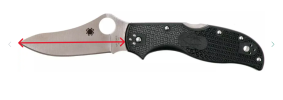
The knife I would like to bring is the Stretch 2 vg10 base model by Spyderco. Like many Spyderco is has a finger choil that is built into the bottom of the bladed portion and the upper handle. The blade if measuring from the end of the chpil or actual edge is under 3" however if you include that it is over 3".

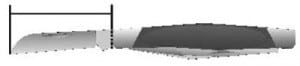
My question is I don't see much in the way of any real direction on how this would be measured. The links below for instance from American knife and tool institute suggest measuring it from the very end of the handle however the knives they used as examples do not have a choil which I think is important because the choil indicates it is not part of the blade per dictionary definition and because it's clearly where your finger is supposed to go hence would logically be part of the handle.

Any thoughts on this? I know the safest bet would be to simply not carry it and play it safe but I'm looking for any actual case law or logical arguments for or against it. Again to sum it up... in cases where it has been measured from the end of the handle to the tip would indicate the area from the end of the FRN to the beginning of the blade would still technically be part of the handle as it is what you actually grip to use the knife.


 
You do not indicate which country or state you are intending to visit, so a specific answer is not possible.

However, assuming you're destination is a state in the US, the answer is simple.

If the state is any state not named Connecticut, the blade length has been defined by laws and court opinions to be the length of the blade as measured in a straight line from the tip of the blade to the front of the guard or where a guard would normally be if the knife in question had a guard. The last half of that definition comes from court cases involving guard-less knives.

Connecticut is the only state, to my knowledge, that specifies blade length as a measurement of the cutting edge. The discrepancy here is whether the measuring individual includes an unsharpened choil as part of the cutting edge, despite not being able to cut.
 
You do not indicate which country or state you are intending to visit, so a specific answer is not possible.

However, assuming you're destination is a state in the US, the answer is simple.

If the state is any state not named Connecticut, the blade length has been defined by laws and court opinions to be the length of the blade as measured in a straight line from the tip of the blade to the front of the guard or where a guard would normally be if the knife in question had a guard. The last half of that definition comes from court cases involving guard-less knives.

Connecticut is the only state, to my knowledge, that specifies blade length as a measurement of the cutting edge. The discrepancy here is whether the measuring individual includes an unsharpened choil as part of the cutting edge, despite not being able to cut.
RI is the main state. In this case the guard it part of the choil as it is grooved specifically to indicate it is part of the handle so I'm not sure it is as cut and dry as the standard you indicate. The guard could be considered where the choil ends, jutting out to protect your finger, which would make it sub 3.

Appreciate the response however it does not address the main question of if the choil specifically made for finger grip as extension of the handle counts.
 
Last edited:
Some cops measure from the pivot. Some use their hand. I would make sure the cutting edge is well less than 3".
 
Some cops measure from the pivot. Some use their hand. I would make sure the cutting edge is well less than 3".
No doubt. But I'm not going off what certain cops do as ultimately what matters to me is what the courts will decide or have decided. A cop citing you for being over blade length from the pivot would be struck down in court as that is not the law.
 
No doubt. But I'm not going off what certain cops do as ultimately what matters to me is what the courts will decide or have decided. A cop citing you for being over blade length from the pivot would be struck down in court as that is not the law.
Yeah everyone loves going to court to fight the power. Meanwhile the confiscated knife is gone forever.

Law is not black and white. Law is grey by design.
 
3.43" But as your attorney I strongly suggest we don't get all bogged down with facts.

If this is true..
I'd never carry if the manufacturer is already telling you that it's too big.
I'm sure model, name, info will be brought out in court
 
I was always told it was whatever extends from the handle/scales/whatever. So even on something like a Native 5 with a larger finger choil you have to measure that part too not just the cutting edge.

Which I always thought was hilarious because you could go to tool issue and sign out a 4" craft knife with a razor edge but my 940 was illegal.
 
What length does Spyderco call it?
Blade Length: 3.43in 87mm
Edge Length: 2.97in 75mm

Yeah everyone loves going to court to fight the power. Meanwhile the confiscated knife is gone forever.

Law is not black and white. Law is grey by design.
Irrelevant to my question. If you operate and live in fear of what a random cop might interprit the law as that's a you problem.
 
The Rhode Island penal code specifically addresses this question-

Screenshot 2026-05-01 120608.png
Short of searching through case law this is probably the best you'll get. If you ask people for opinions on knife laws on a forum, you'll get opinions, but those opinions won't help you in court.

Here is a link to the entire statute regarding knives, it's exactly the same as on the Rhode Island legislative website, but for some reason I can't get a link from the RI website to work- https://law.justia.com/codes/rhode-island/title-11/chapter-11-47/section-11-47-42/

I believe this is the knife you referred to. I would advise measuring like the red arrow. Neither the choil nor the opening hole are a part of the "handle", but they are a part of the "blade".

Screenshot 2026-05-01 122037.png
 
Last edited:
The Rhode Island penal code specifically addresses this question-

View attachment 3174165
Short of searching through case law this is probably the best you'll get. If you ask people for opinions on knife laws on a forum, you'll get opinions, but those opinions won't help you in court.

Here is a link to the entire statute regarding knives, it's exactly the same as on the Rhode Island legislative website, but for some reason I can't get a link from the RI website to work- https://law.justia.com/codes/rhode-island/title-11/chapter-11-47/section-11-47-42/

.
Thanks for posting, but it doesn't really specifically address it.

"from the end of the handle where the blade is attached to the end of the blade"

Cases surrounding knife length have brought up dictionary definition of these terms, specifically the Merriam-Webster dictionary. Blade is defined as "the cutting part of an implement". Handle is defined as "a part that is designed especially to be grasped by the hand". So the end of the handle where the blade is attached could mean top of the choil where the cutting part begins and the part meant to be grasped by hand ends.

( https://law.justia.com/cases/california/court-of-appeal/4th/35/775.html ) is an example where they appealed and still lost where the sharpened part only defense did not succeed. However I saw another last night (cant find it offhand right now) where it was ruled the other way in an appeals court.

I guess this goes to show you just assume the worst case and "metal from handle to tip" is how it should be followed. What I am really looking for are most case law examples to see how it was handled.
 
Last edited:
The beast in question just because pics are cool.

20260501-171444.jpg
 
If you think you know the answer why are you asking ? If you are "caught" with the knife in question and the officer measures from the handle and arrested you , you will spend at very least a few hours in custody and you will have to fight the charges at a later court date. At that time you will definitely want a lawyer and not a court appointed one unless you plan on losing. Also if you are arrested for some other crime (wilfully or mistakenly committed) your knife can be then considered a weapon and those charges added to the others and at that point the dimensions of the "weapon" in question don't matter anymore. Just take the advice of others and measure from the front of the handle, or spend a indeterminate portion of your life trying to argue knife terminology in court.
 
Not nice to knife.people there.....they will measure all metal as blade length.....😡...So tip to handle measure
 
Yeah everyone loves going to court to fight the power. Meanwhile the confiscated knife is gone forever.

Law is not black and white. Law is grey by design.
A few lessons here. First of all, police actually know very little about the law. They are not attorneys at law and a police academy is certainly not law school. None issue a JD (juris doctor) degree upon graduation, which is why we have courts. Sure, they make arrests but only a surprisingly small number of them (about one third) end in convictions. Carrying an inexpensive folder, well concealed, is the best practice since any EDC knife can be lost, broken or confiscated. Another important thing to remember is never talk to police. Your EDC knife is an everyday use item. That's it. If an LEO decides to arrest you regardless, cooperate but make no statements without an attorney present to protect your rights.
 
That is exactly what this thread is about…and it’s your thread
Nope. My thread is about actual case law with relevant examples, and how the courts/judges have interpreted this law.

What a random cop who is not a lawyer and and doesn't make any type of ruling on the law is not of my concern here.
 
Status
Not open for further replies.
Back
Top