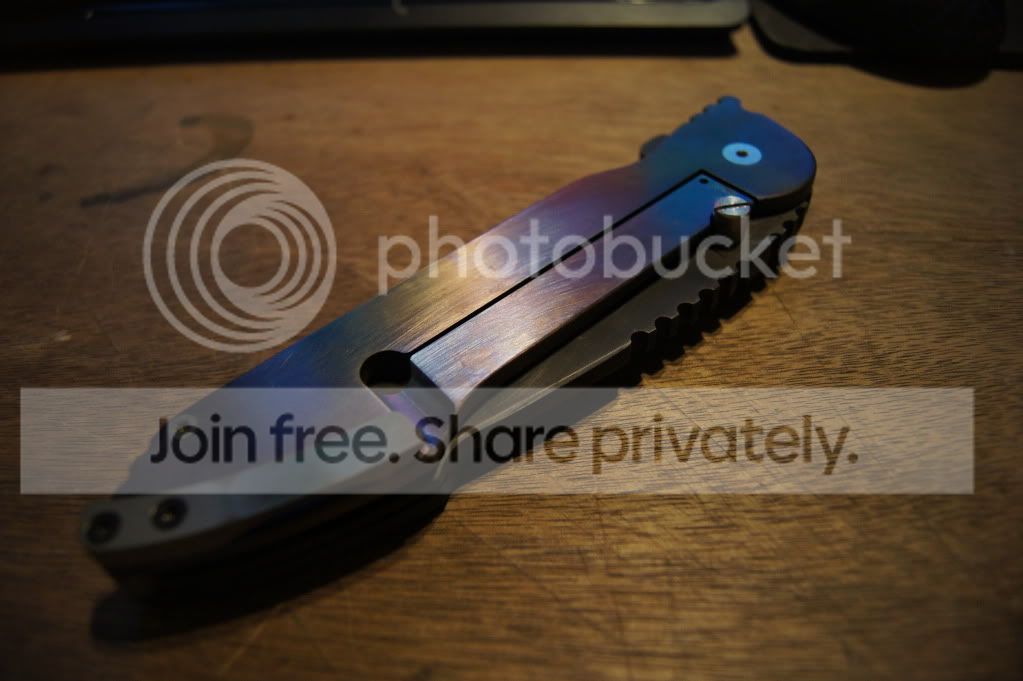
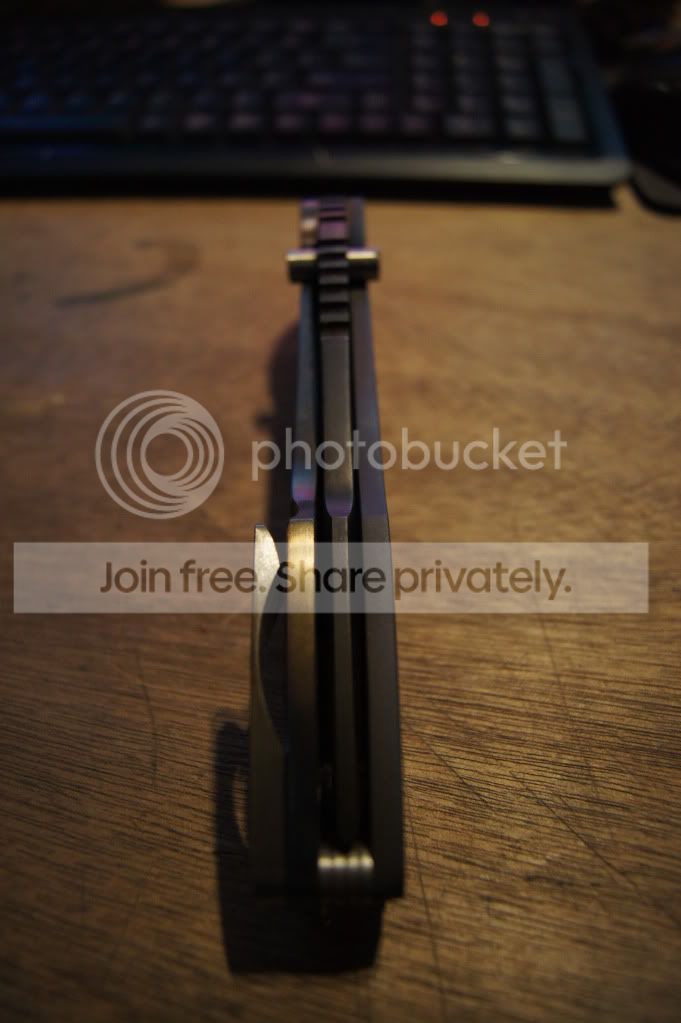
Question on frame lock cutouts..

Joined
Jul 24, 2007
Messages
3,285
A lot of people prefer frame locks over liner locks because of the thicker lockbar, despite the fact that the cutout section on the frame lock, even on many famous models like Hinderer and ZT, often is even thinner than locking liners in many liner locks, making the cutout section somewhat of a weak point on the frame lock.

My question is, is there any particular reason why the cutout section often is so thin? I mean it has to be thin enough to bend when you operate the lock of course, but it often seems that it is unnecessarily thin and fragile. Are there any other, not quite so obvious reasons why many high end knives are manufactured this way?
 
All has to do with the force required to unlock it when it is in the open position. That cutout has a lot to do with the force required to unlock.In a heavy duty frame lock like a Hinderer, Without a significant cutout, it would be very difficult, if not impossible, to unlock the knife.
 
Take a frame lock and a liner lock of equal minimum thickness, all other things being equal(lock face, lock face angle, etc...) and the frame lock will have a stronger lockup than the liner lock. It has the added pressure of your hand squeezing the lock as well. The frame lock will usually be stiffer than the liner lock as well, due to the thick frame holding the pivot, blade, pivot stop, spacer, etc...
 
Take a frame lock and a liner lock of equal minimum thickness, all other things being equal(lock face, lock face angle, etc...) and the frame lock will have a stronger lockup than the liner lock.
Of course, that's obvious. The thing is though that the thinnest part on the frame lock often is thinner than the liners of liner locks, which seems a little unnecessary. The Hinderer XM-18 cutout part for an example is very thin (and long for that matter), way thinner than the liners on, say, the Spyderco Gayle Bradley, yet there's no problem unlocking the Gayle Bradley.

It has the added pressure of your hand squeezing the lock as well.

I didn't mention anything about that in my question. I didn't ask for general pros and cons of the frame lock contra the liner lock, I just wanted to know about the cutout thing. But as you mention it, I have also heard about that. It seems a bit like a double edged sword though, because it also means that you put more strain on the frame lock when you grab it hard, meaning you will wear the lock down faster.
 
I didn't mention anything about that in my question. I didn't ask for general pros and cons of the frame lock contra the liner lock, I just wanted to know about the cutout thing. But as you mention it, I have also heard about that. It seems a bit like a double edged sword though, because it also means that you put more strain on the frame lock when you grab it hard, meaning you will wear the lock down faster.

You are correct you did not ask that. I had typed up a reply and then somehow erased it, and started writing about my thought process at the time. Apologies.
 
I don't see why the lock up would be stronger if the cut out was the same thickness as the the regular liner lock and if the leaf wideth was the same. It is only that one edge that creates the strength and they are both the same - not really much there at all. Because the leaf is thicker the contact area in the blade contact area still has not changed but remains that same small edge. Frank
 
Im not a knifemaker but, consider that given equal thickness, the shorter spring will be stronger than a relatively longer one. On a liner, the entire bar is the same thickness, thus there is less stability. On a frame lock, there is only one area that is as unstable as the entire bar of a liner, thus it is less susceptible to failure under stress.

It's been a while since physics so my terms are not fresh but that's the general idea.
 
You can get away with .070' -.080" on a liner lock, because the whole lock is that thick.
It's much easier to bend 2"+ of .070 thick Ti, than 1/2" of it.

So, because the length of the relief is so short on a framelock, they sometimes have to be thinner than a liner lock would.

Looks are also deceiving.
Are you sure they are actually thinner, and don't just appear thinner?
I cut my reliefs to app. .060", which also happens to be a common liner thickness for me.
 
http://www.bladeforums.com/forums/showthread.php/460936-Frame-lock-stronger-then-hidden-liner-lock

Here's a good old post to get your mind working.... I am not sure you will get a definitive answer for your question, but I believe it should put your mind to rest that a properly made framelock or linerlock can both be great, reliable knives...:D

Great link, thanks. I know the thickness of the lockbar isn't the most common point of failure, the lock bar/tang junction is. I also know things like this basically only happen in extreme cases:
Emerson+HD7.jpg


Still, it just made me wonder why the cutout is often made so long and thin. An incident like the one above seems to be less likely to happen on a knife like this one for an example, where the cutout is much thicker and shorter:

DSC01093.jpg

DSC01096.jpg


Link:
http://www.bladeforums.com/forums/showthread.php/925239-WIP-Massive-Titanium-Roller-Bearing-Frame-Lock/page13
 
That top picture is a good argument for linerlocks being better.
Might or might not be true, but it's a good argument for it.
You'd be hard pressed to make a linerlock fail like that.
The scale adds support, and traps the lock, preventing a buckle like that.

With the relief in the second picture, you actually have to cut thinner than with a longer relief.
Working the spring doesn't feel as good either, and all the repetitive bending stresses are all concentrated in one tiny area.
With the longer relief, your bend should actually be a bit of an arc, rather than just an abrupt bend at a single place.

I have a couple of frames around here that are missing the lockbars because of cuts like that one.
I experimented, and sat around working them back and forth a couple of hundred times, and they snapped.
They were being bent to a greater extreme than if they were in an actual knife, but not by a lot.

I never did get one to break with a longer relief.

Not a true, scientific test, but done for my amusement.
 
I believe any time a "notch is cut into a bar as a leaf spring. you immediately create a weak area that wants to collapse. Try one in a vise and then try a linerlock leaf with the same thickness thoughout the length. The thicker bar with the notch will collaps with a lot less side pressure which is how the force is produced when the leaf engages the lock face. Frank
 
That top picture is a good argument for linerlocks being better.
Might or might not be true, but it's a good argument for it.
You'd be hard pressed to make a linerlock fail like that.
The scale adds support, and traps the lock, preventing a buckle like that.

With the relief in the second picture, you actually have to cut thinner than with a longer relief.
Working the spring doesn't feel as good either, and all the repetitive bending stresses are all concentrated in one tiny area.
With the longer relief, your bend should actually be a bit of an arc, rather than just an abrupt bend at a single place.

I have a couple of frames around here that are missing the lockbars because of cuts like that one.
I experimented, and sat around working them back and forth a couple of hundred times, and they snapped.
They were being bent to a greater extreme than if they were in an actual knife, but not by a lot.

I never did get one to break with a longer relief.

Not a true, scientific test, but done for my amusement.

Ok, that's a reason to make it longer.
 
I think one reason the above lock failed is due to the cutout being inside the handle which doesnt keep the lock pressure in line with the blade interface.Than being said,wouldnt a cutout done evenly on both sides,instead of one side,be stronger as the pressure would be more evenly distributed?
 
DISCLAIMER: MY OPINION BASED ON NOTHING BUT MY OWN, POSSIBLY FLAWED, LOGIC:

My thought process, that I never finished typing out, was that the Titanium is supporting all the parts of the knife. In a liner lock the thickness is uniform and thus the thickness is based on how much/little flex you want in the blade and fittings, not so much how strong a lock up you are after. With a frame lock you already have plenty of strength in the thick areas, thus a frame lock maker is "engineering" the thickness of the spring to go after the strength of the lock up.

I hope that made some sense, I'm a bit hungover. :)
 
STR has talked about this in the past and a quick search would turn up some of his posts. Knife manufacturers have a lot of different people to cater to. If they made the lock cutout super thick, they would no doubt have people whining that they cant open their knives or in the case of flippers, they don't flip. The cutout has to be thin enough to be easily manipulated, while leaving just enough material to maintain the bulk of its strength. I am no engineer so I can't make specific arguments, just give you my impressions.

One point I distinctly recall STR mentioning, was that the detents on knives would wear out far too quickly if the cutout was left extra thick. That is something I am sure prevents manufacturers from making thick cutouts like some of us would like. Still there has to be some middle ground. For example, my ZT0551 has a .1875 thick lockbar made out of titanium. The cutout is only .030" thick! This to me, does not make any sense... Why carry around a huge, thick, tank of a knife that has a wussy little cutout like that. I am selling this knife for that reason alone. Now if it was something like .050-.060 thou I would be much happier with it.

So ya, I think manufacturers are simply trying to appease everyone, impossible as that is, they haven't much choice :)
 
Last edited:
Strength of the lockup, on a properly engineered framelock, or linerlock is controlled by the geometry, not the spring pressure.
They will lock, and lock well, with almost zero pressure.
The spring pressure just puts the lock there and keeps it from falling out of engagement, it should not be a major factor in what actually makes it stay locked.

We are really engineering the spring tension for the detent, and disengaging the lock.
 
Thanks to the OP for asking and special thanks to Brian for sharing his extensive knowledge in an understandable way.

Now I have some things to ponder, until I understand them!
 
Strength of the lockup, on a properly engineered framelock, or linerlock is controlled by the geometry, not the spring pressure.
They will lock, and lock well, with almost zero pressure.
The spring pressure just puts the lock there and keeps it from falling out of engagement, it should not be a major factor in what actually makes it stay locked.

We are really engineering the spring tension for the detent, and disengaging the lock.


.030" just looks too riduculously paper thin to me on an overbuilt knife. Maybe I'm worrying for nothing.. I know I couldn't break it using a knife as a knife should be used, ie. cutting. I just feel like an 'overbuilt' knife, should be overbuilt in every aspect. What do you think?
 
Back
Top