Question on frame lock cutouts..

.030" seems thin.

Thinner than I would probably do, but I am not familiar with the knife, or what style of relief they did.

Those Kershaw boys make a good knife, and have a lot of experience.

If it's a single plunge with the side of a mill or cut with a ball endmill in the style shown earlier in this thread on the second knife, it might not be unreasonable.
I don't remember the numbers I cut to on the few I made that way, but they were thin.

I stopped doing that style of cut after 20 knives or so, it's just not the one I like.
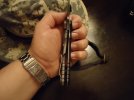
 
Yes they do make a good knife for sure. Its milled out on the inside. Im not sure if they use a large ballnose or fix it in a jig in its side and profile it out with a regular endmill. Anyways heres a pick of it (not my pic)
 

Attachments

  • zt0551008.jpg
    zt0551008.jpg
    40.7 KB · Views: 40
You can get away with .070' -.080" on a liner lock, because the whole lock is that thick.
It's much easier to bend 2"+ of .070 thick Ti, than 1/2" of it.

So, because the length of the relief is so short on a framelock, they sometimes have to be thinner than a liner lock would.


I'm a structural engineer so this is pretty elemental stuff for me. The explanation above is pretty much the gist of it, and a direct answer to the question in the original post. The lock, whether a part of the liner or a part of the frame, cantilevers from the butt end of the knife to block a part of the tang of the knife. This piece has some properties as a spring to hold it in position and you push against the tip end of this spring with your thumb when you disengage the lock in order to close the knife.

As an example say you start with a given length of bar and you want a certain amount of force to unlock the knife, if it is a thick bar with a milled out portion at the bottom you need thinner material in the milled out section to give the same stiffness as the liner which would be the same thickness all the way down. The shorter the milled section, the thinner the material must be along that section. Also important is the height of the bar at the milled section, and the material involved. Ti has different bending stiffness from steel (different modulus of elasticity) and relative thicknesses would have to take this into consideration as well.

That all explains why things are made the way they are, it doesn't explain strength. The lock bar when functioning as a lock is actually in compression. Without performing the full buckling analysis I'm going to guess that the frame lock is stronger because the length that can buckle is much shorter than it is for a liner lock. I would guess that if you watched both as you slowly load them to failure you would see the liner start to buckle and become something other than straight before you would see the frame lock do the same, and it is this deflected shape that accentuates the stresses in the metal and leads to failure.

The factors mentioned such as length of bar, thickness(es), height, length of milled section, material are all important. Another factor not mentioned yet is the relative position of the point of contact of the lock on the blade tang with respect to the location of the pivot. Farther from the pivot makes the lock stronger because it gives it a greater lever arm to act against. This is an important measurement to include in any comparison between 2 different knives.
 
That all explains why things are made the way they are, it doesn't explain strength. The lock bar when functioning as a lock is actually in compression. Without performing the full buckling analysis I'm going to guess that the frame lock is stronger because the length that can buckle is much shorter than it is for a liner lock. I would guess that if you watched both as you slowly load them to failure you would see the liner start to buckle and become something other than straight before you would see the frame lock do the same, and it is this deflected shape that accentuates the stresses in the metal and leads to failure.

I liked your post and agree with it but I'm curious about the stress issue with the thin portion on a framelock compared to the even thickness of a liner....

Wouldn't the thin milled section of a framelock concentrate the stress in that area? For example if you had a 3ft long bar of steel with a notch ground in the middle, you grab both ends and tried to bend it, it would bend at the thin part. Now it seems to me if you had a thinner bar of equal length and bent it the stress would be more evenly distributed along the length so it would take more bending before the steel "takes a set".

It seems to me a liner lock(or a framelock with the same thickness across the bar) would have more flex to it and possibly flex to the point the lock disengages faster, but it would handle a sharp blow along the spine better than the short/thin section of the framelock since the stress is more evenly distributed. I could be entirely wrong though.

(excuse my laymen terms, my engineering classes are quite a few years behind me and I don't work in that field)
 
Personally, I would actually like to see a buckling analysis of a framelock compared to a linerlock.
I've always had an unsubstantiated gut feeling that the scale on a linerlock would add a tremendous amount of resistance to buckling, and overall strength to the system.

Looking at that first picture, in post 11, all of the buckling happened outward, away from the centerline of the mechanism.
On a linerlock, there would be a scale there, theoretically keeping that from happening.
Or at least making it more difficult.

It seems like a scale performs several tasks, reinforcing the bar against buckling being one.
There are many forces at play in such an instance, and even changing geometry.
The lockbar is effectively getting shorter, and stronger as it's fulcrum moves forward as it's compressed against the scale, etc...

Not only is the distance of the point of contact from the pivot important, but it's location.
You want the bulk of the applied forces pushing back along the lockbar, and as little as possible trying to lift it.
I don't know the proper way to explain that, though I could draw examples to make it as clear as mud.

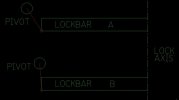
When designing, I always imagine a radial line from the center of my pivot, to my point of contact.
My goal is to try and get my lockbar to run as close to perpendicular to that line as I possibly can.
This means I want that contact point as far away from the pivot as the design allows, AND as far forward I can get it, while still fitting in some substantial thrust washers.

I never thought about it until right now, but the lockbar has an axis, I am trying to make that axis as close to parallel with that radial line as I can...

Sprite 6.jpg

Lock B will be stronger than A, even though the distance from contact point to pivot is the same.
 
Back
Top